Gull (Larus), a genus of web-footed birds belonging to the Laridæ, a family of long-winged sea-birds having the longitudinal nostrils placed laterally and not covered by a cere, the three anterior toes completely webbed, the hind-toe, when present, small and not touching the ground. The family includes the Scissor-bills or Skimmers (Rhynchopidæ), the Terns or Sea-swallows (Sterninæ), and the true Gulls (Larinæ). The true gulls are of less slender build than their nearest allies, the Terns; their wings are not quite so long and pointed, and they have the bill more hooked. The most important genera are Stercorarius, the voracious and predatory Skuas; Rissa, the Kittiwakes; Xema, the fork-tailed Gulls; and Larus.
The genus Larus comprises sixty species, cosmopolitan in their distribution, and includes many of the larger gulls and most of those common in Great Britain. The prevailing colour is 'white, with a gray mantle varying in shade from the most delicate pearl gray to a dark blackish slate or nearly black,' and there are often black markings about the head, which, however, vary in different seasons. The two sexes are usually almost alike in colour, but the young are dusky and brownish and have the bill dark, while in adults the bill, legs, and feet are bright red or orange. The legs are very powerful, and are placed well forward so that the body is carried horizontally, the bill is stout and curved, with a prominent angle on the lower part and a corresponding swelling on the upper. Though most gulls are marine, they frequent, and even breed by inland lakes not far from the sea, and large flocks of them may often be seen following the plough eagerly picking up the worms and grubs. They are very voracious and will eat almost anything, but feed chiefly on fish and molluscs. To break the shells of the molluscs they sometimes carry them high into the air and drop them upon a rock. Audubon tells of a gull observed by him which, when the shell did not break the first time, carried it a second time higher, and a third time higher still. Some of the larger species—e.g. the Great Black-backed Gull (L. marinus), prey even upon the eider-duck and other wild fowl, and very many steal the eggs of other birds. Many of the species are migratory, and all are powerful of wing and fly with apparent ease against a storm, during which, however, they never soar so high as in fine weather. Their keenness of vision is remarkable, as must have been observed by every one who has watched them following in the wake of a steamer, and noted the distance from which they see even a small fragment thrown on the water, and the unerring precision with which they dart down upon it.
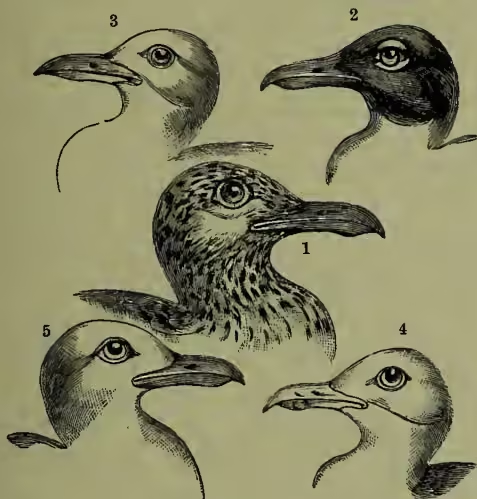
1, Great Black-backed (young); 2, Black-headed; 3, Kittiwake; 4, Lesser Black-backed; 5, Herring Gull.
Gulls often nest together in large numbers, and to dwellers by the sea a 'gullery,' with its busy life and incessant noise of screaming and quarrelling, is a not unfamiliar sight. The characteristic cry of many gulls is well suggested in the old name of 'Sea-mews.'
The most widely distributed British species is the Herring Gull (L. argentatus), which breeds on precipitous cliffs or isolated rocks all round the coast. The nest is made of grass and is usually placed on a ledge of rock, but sometimes on the ground; and Howard Saunders says that in North America, when the bird has been repeatedly plundered by fishermen, it even nests in trees. The eggs, usually three in number, are light brown, green, or pale blue, mottled with a darker shade. The male bird measures 22 to 24 inches, the female is slightly smaller; the gray of the back and wings is lighter than in most species, and on this account it is often called the Silvery Gull. The Common Gull (L. canus) is only a winter visitor to England and Wales, but breeds abundantly on the Scottish coasts and fresh-water lochs, in the Hebrides, and in Orkney and Shetland. It lays three eggs, breeding in colonies on grassy islands and slopes not far above the level of the sea, and seldom going far from land. Its average length is 18 inches. The Great Black-backed Gull (L. marinus) rarely breeds in England, though large flocks may be seen at some seasons. In Scotland, particularly in the Outer Hebrides, it is more plentiful, though by no means common. The Lesser Black-backed Gull (L. fuscus) is very abundant in the marshes of Cumberland, and nests also in Devon, Cornwall, and throughout Scotland. Its plumage is white in summer except on the mantle, where it is dark gray or black. The Black-headed Gull (L. ridibundus) is the commonest species in Ireland, and is plentiful on the flatter portions of the English and Scottish shores. It has a dark-brown hood in summer which disappears in winter. The Glaucous Gull, or Burgomaster (L. glaucus), and the Iceland Gull (L. leucopterus), visit Britain occasionally in cold weather. One specimen of Ross's Gull (Rhodostethia rosea) was shot in Yorkshire in 1846. Nothing is known of the breeding habits of this rare and beautiful Arctic species, and only twenty-three examples had been recorded previous to 1881-82, when it was seen in large flocks off Point Barrow in Alaska. About thirty specimens of another truly Arctic species, the Ivory Gull (Pagophila eburnea), have been taken in Britain at various times. In North America gulls are very plentiful. The Great Black-backed Gull (L. marinus) and Herring Gull (L. argentatus) are common in the north-east, while the Common Gull is represented by two closely related species (L. brachyrhynchus and L. delawarensis). The Mackerel Gull (Hydrocolæus scopulinus) of New Zealand may often be seen in attendance on the long-billed oyster-catcher as he digs in the soft sand for blue crabs and other delicacies, waiting quietly until something is discovered, then flapping his wings and making a dash at it. Even if the oyster-catcher succeed in flying off with his prize he is inevitably overtaken and compelled to give it up to the swifter and stronger gull.
The Great Skua (Stercorarius catarrhactes), which breeds in the Shetlands, and is occasionally seen on the coasts or fishing-grounds farther south, is a splendid example of a robber gull, deriving its food chiefly by victimising or even killing other sea-fowl. It measures about 2 feet in length; the plumage is predominantly brown, 'with white bases to the quills conspicuous in flight'; the cry, as the name suggests, is skui, skui; the nest is a cavity in the moss and heather of the highest moorlands, and is prepared in the later half of May; the eggs (never more than two) are olive-brown. Three other species of Skua are recorded among British birds.
The Kittiwake (Rissa tridactyla) is a very common bird on British coasts, and is elsewhere widely distributed. As the specific name suggests, the hind-toe has disappeared; the length of the body is about 15 inches; white predominates in the plumage, but the upper surface is gray, and there is some black on the wing. The kittiwakes feed on fish and other marine animals, make nests of seaweed and flotsam on the rocky ledges, lay two or three eggs 'from grayish-white to olive-buff, blotched and zoned with ash-gray and rich brown.' Howard Saunders notes that as the eggs are seldom laid until the later part of May, many of the young can scarcely fly or are still in the nest by 1st August, when the Sea Birds Protection Act leaves them to be slaughtered in thousands to provide plumes for ladies' hats.
The flesh of gulls is rank and coarse, but that of the young birds is salted for winter use on many northern coasts. The eggs are much sought after, and it is stated that from 40,000 to 50,000 eggs of the herring gull are taken for food, in a single season, from the island of Sylt alone. See Howard Saunders, 'The Larinæ or Gulls,' in Proc. Zool. Soc. (1878); and his and other manuals of British birds.