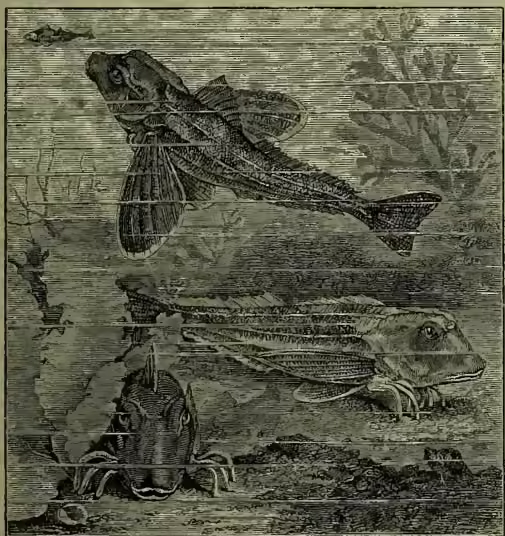
Gurnard (Trigla), a genus of acanthopterous fishes of the family Cottidae, represented in tropical and temperate seas by about forty species, of which seven occur on British coasts. The head of the gurnard is angular, the eyes near the summit, the upper surface and the sides entirely bony, the teeth small and very numerous. The body is rounded, tapering, and covered with small scales; the air-bladder is often in two lateral parts provided with lateral muscles, and the broad pectoral fins are usually brightly coloured on the inner surface. The most marked peculiarity of the genus is the presence, in front of the pectorals, of three free finger-like rays. These are well supplied with nerves, and are organs at once of locomotion and of touch. Most of the gurnards live near the bottom, and feed on crustaceans, molluscs, and small fishes. When handled they emit a peculiar sound caused by the escape of air from the air-bladder—a fact which has gained for one species (T. lyra) the local name of 'Piper.' The most common British species is the Gray Gurnard (T. gurnardus). Its colour is brownish-gray, marked with white, and the lateral line bears a series of white, crested, bony plates. The Red Gurnard (T. pini) is also common, and is much used as food. It attains a length of about 15 inches. Much rarer is the Sapphirine Gurnard (T. hirundo), so named from the beautiful blue of its pectoral fins. It grows to a length of about 2 feet. Gurnards are caught by the trawling-net or by hook and line.