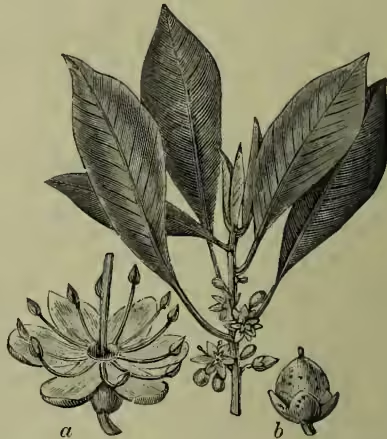
a, a flower; b, fruit.
Gutta-percha, a substance in many respects similar to caoutchouc, is the dried milky juice of various trees of the order Sapotaceæ; the chief is apparently that called by Hooker Isonandra Gutta, and by Bentley and Trimen Dichopsis Gutta. The tree, which is found in the peninsula of Malacca and the Malayan Archipelago, is very large, attaining a height of 70 feet; the trunk is sometimes 3 or even 4 feet in diameter, although it is of little use as a timber-tree, the wood being spongy. The leaves are alternate, on long stalks, obovate-oblong, entire, somewhat leathery, green above, and of a golden colour beneath. The flowers are in little tufts in the axils of the leaves, small, each on a distinct stalk, the corolla having a short tube and six elliptical segments; they have twelve stamens and one pistil. The name, gutta-percha (gátta párcha, or gittah pertja), is Malay. There are two or three kinds of gutta-percha known in commerce, and it is more than probable these are yielded by different species. That from Singapore is esteemed the best, and is distinguished by the Malay traders as Gutta Taban or Tuban; that of Borneo is of less value—this is called Gutta Percha by the traders, and has given the general name to all; and another kind goes by the name of Gutta Girek. The first two are those generally known in our markets. The former mode of obtaining the gutta-percha was a most destructive one. The finest trees were selected and cut down, and the bark stripped off; between the wood and bark a milky juice was found, which was scraped up into little troughs made of plantain leaves. Now the plan of tapping the living trees is employed. The juice soon coagulates, or may be boiled, and is then kneaded by hand into oblong masses a foot in length.
Gutta-percha was known in Europe long before its peculiar characteristics and uses were known. It was brought home at various times by voyagers, in the forms of drinking-bowls and native shoes; and was thought by some to be a species of india-rubber, while others asserted it was a kind of wood, which they named mazer-wood. But for its introduction in 1843 we are indebted chiefly to Dr William Montgomerie of the Indian Medical Service, who was rewarded with the gold medal of the Society of Arts. He first noticed that the Malays used it for making handles to their knives, &c., and it immediately occurred to him that it might be of great use in a variety of ways, especially in making handles for surgical instruments, the hand being able to get a light but firm grasp of them. Soon the importation of gutta-percha increased amazingly; in 1860 it exceeded 16,000 cwt. In 1864, 1865, 1870, and 1871 the imports varied from 25,966 cwt. to 35,636 cwt.; in 1876-83, from 21,100 cwt. to 66,000 cwt. Down to 1888 these imports declined very much, as in that year they only reached 22,500 cwt., at an average price of 162 shillings per cwt. In 1889, however, they showed an upward tendency both in quantity and value, the total imports from January to October 1889 being 38,940 cwt., and the average price 241 shillings per cwt. By far the greatest portion of it is imported from the East Indies.
Its most important application has been in the coating of marine electric telegraph wires. In this application, as in most others, its inherent defect, arising from the readiness with which it becomes oxidised and decomposed, has manifested itself seriously, and it is greatly affected by age in its resisting qualities. Hence substitutes of greater stability have been looked for. Many of these have been forthcoming, india-rubber being used now to a large extent, as also a composition produced from asphalt, balsam of sulphur, &c., and other compounds. Gutta-percha is used for making a vast variety of useful and ornamental articles. Among others the following may be mentioned: golf-balls (very extensively), overshoes (more in America than in Britain), beltings for machinery, pump-buckets, sheeting, tissue, thread or whip cord, and tubing. A very large trade is done in shoe soles. It is turned by surgeons to various uses, chiefly for splints and moist coverings to retard evaporation. It has also been used for stopping hollow teeth.
The great value of gutta-percha arises from the ease with which it can be worked, and its being so complete a non-conductor of electricity. It softens in warm water, and can be moulded into any form in that state, as when soft it is not sticky and turns well out of moulds. It will always be of great value as a material in which to take casts, as it can in the soft state be made to take the sharpest forms most faithfully; and, as it quickly becomes hard, and preserves its shape if not too thin, the range of its utility in this respect is very extensive.
It is imported in blocks and lumps of five to ten pounds weight, in various forms, chiefly like large cakes, or rounded into gourd-like lumps. It has a very light reddish-brown, or almost a flesh colour, is full of irregular pores elongated in the direction in which the mass has been kneaded. It has a cork-like appearance when cut, and a peculiar cheese-like odour. Before it can be used it has to undergo some preparation. This consists in slicing the lumps into thin shavings, which are placed in a devilling or tearing machine revolving in a trough of hot water. This reduces the shavings to exceedingly small pieces, which, by the movement of the tearing-teeth, are washed free from many impurities, especially fragments of the bark of the tree, which, if not separated, would interfere with the compactness of its texture—one of its most important qualities. The small fragments, when sufficiently cleansed, are kneaded into masses; and these are rolled several times between heated cylinders, which press out any air or water, and render the mass uniform in texture. It is then rolled between heated steel rollers into sheets of various thicknesses for use, or is formed into rods, pipes for water, speaking-tubes, or any of the innumerable articles which may be made of it.
Gutta-percha differs very materially from caoutchouc or india-rubber in being non-elastic, or elastic only in a very small degree. Notwithstanding this very striking character of caoutchouc, the two articles are very often confounded in the public mind.