Hadrian's Wall. Before Agricola advanced into Scotland he planted some forts on the neck of land between the estuary of the Tyne and the Solway Firth, to protect him from attack in his rear and to secure the bringing up of supplies. He adopted the same precaution before leaving the Lowlands of Scotland for the Highlands, placing encampments between the firths of Forth and Clyde. Afterwards walls were constructed on these two lines. On the English side of the Border we find a stone wall with a ditch on its north side. Attached to it are stationary camps, mile-castles, and turrets for the accommodation of the soldiery who manned it. To the south of the stone wall is a series of ramparts generally called the vallum. This fortification consists of three aggers or mounds and a ditch. The military way along which the soldiery moved lies between the murus or stone wall and the vallum. The wall was not intended as a mere fence to block out the Caledonians, but as a line of military strategy. Every station and mile-castle has a wide gateway opening northwards. This does not look as if the Romans in the time of Hadrian had given up the country north of the wall to the enemy. Besides, two Roman roads, the
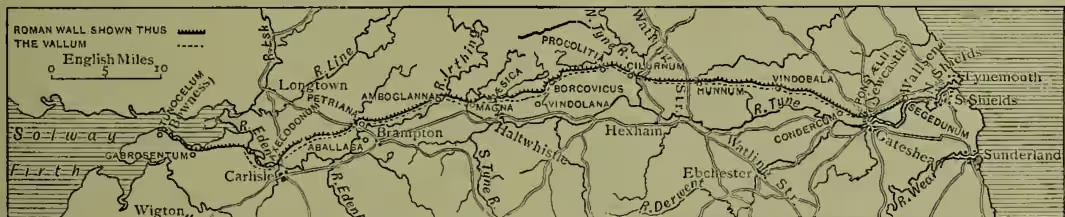
Watling Street and the Maiden Way, run past the wall into Scotland. On these ways were stationary camps, which have yielded inscriptions and coins considerably posterior to the time of Hadrian or Severus. A controversy long existed as to the time when the lines of fortification in the north of England were constructed. One great authority, the Rev. John Horsley, author of the Britannia Romana (1732), maintained that the north agger of the vallum was reared by Agricola, and that it was the road by which his forts were connected, that the ditch and the other two aggers were the work of Hadrian, and that the wall was reared by Severus. Stukeley (1687-1765), however, expressed the opinion that both vallum and murus 'were made at the same time, and by the same persons, and with the intent that the vallum should be a counterguard to the other, the whole included space being military ground.' Since Horsley's day inscriptions in honour of Hadrian have been found in four of the mile-castles in the central part of the line, and, as the mile-castles are an essential part of the wall, Hadrian is now generally believed to have been the builder of the whole structure. Severus, however, repaired it before he advanced into Scotland, where in three years he lost 50,000 men, and came back to York to die. Agricola came to Britain in 78 A.D. Hadrian came towards the close of 119 A.D. Severus died in 211 A.D. Towards the close of the 4th century Theodosius, for a brief period, reasserted the Roman dominion over the district between the walls of Antoninus (q.v.) and Hadrian, which, in honour of the Emperor Valens, obtained the name of Valentia. But this newly-established province was soon lost, and it was not long before the Romans finally abandoned Britain. Considerable portions of Hadrian's Wall yet remain. In two places the wall stands 9 feet high. See Collingwood Bruce, The Roman Wall (1851; 3d ed. 1866), and Handbook to the Roman Wall (1863; 3d ed. 1885); and Neilson, Per Lincam Valli (1891).