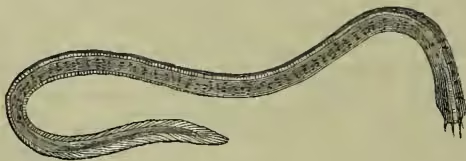
Hag, one of the vernacular names for the Myxine glutinosa L., one of the Cyclostomata or Roundmouths, allied to the lamprey. It is common off the coasts of the north of England, Scotland, and Norway, and of the North Atlantic generally, living in muddy ground at a depth of 40 to 345 fathoms. The mouth is a hollow suctorial disc, furnished with a single tooth above and two rows of strong, pointed, horny teeth below. There is a single nasal aperture above the mouth, which communicates with the pharynx. Round the nostril and mouth are four pairs of short barbules or tentacles. The body is eel-shaped, with no lateral fins, but a slight median fin round the tail. There are no bones; the backbone is represented by a persistent notochord with a cartilaginous sheath; the skull and mouth-skeleton are also cartilaginous. There are six gill-pouches on each side, communicating internally by as many short tubes with the gullet, and externally giving off six longer tubes which unite and open by a single external aperture in each side of the body at some distance from the head. No eyes externally; mere rudiments internally. The intestine is straight. On each side of the ventral median line are a series of cutaneous glands which secrete large quantities of gelatinous slime. There are no genital ducts. The eggs are of very large size, and when expelled from the ovary are contained in a horny egg-membrane; their shape is an elongated ellipsoid, at each end of which are a number of fine knobbed processes of the horny case, by which the eggs become entangled together. In the young state the animals are hermaphrodite, and contain immature eggs and ripe milt; when older they produce eggs only. The fish is about 15 inches in length when adult, and of a livid red colour. There are no scales. The Myxine, when not feeding, lies buried in the mud, with only the single nostril protruded, and a respiratory current of water passes through this nostril to the gill-pouches, escaping again by the branchial aperture. These creatures are often caught in very large numbers on haddock-lines (long lines). They gorge the bait (mussels) down into their stomachs. They also attack fish (cod, haddock) hooked on the lines, and devour all the flesh, leaving the skin and skeleton. They probably attack living fish (Gadidae) in the same way, but evidence on this point does not seem very certain. Three species are known—the North Atlantic one mentioned, another from Japan, and another from Magellan Strait. Bdellostoma, which is closely allied, has six or more separate external branchial openings on each side, and is larger. Two species are known; one is common at the Cape.—Nansen, while he was still at Bergen, described the hagfish as a hermaphrodite 'in a transition stage,' for according to his researches the animal is a male until it attains a certain size, and thereafter a female, or in some cases a hermaphrodite.