Hair. With the exception of the palms of the hands and the soles of the feet, the human skin is almost everywhere studded over with hairs. In few localities, however, does the hair attain any degree of thickness or length. Except on the scalp, the male cheeks, &c., the hairs are fine, short, and scanty, but more apparent in the male than the female.
An individual hair may be regarded as consisting of a root, a shaft, and a point. The root is the short, soft bulbous portion which is withdrawn from the skin when a hair is plucked from the body; the shaft is the part which projects beyond the surface of the integument; and the point is its attenuated free extremity.
The root of the hair is enclosed within a minute tubular depression in the skin which is termed the hair-follicle. This is the chamber in which the hair is manufactured, and it is here also that additions are made to its root so that it increases in length. The skin is composed of two layers: an outer epidermis and an inner corium. The epidermis is the cellular protective layer, and the hair and nails may be regarded as outgrowths from it. Amongst the lower animals the claws, hoofs, spines, feathers, scales, &c. all belong to the same category—all, like the hair, are appendages of the epidermal layer of the skin. The corium is fibrous and vascular, and rests directly upon the fatty subcutaneous tissue of the body. Both layers of the skin take part in the formation of the hair-follicle. Its wall, therefore, has two distinct layers entering into its formation—the inner layer being cellular and epidermic, whilst the outer layer is fibrous and continuous with the corium. When a hair is wrenched out of its socket the inner layer of the follicle adheres to the root, and is in great part withdrawn with it. It is therefore termed the root-sheath. In the case of the short hairs the hair-follicles do not sink beyond the skin, but in the case of the head-hairs and beard they are much deeper, and penetrate into the subcutaneous fatty tissue.
The extremity of a fresh hair-root is expanded in the form of a knob, called the hair-bulb. This hair-bulb is composed of cells like those of the root-sheath, and at the bottom of the follicle the two are directly continuous with each other around the circumference of the bulb. Again, at the bottom of the hair-follicle there is a little fungiform projection continuous with the corium. It is called the hair-papilla, and is plentifully supplied with both blood-vessels and nerves. This papilla is of the utmost importance in connection with the process of hair-growth. It is also an agent in fixing the hair in its follicle, because the lower aspect of the hair-bulb is hollowed out into a cavity, and the papilla is received into this in the same manner as a head is received into a cap.
In structure a hair may be considered as being composed of three distinct parts. Its chief bulk consists of fibrous substance; this is coated on the outside by a thin scaly layer, termed the hair-cuticle, whilst its centre is traversed by a narrow cellular thread or core, which is termed the medulla. The hair-cuticle is exceedingly thin, and is formed by a single layer of minute flat scales deposited upon the surface of the hair. These scales overlap each other in an upward direction from the root to the point of the hair. The free uncovered margins of the cuticular scales therefore look upwards towards the point, and when examined under the microscope they appear on the surface of the hair in the form of wavy lines, and at the same time give to its outline a slightly toothed or serrated appearance. It is the arrangement of these scales which gives to hair its commercial value. It is due to them that the felting of hair is possible. But human hair is ill adapted for this purpose, because the cuticular scales are closely applied to the body of the hair. In wool, however, the scales stand well out, and the serrations are so distinct that the hairs interlock firmly the one with the other.
We have mentioned that the hair-root is attached to its follicle (1) by a continuity at the bottom of the follicle of the cells composing the hair-bulb and those forming the root-sheath, and (2) by the hair-bulb being moulded over the surface of the fungi-form hair-papilla. There is yet a third connection. The follicle is lined by delicate imbricated scales, which are directed downwards and interlock with the upwardly-directed scales which coat the hair-root.
The fibrous substance of the hair is composed of flattened fibres applied to each other in the longitudinal direction, and firmly united by intervening cement-substance. These fibres can be still further resolved into minute flattened elongated plates or cells, which constitute the ultimate elements of the fibrous substance. The pigment or colouring matter of the hair is distributed throughout the fibrous substance. It is partly placed within the cells which build up the fibres, and partly in the cement-substance which glues the cells together. But the colour of a hair is not entirely determined by the quantity or kind of pigment present. It is also to a certain extent determined by the presence of air which is contained in minute chinks or crannies in the fibrous substance. These air-spaces are numerous in white hairs, but are almost entirely absent in black hairs.
The central medulla is not present in every hair, nor, indeed, is it to be found throughout the entire length of those hairs in which it exists. Thus it is absent in the fine short hairs of the body, and also
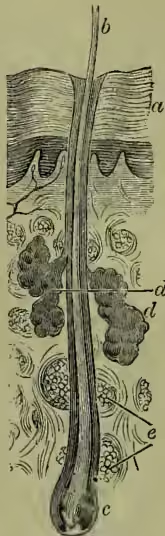
Vertical section of Skin, showing hair-follicle:
a, epidermis; b, hair; c, hair-bulb; d, d, oil-glands; e, fat-cells.
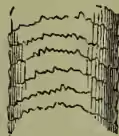
Surface of a human Hair, magnified.
in a large proportion of the hairs of the scalp. In structure it consists of two or three rows of rectangular cells, which contain a certain amount of air.
The structure of human hair is such that it can almost always be distinguished from hair drawn from other sources. At the same time it should be noted that the hair of certain of the anthropoid apes (more especially the Chimpanzee and Gorilla) resembles it so closely, both in structure and in microscopical appearance, that the differentiation would be matter of extreme difficulty—if indeed it were possible. Waldeyer, in his Atlas der Menschlichen und Thierischen Haare (1884), gives a series of beautiful illustrations in which the hair of man may be compared with that of certain of the lower animals.
In connection with each hair there is a remarkable contrivance by means of which it is kept smooth, glossy, and pliant. It is furnished with two or more oil-glands, which secrete a greasy fluid. Each of these glands consists of a little sacculated pouch which opens into the hair-follicle near its orifice by a short duct or channel of exit. The oily matter which is formed in the gland is discharged into the hair-follicle, and thus upon the surface of the hair.
Hairs are likewise provided with minute muscles. These consist of slender bands of contractile tissue, which cross the obtuse angle which is formed by the hair-follicle and the surface of the skin. On the one hand this little muscle is attached to the superficial part of the true skin, and on the other to the lower end of the hair-follicle. They are not under the control of the will, but cold and certain emotions, such as horror and fear, will bring them into play. In such cases the hair-muscles contract; they straighten the hair-follicles and erect the hairs. The condition known as 'goose-skin' is the result.
The hair-follicle is the laboratory in which the manufacture and continued growth of the hair is effected. At the bottom of the follicle is the little papilla upon which the hair-bulb is moulded. The blood-vessels of the papilla supply the material necessary for the growth of the hair. Additions are made to its base, and as it rises up in the follicle its upwardly-directed scaly covering sweeps before it the scales lining the follicle. The scales which are thus carried to the surface constitute a part of the scurf of the head. The rate at which the hair grows differs very much in different parts of the body, and it is also said to be affected by the age of the individual, the age of the particular hair under investigation, the season of the year, and even the hour of the day. The average growth of the beard has been computed to be inches each year. In the growth of the head-hair the greatest discrepancies exist in the results obtained by different observers. In young females who have lost their hair by fevers it has been noticed to grow at the rate of 7 inches each year.
When the growth is good the average length of hair on the female head will be found to vary from 22 to 28 inches. Anything beyond this must be regarded as exceptional. Cases, it is true, are recorded in which it has measured from 5 to 6 feet; but these are very rare. In the 'Hair Court' of the 1862 international exhibition there was a specimen of jet-black hair measuring 74 inches. But most extraordinary instances are recorded of the power of hair-growth possessed by certain of the North American Indians. A chief of the Crow tribe is mentioned by Catlin as having hair of the almost incredible length of 10 feet 7 inches.
The duration of hair-life is limited, and sooner or later it is shed. Indeed it is stated that the hairs of an infant are completely shed within a year after birth; those on the body and limbs go first, whilst the hairs of the head and the eyelashes follow. This change is carried on almost imperceptibly, seeing that the place of the falling hairs is taken by a second crop. The process of loss and renewal is very simple. The old hair is detached from the papilla, and soon another hair makes its appearance at the bottom of the same follicle, and grows towards its orifice. The detached hair is thus thrust out and shed. The whole process is not unlike the replacement of the milk teeth in the child by the permanent teeth. The second crop of hair which appears is perennial. An eyelash has been calculated to remain attached for 110 days. A head-hair has a longer period of life. It lives from two to four years. Before it dies provision is made for its successor, and so the process of shedding and renewal goes on continually. During its life a hair is only capable of growing a certain determinate length. The circumstance which determines this length is the amount of nutritive material which can be drawn from the blood-vessels of the papilla. Thus when a hair has attained its full length it will resume growth for a second time on being cut short. It is only when the loss exceeds the powers of renewal that a tendency to baldness results. In the case of the female head the daily loss may contain a quarter of the hairs shed of a length under 6 inches without giving rise to apprehension. Should the number of fallen short hairs exceed this proportion the hair-loss is abnormal, and baldness is likely to ensue.
As age advances the hair becomes gray. This is a natural and physiological process; but it may be hastened by severe trouble or other causes. In many cases the premature blanching of the hair is hereditary. When the change is taking place party-coloured hairs may be frequently found; of these it is the basal portion which is white, while the terminal part retains its colour. Brown-Séquard made some interesting experiments on his own beard whilst it was turning gray. He marked certain of the coloured hairs, and kept a constant watch on them. He states that in some cases an entire hair would turn gray in the course of a night. Two factors would seem to be at work in producing this condition of hair—viz. a loss of the power to produce pigment, and an increase of air in the shaft of the hair. Sometimes the change occurs rapidly—in the course, perhaps, of a few hours. Well-authenticated cases of this are on record. It is said that the auburn hair of Marie Antoinette turned gray in a single night. Surgeon Parry asserts that he actually saw the jet-black hair of a rebel sepoym whilst under examination and the fear of a horrible death turn gray in the course of half an hour. Baron Alphonse de Rothschild during the Commune is another instance. It is difficult to give any reasonable explanation of these sudden cases of hair-blanching.
The hair is regarded by anthropologists as being of high importance as a race character. Although there is no one special colour of hair peculiar to any one race, this character must not be disregarded. In our own country we may see every hue from the fairest flaxen to the blackest jet. Without doubt this points to a diversity of origin. Independently of colour, however, there are characters present in the hair which separate many of the races of man widely from each other. In the American Indians, Chinese, Japanese, and natives of High Asia the hair is long, straight, and harsh like a horse's mane. Amongst the negroes, Hottentots, and Papuans it is crisp and woolly. Between these extremes we may place the European, in whom the hair is wavy and flowing. The close curling of the negroes' hair has been shown by several observers to be largely due to the fact that the hair-follicles are curved. A spiral twist is thus given to the hair. It has been held that the straight harsh hair of the American Indian is circular in transverse section, that the wavy European hair is oval, and that the crisp woolly negro hair is flattened and tape-like in cross-section. There now appears to be reason to doubt this (see Waldeyer's Atlas).
The chief use of the hair, and particularly of the fur of various mammals which is especially developed in the winter, is to protect the body from external cold. Except on the scalp and on the throat, this cannot be considered as applying to man. What, then, are the uses of the hair on the face, and especially on the upper lip? We shall answer this question with an extract from an article 'On the Use of the Hair' in the Lancet for November 3, 1860: 'Mr Chadwick, who has done so much for sanitary reform, tells us that he was once very much struck by seeing some blacksmiths who wore beards, with their moustaches discoloured by a quantity of iron dust which had accumulated amongst the hairs. Turning it over in his mind, it struck him that had not the dust been so arrested by a natural respirator, it must have found its way into the lungs, where it could not have been otherwise than productive of evil consequences. He hence rightly advised that the razor should be discarded by labourers in all dusty trades—such as millers, bakers, masons, &c.; by workmen employed in grinding iron or steel; and by travellers on dusty roads. In hot, sandy countries the use of the beard is soon discovered; and travellers in Syria and Egypt find it necessary to defend their mouths against the entrance of the hot air of the desert. But not against dust alone is the facial hair a protection; it is the best barrier against cold air, biting winds, and wheezy fogs that a Northman can obtain. . . . According to Mr Chadwick, the sappers and miners of the French army, who are remarkable for the size and beauty of their beards, enjoy a special immunity against bronchial affections.' In corroboration of the last-named fact we may mention another of a still more striking character. During the long-continued search for Franklin's expedition, a transport vessel, the North Star, was frozen up during one of the severest arctic winters on record, in Wolstenholme Sound. The crew maintained their health perfectly during all the trials to which they were exposed. On their return to England in the early summer they shaved off the hair that had been growing around the mouth and throat for the last eight or nine months, and within a week every man was on the sick list with some form of bronchial or pulmonary disorder.
The short hairs scattered over the body may be regarded as being rudimentary. In other words, they are vestiges of a hairy covering which at one time did fulfil a protective and sheltering function. In the Ainos of Japan and the Todas of the Nilgherries these hairs are still retained in a high degree of development.
Cases occasionally occur where there is an abnormal abundance of hair of considerable length in women on parts where the hair is usually little more than down. A hairy woman, named Julia Pastrana, supposed to be a Mexican, was exhibited in London; her embalmed body was exhibited also in that city in 1862, and we extract the following remarks from a memoir on her in The Lancet for May 3 of that year: 'The ears, and all parts of the face except the eyes, were covered with hair of different lengths. The beard was tolerably thick, the hairs composing it being straight, black, and bristly, the part of it which grew on the sides of the chin hanging down like two plaits. . . . The upper portion of the back of the neck and the hinder surface of the ears were covered with hairs. On the shoulders and legs the hairs were as abundant as they are occasionally seen on very powerful men.' Dr Chowne described similar but less marked cases of hairy women in the Lancet for 1843; and in 1886 members of a Burmese family, whose bodies were almost entirely covered with hair, were first exhibited in London. See BEARD, WIG, BALDNESS, Plica POLONICA, RINGWORM, SCALDHEAD, PARASITES, &c.; also Sir Erasmus Wilson, Healthy Skin and Hair (1845; new ed. 1886).