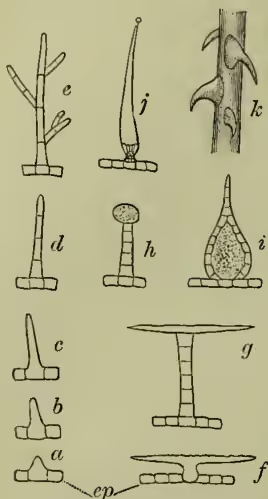
Hairs of Plants are outgrowths of epidermal cells, which assume various forms. They may remain unicellular, resembling simple tubes, or become multicellular by division of the originally simple cell. They develop on almost any part of the surface of plants; and there are few plants that are entirely without them. A plant may have only one form of hair; but most plants have several forms. Similar kinds of hairs are often characteristic of plants belonging to the same order—e.g. the glandular hairs of the sun-dew (Drosera) order, the stinging hairs of the nettle (Urtica) order, and the scaly hairs of ferns. Root-hairs (see ROOT) are among the simplest in form; they are always unicellular tubes which absorb water and certain minerals essential for the life of the plant. The aerial organs of plants develop hairs which serve to protect them from cold, or injury from other sources—e.g. many winter buds have hairy scale leaves which often, with a gummy secretion, keep out moisture, and thus protect the tender tissues from injury by frost. Many leaves also are protected from excessive radiation by the growth of hairs. The common form of glandular hair is that with a swollen tip which secretes oily or resinous, often strongly-smelling, matters which may be regarded as waste-products that have become adapted to the attraction and capture of insects (see INSECTIVOROUS PLANTS). Some glandular hairs have the glands within their bases. In the orders Composite and Valerianæ hairs form on the fruit an organ of flight (pappus), by means of which the wind is enabled to carry the seeds, and thus secure their wide distribution. When hairs become stiff, generally by impregnation with silica, they form bristles; and when they become woody and hard they form prickles, as in the bramble and rose. Hairs may also grow internally in large intercellular spaces, but these occur only in a few plants.