Hamster (Cricetus), a genus of rodent mammals of the family Muridae, characterised by a stoutish body, short legs and tail, cheek-pouches reaching back almost to the shoulders, five toes on the hind-foot and four toes and a thumb-wart on the fore-foot. Two incisor teeth are present in each jaw (as usual in rodents), the upper ones yellow and undivided; there are three molar teeth on either side in each jaw, which have true roots, the foremost the largest. The stomach has two divisions, and there is a large cæcum. There are nine species, of which the most important is the Common Hamster (Cricetus vulgaris), distributed from the Rhine to the middle of Siberia, and from 60° N. lat. to the Caucasus. It is about 1 foot in length (2 inches being occupied by the tail, which is slightly hairy); yellowish-gray above, black below, with several yellowish-white patches on the side, and with white feet. It breeds twice in the year, and from four to sixteen young are produced each time, which are born blind. The males especially are very pugnacious, and will defend themselves courageously to the last gasp. During the winter the hamster hibernates, living upon its store of food. Each individual makes a burrow for itself, to which there is a vertical entrance and a sloping passage for exit. The sleeping apartment is always separate from the storehouse, of which young hamsters only make one, older ones several.
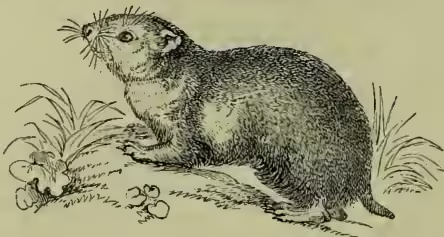
It lives upon roots, grain, and fruits, but does not disdain to eat frogs, beetles, or worms. During the summer it lays up a store of grain and pulse, which it carries home during the night in its cheek-pouches. Only the nutritive portions of its booty are stored up, the husks and chaff being rejected; sometimes the amount of its hoard will reach nearly a hundredweight. Hence it is a great pest to the farmers of the countries in which it abounds, and the object of their unceasing hostility. The skins of hamsters are of some value.