Harbour, an inlet of the sea, so protected from the winds and waves, whether by natural conformation of the land, or by artificial means, as to form a secure roadstead for ships. It is with harbours which are wholly or in part artificial that this article deals.
Harbours may be divided into harbours of refuge and those for commercial purposes. The latter are often merely tidal—i.e. capable of being entered by vessels only at certain states of the tide, and where the vessels rise and fall with the tide. The former are roadsteads of good depth, protected by breakwaters, and accessible at all times of tide, where ships may take refuge during storms. The two kinds are sometimes combined, there being the harbour proper, and a capacious protected roadstead outside of it, as at Cherbourg and elsewhere.
With the birth of commerce and naval warfare, in the earliest ages of civilisation, arose the necessity for artificial harbours. The Phœnicians, the fathers of navigation, soon set to work to protect their scanty strip of Levantine coast. At Tyre two harbours were formed, to the north and to the south of the peninsula on which the city was placed. At Sidon similar but less extensive works long testified to the wealth and engineering genius of the Phœnicians. The breakwaters were principally constructed of loose rubble.
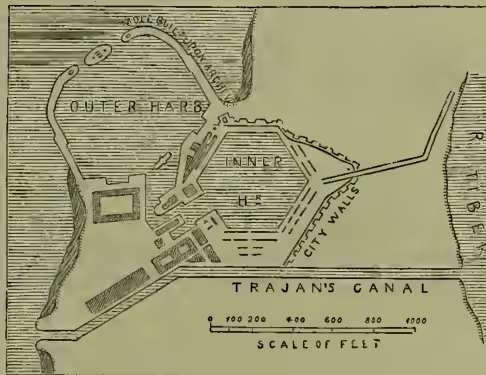
Carthage, in another part of the Mediterranean, also possessed a harbour, in two divisions, formed by moles, and connected with one another by a canal 70 feet wide. On the inner harbour stood the arsenals, with room around them for 220 warships. Still keeping to the great inland sea, we come to Greece; but here nature had provided so many navigable inlets that little remained to be done by man. Nevertheless, some minor works were executed at the Piræus and elsewhere, chiefly, of course, for warlike purposes. The Romans, finding ships necessary to the dominion of the world, set about constructing harbours for them, in their usual solid and workmanlike manner. The coasts of Italy still show how well they understood both the principles and the practice of this branch of marine engineering. Below is given a plan of the ancient port of Ostia, at the mouth of the Tiber (now more than two miles inland), one of their finest and most complete undertakings of this nature. A distinguishing feature of their harbour-making is the open or arched mole. Built with open arches, resting upon stone piers, it gives full play to the tidal and littoral currents, thus preventing the deposit of sand or mud; but in proportion as this advantage is increased (by increasing the span of the arches), so also is the agitation, and consequent insecurity, of the water within. The decay of commerce and civilisation, consequent upon the fall of the Roman empire, put a stop to harbour-making; nor could any want of the art be felt until the revival of commerce by the Italian republics of the middle ages. But the rich traffic of Venice and Genoa soon led to the construction of suitable ports at those places; and the moles of the latter city and the works in the lagoons of Venice remain to this day. France was next in the field, embanking, protecting, and deepening the mouths of the rivers along her north-western shores, as at Havre, Dieppe, Dunkirk, &c. In 1627, during the siege of Rochelle, Metezeau constructed jetties of loose rubble-stone, to prevent access to the city.
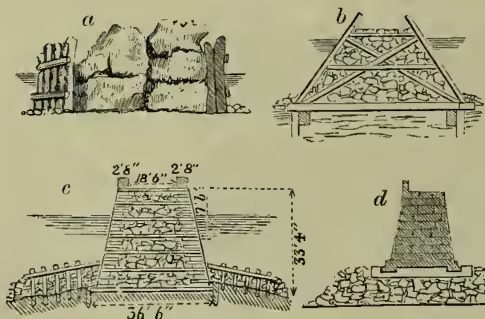
Meanwhile, Britain, whose ocean-commerce is of comparatively recent date, lagged far behind her continental rivals. With few exceptions her ports were absolutely unprotected, or rather uncreated; and this state of things continued until late in the 18th century. Two of the few exceptions were Hartlepool, where a harbour was formed about 1250, and Arbroath in 1394. In the 17th century, at Whitby and Scarborough rough piers were thrown out, protecting the mouth of the port; while at Yarmouth a north jetty and subsequently a south one were formed. An ancient mole existed at Lyme Regis, a section of which, from Smiles's Lives of the Engineers, is given below (see fig. 3). But the chief efforts of the early English engineers were directed against the shoals and waves of harbours for commercial purposes; (3) piers, either straight, or kanted, or curved; (4) quays or wharves.
These different works are obviously suited for different localities, and for contending with different exposures. Quays are clearly suited for the most sheltered situations only, and the engineer must consider, when designing a harbour, which type of harbour will be most economical and effective. In coming to a decision the nature of the traffic, the exposure, and the geological features of the coast must be carefully considered. A good chart or marine survey furnishes valuable evidence as to the force to which harbour-works will be exposed. Among the points to be noted is the line of maximum exposure, or the greatest fetch or reach of open sea, as well as the depth of water, in front of the harbour. Thomas Stevenson proved by observations that the waves increase in the ratio of the square root of their distance from the windward shore as measured along the line of exposure, and he gives the following simple formula: Where = height of wave in feet during a strong gale, and = length of exposure in miles for distances of, say, 10 miles and upwards, then . The heights so obtained will be increased when they pass into converging channels, and decreased when they pass into expanding channels. The greatest measured height of the waves was by Scoresby in the Atlantic Ocean, where he found billows of 43 feet in height from hollow to crest, and 36 feet was not an uncommon height. At Wick, Caithness-shire, waves of about 40 feet have struck the breakwater. Amongst the greatest recorded forces exerted by the waves may be mentioned the breaking or quarrying out of its position in situ of a mass of 13 tons on the Skerries of Whalsay, in Shetland, at a level of 74 feet above the sea—this height, of course, being reached by sliding. But the most astonishing feat of which we have any knowledge was at Wick breakwater, where in the winter of 1872 a mass of masonry, concreted together as a monolith, and bound with iron bars inches in diameter, and weighing no less than 1350 tons, was torn from its seat in the work, and thrown to leeward.
Thomas Stevenson devised an instrument called the Marine Dynamometer for ascertaining numerically the force which is exerted by the waves in the Atlantic and German oceans. He found that the mean of his observations during winter was more than three times that exerted during summer, the maximum force recorded being tons per square foot.
Various local causes materially affect the height, and therefore the force of the waves. In some cases, where a strong current runs past the coast, as at Sumburgh roost in Shetland, it causes a dangerous breaking sea in the current, and while this roost or race continues to rage the coast under lee is comparatively sheltered; but when the force of the tide is exhausted and the roost disappears, a heavy sea rolls in upon the shore. It is this encounter between the ground-swell waves of the ocean and the current of tide or land water which causes miniature races at the mouths of rivers.
Another most material element in the question of exposure is the depth of water in front of the harbour; for, if that depth be insufficient to admit of the transmission of the waves, they break or spend themselves before they reach the piers. Thus, Leslie found at Arbroath harbour that the works were not so severely tried by the heaviest waves as by others of lesser size which were not tripped up and broken by the outlying rocks. In the same way, at the river Alne the harbour within the bar is more disturbed by ordinary waves than during great storms. It thus appears that the
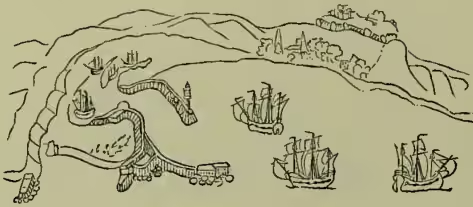
Dover. When, however, Smeaton rose to vindicate the engineering talent of England, things took a different turn; and now few countries surpass Great Britain in the number of artificially improved commercial harbours, or in the just appreciation of their importance.
In the construction of harbours the great desiderata are sufficient depth of water and perfect security for the vessels likely to frequent them, together with the greatest possible facilities for ingress during any weather; while the chief obstacles to be surmounted are the action of the waves upon the protecting piers and breakwaters, and the formation of sandbanks and bars, which diminish the depth of water at the entrance and also within. The designs of harbours, as has been already indicated, may be classified under the following heads: (1) harbours of refuge and anchorage breakwaters; (2) deep-water and tidal largest waves are not always so destructive as smaller ones. Scott Russell has stated the law that waves break whenever they come to water as deep as their own height; so that 10-feet waves should break in 10-feet water, and 20-feet waves in 20-feet water. There seem, however, to be some waves which break on reaching water whose depth is equal to twice their own height. Proofs of the depth to which the surface undulations extend have been given by Sir George Airy, Sir John Coode, Captain Calver, and Mr John Murray, C.E. Rankine has shown that the crest and trough of the sea are not, as was generally believed, equidistant from the level of still water. When is the length of the wave, its height from trough to crest,
It has been held by some engineers that in deep water waves are purely oscillatory, having no power of translation, and therefore incapable of exerting any force against a vertical face of masonry. This, however, is incorrect. Were there no wind propelling the waves, no current to interfere with their character, and no interference with one another, such as the reflected wave from a vertical face meeting the next opposing wave, such a theory might be true. True, however, it is not; and all sea-works, in whatever depth of water they may be placed, will assuredly have to withstand impulsive action. Besides, it must be kept in view that in order to reduce the expense of construction it is essential, where the bottom is soft, to make the foundation a pile of loose rubble or concrete blocks. It follows from what has already been said that the rubble, by shoaling the water in front of the work, will cause the waves to become waves of translation before they reach the vertical superstructure, which, assuming the waves to have been simply oscillatory, would have reflected them without breaking, and therefore without their having exerted an impulsive force further than statical pressure upon the masonry.
There is no fixed rule as to the best profile of any sea-work, which must necessarily depend upon a variety of local peculiarities, such as the nature of the bottom, and the size and quality of the materials obtainable. While a long, sloping breakwater does not offer the same amount of resistance to the waves, neither is it in itself so strong, for the weight resting on the face-stones is decreased in proportion to the sine of the angle of the slope. On the other hand, the tendency of the waves to produce horizontal displacement, supposing the direction of the impinging particles to be horizontal, is proportional to the cube of the sine of the angle of elevation of the wall.
In tidal harbours, or those in shoal-water, it is admitted by all that the waves break, and therefore exert an impulsive force. Such works have to withstand (1) the direct horizontal force which tends to remove the masonry; (2) the vertical force acting upwards on projecting stones or protuberances, and against the lying beds of the stones; (3) the vertical force acting downwards upon the talus wall, or passing over the parapet and falling upon the roadway; (4) the back-draught, which is apt to remove the soft bottom in front of the work; and (5) the blowing action of waves on the air or water which fills the interstices of open-work piers.
In designing the ground-plan of harbours, some rules should be kept in view: (1) the entrance should be always kept seawards of the works of masonry, care being taken that the direction of the piers does not throw the sea across the entrance; (2) there should be a good 'loose,' or point of departure free of rocks or a lee-shore; (3) spending beaches inside should be provided to allow the waves that pass in to break and spend themselves. A harbour basin surrounded with vertical quay walls becomes a 'boiling pot;' this is a point frequently overlooked by engineers; (4) the relation of the width of entrance to the area of a harbour should be a matter of careful study, as upon this depends the tranquillity of the interior, or what has been called the reductive power of the harbour. Stevenson's formula for the reductive power is given below: = height of wave at entrance; = breadth of entrance; = breadth of harbour at place of observation; = distance from mouth of harbour to place of observation; = reduced height of wave at place of observation.
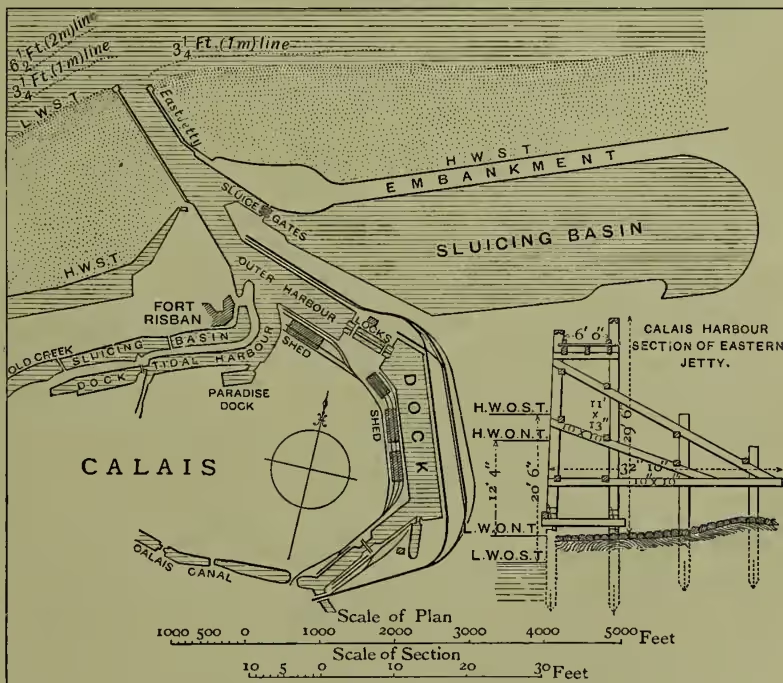
Fig. 4 represents the harbour of Calais, which was constructed by the French government, and opened on 3d June 1889. Great difficulty was experienced in keeping the entrance free from sand, the old sluicing basin being found quite inadequate for the purpose on account of its distance from the entrance. The large basin constructed has proved more effective, enabling much larger steamers now to be put upon the passage.
Rendel's plan of depositing rubble from open stages of pile-work is frequently used in the construction of deep-water piers.
The cross-sectional form of breakwaters depends naturally on the depth of water, exposure, and the materials that can be most easily obtained. The system of bringing up a rubble mound to within 12 or 18 feet of low-water level, and then forming a masonry wall on this base, was adopted at Portland, Alderney, Wick, Holyhead, and other places; while at Dover and Aberdeen the wall with a slight batter has been brought up from the bottom. The introduction of Portland cement concrete in comparatively recent times, as described in the article BREAKWATER (Vol. II. p. 415), has greatly facilitated the work of the harbour engineer.
The commercial value of a harbour increases, according to Stevenson, not simply as the depth of the water is increased, but as the cube of the depth. Hence the great expense which is willingly incurred for securing even a foot or two of additional depth. The greatest achievement in deepening is at the Tyne, where Ure dredged out the channel to 20 feet at low-water all the way up to Newcastle. In 1889-95 Messrs Stevenson of Edinburgh deepened the lower reaches of the Clyde to 23 feet at low-water spring tides. Scouring is also employed for increasing the depth, as by Sir W. Cubitt at Cardiff, where 2500 tons of water a minute are let off. Rendel's scheme for Birkenhead was based simply on the quantity liberated and the sectional area of the channel, and was therefore operative for any distance, and did not depend on the propelling head, or on the direction in which the water left the sluices, which conditions regulate ordinary scouring on the small scale, and which is efficacious for only short distances from the outlet.—Docks (q.v.) of various kinds are connected with harbours.
Pine timber is admirably adapted for soft soils, when the exposure is not great, but, owing to the ravages of the Teredo navalis and Limnoria terebrans in localities where there is no admixture of fresh water, it is soon destroyed. Greenheart, African oak, and bullet-tree are little affected by the worm, as shown by experiments made in 1814 at the Bell Rock by Robert Stevenson. Even limestone and sandstone are perforated by the Pholades and Saxicavæ. Metals also suffer from chemical action when immersed in salt water. George Rennie's experiments showed that wrought iron resists this action better than cast in the ratio of 8 to 1; while Mallet's experiments show that from th to ths of an inch in depth of castings 1 inch thick, and about ths of wrought iron, will be destroyed in a century in clean salt water. A cannon-ball inches in diameter became oxidised to the extent of ths of an inch in the century.
See BREAKWATER, DOCKS, COALING STATIONS, and the articles on CALAIS, CHERBOURG, DOVER, HAVRE, HOLYHEAD, PETERHEAD, PLYMOUTH, PORTLAND, &c.; also Sir John Rennie's book on Harbours (4 vols. 1851-54); Thomas Stevenson, Design and Construction of Harbours (3d ed. 1886); L. F. Vernon Harcourt, Harbours and Docks (2 vols. 1885); and the Minutes of Institution of Civil Engineers, passim.