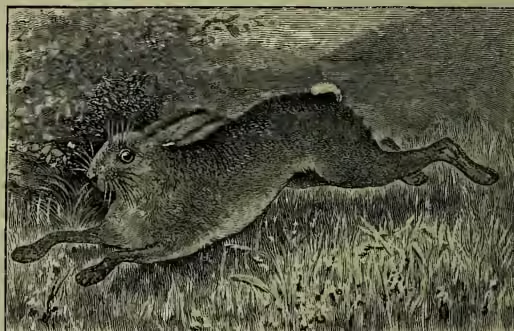
Hare, a term including all members of the rodent family Leporidae, with the exception of the rabbit. Its chief distinctive characters are as follows: four incisor teeth in the upper jaw (instead of two as in most Rodentia), two small square teeth standing immediately behind the well-known front teeth; five or six molars in the upper and five in the lower jaw, which are composed of two flat plates disposed transversely; lips thick, with a deep median incision and very mobile, with long bristles; eyes large; ears more or less long; head and body long and compressed; hind-legs long (except in Lagomys), five toes on the fore, four on the hind legs; tail short. The body is covered by a thick, almost woolly coat, which is in some demand for making hats. Two recent genera only are included, Lepus and Lagomys. The Common Hare (Lepus timidus) is about 27 inches in length—of which only 3 inches belong to the tail—1 foot high, and weighs 13-20 lb. The fur consists of two kinds of hairs, one short, thick, and woolly, the other longer and stouter. The colour, owing to the varying tints of these two sets of hairs, is a dull reddish-brown, paler on the sides and white below, which from its resemblance to the earth is admirably adapted to conceal the animal.
The hare is in the main of nocturnal habits, and passes the day sleeping in its 'form,' a slight depression among the grass and other herbage, sheltered from the sun in summer and the wind in winter. In the evening it creeps out to feed, nearly all vegetable substances being palatable to it; green vegetables and root-crops are, however, its special delicacies, though it will gnaw the bark off trees when hard pressed. In places where it is protected by game-laws it does great damage on account of its voracity and fertility.
In addition to its protective colouring, caution and speed are the hare's security. Crouched in its form, on any sign of danger it at once sits up on its haunches and looks around; its next action is to crouch down and try to conceal itself; should this fail and the enemy approach too near, it betakes itself to flight, in which its long hind-legs give it a great advantage in running either on a level or uphill; in descending it proceeds diagonally, otherwise its springs would overturn it. Its course is chosen with great cunning so as to place all possible obstacles in the way of its pursuer, and though it does not take naturally to water it has been known to swim a considerable distance when closely pressed. It has many enemies; nearly all beasts and birds of prey will attack it, not to mention man, whose pursuit is treated in special articles (see COURSING; also GAME LAWS).
The time of pairing is in February or March, and at this period the pugnacity, which is even more a characteristic of this cautious animal than its proverbial timidity, comes into evidence, for the males fight ferociously for the females. The period of gestation is thirty days; there are three to five young (known as 'leverets') in each litter, and four (rarely five) litters are produced yearly; the first in March, the last in August. The young can see when born, and are only indifferently tended by their mother for about a month.
The Common Hare is distributed over the greater part of Europe and a small portion of western Asia, as far north as Scotland, south Sweden, and Persia, and as far south as France and north Italy. Three different local varieties have been recognised: (1) the South European (L. mediterraneus, L. meridionalis), small, short, with looser hair of a reddish tinge; (2) the Mid-European (L. timidus s. str., L. campicola), stouter, with longer hair and brownish-gray; (3) the Eastern form (L. caspicus), very thick-haired, and gray or whitish-gray in colour.—The Irish Hare, formerly known as L. hibernicus, is not regarded as a distinct species by the best authorities, but as a variety of the Alpine hare.
The Alpine Hare (L. variabilis) is distinguished by its smaller size, the shortness of the ears, which are not so long as the head, the white tail about half the length of the head, and the form of the first upper molar. It occurs in the circum-polar regions as far south as 55° N. lat., and also in elevated positions in more temperate regions, such as the Alps, Pyrenees, and probably the Caucasus. As a British form it is confined to the north of Scotland and Cumberland. Three different varieties have been described: (1) the Polar, white both in summer and winter, with the exception of the tips of the ears; (2) alpine form or 'Blue Hare,' grayish-brown in summer; (3) temperate form, grayish-brown both summer and winter, but somewhat whitish in the latter season. The Irish hare is probably this form.
Two species of hare have been recorded from India and central Asia, and one from the Cape. The American continent yields some dozen different forms, only one of which, however, occurs in the southern portion. Among these are the Polar Hare (L. glacialis), the Northern Hare (L. americanus), and L. aquaticus and L. palustris, the Swamp and Marsh Hares; these last are excellent swimmers and divers.
Fossil hares have been found in the Pliocene formations of France, the Post-Pliocene of North America, and the caves of Brazil.
The Pikas belong to the genus Lagomys (sometimes made the type of a distinct family, Lagomyidae), which is distinguished from Lepus by its short hind-legs, very short tail, and rounded ears, as well as by the presence of complete collar-bones.
The type species L. alpinus somewhat resembles a Guinea-pig in shape and size; the colour is reddish-yellow sprinkled with black above, redder on the sides and front of the neck, paler below. It continually emits a penetrating whistle, repeated two or three times in succession, which has been compared to the note of a woodpecker. It inhabits burrows in the ground which it excavates for itself, and in which it stores up food for the winter. Its habits are nocturnal. There are eleven different species, which extend from Kamchatka along the chain of mountains in the centre of Asia, just entering Europe in the neighbourhood of the Volga. In America they are confined to certain parts of the Rocky Mountains. See FURS; and The Hare, by Macpherson, Lascelles, &c. ('Fur and Feather' series, 1896).