Harmonics. Every musical sound, although to the untrained ear it appears to be single, will, on close observation, be perceived to consist of a principal or fundamental tone accompanied by higher tones or harmonics which blend and generally harmonise with it. The existence of such harmonics (or partial tones) may be perceived on loudly sounding a low note on a pianoforte with the loud pedal held down: as the sound dies away the harmonics become more and more prominently audible, especially when they are singly listened for one after the other; and the more tinkling the quality of tone of the instrument the more readily they are heard. In fact, in a tinkling pianoforte they are at all times louder than the fundamental tone, though they are masked by it, as all high tones appear to the ear to be masked by lower tones; and the tinkling quality is due to their presence. The peculiar recognisable character of all sounds—different voices, pianoforte, organ, violin, &c.—is due to the presence of harmonics, each with its own intensity; and by sounding along with a simple fundamental sound a number of harmonic tones, each with varying degrees of loudness, an endless range of quality may be conferred upon the fundamental tone.
For demonstration of harmonics in sounds of all kinds a series of resonators is necessary. When a tuning-fork is vibrated near a hollow vessel of suitable capacity (say a lamp-chimney sunk in water to an adjusted depth), the air within the hollow vessel vibrates in unison with the fork and emits a loud sound; similarly, when the capacity of such a resonator corresponds to the pitch of a harmonic tone present in a given sound, the resonator sounds out that harmonic. By a series of such observations all the harmonics can thus be severally recognised. The physical basis of harmonic tones is the fact that no vibration of an elastic body is ever accomplished without a more or less well-marked division of the vibrating body into segments which vibrate independently and simultaneously. To realise this, take a long string stretched between two points; set it in vibration by means of a violin-bow; the cord will appear to vibrate as a whole. Now, by means of the fingernail or of a stretched thread lightly pressed upon it at the exact mid-point, 'stop' the mid-point and again bow; the string will appear to vibrate in two independent halves or loops, with a node or point of rest between them; the vibrations will be twice as frequent as at first, and the sound produced will be the octave of that originally heard. Again, stop a point one-third of the length from either end and again set in vibration; two nodes and three loops will be formed; the vibrations will be three times as frequent, and the sound will be the twelfth above the original fundamental. In the same way, any point cutting off one aliquot part of the string may be stopped; the string will spontaneously form the corresponding number of nodes and loops when set, in any fashion, into vibration. If we suppose the original sound to have been on the second ledger line below the bass staff, the various sounds produced by treating the string in this way will respectively be:
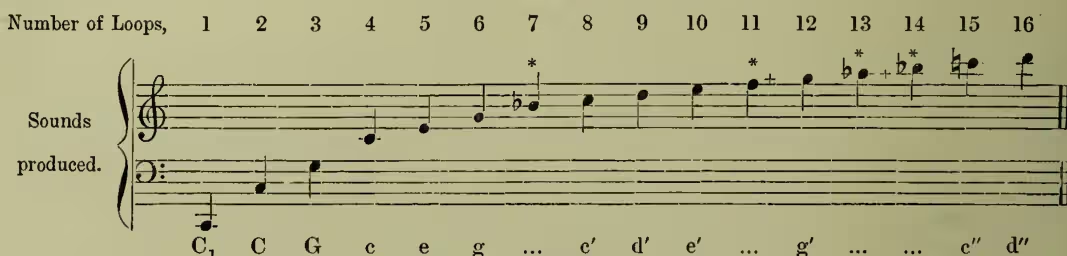
The unaided ear can distinguish harmonics up to No. 6.
The notes marked with asterisks are not notes of the natural scale; 7 and 14 are a flat B often to be heard in the sound of chime-bells; 11 is nearer than ; 13 is nearer to A than it is to . Now, in a vibrating string all these vibrations co-exist; to what degree any one shall be present depends on the way in which, or the point at which, the string is bowed or struck or plucked; and the quality of the resultant note varies accordingly. From the harmonics the true ratios of the members of the diatonic scale may be found—e.g. has a frequency of vibration 15 times as great as that of ; whence has a frequency times as great; and so for the rest, as follows:
| Notes of the scale of C..... | C | D | E | F | G | A | B | C |
|---|---|---|---|---|---|---|---|---|
| Notes of any diatonic scale in general... | d | r | m | f | s | l | t | d' |
| Ratios..... | 1 | 2 |
For the modification in these ratios introduced by the system of temperament, see TEMPERAMENT. The standard work on Harmonics is Helmholtz's Sensations of Tone (trans. by Mr Ellis; 2d ed. 1885).