Harmony, paradoxical as it may seem to the lay mind, is the science of discord. It treats of the laws which control the relationship of one chord or set of chords to others, and which decide the relation to the fundamental concord of the dissonant elements in a discord.
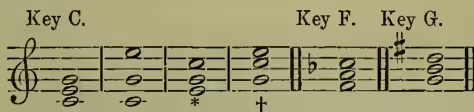
Concords.—A chord or combination of several tones in any scale or key may be a concord or a discord. The one concord in a key consists of the tonic or keynote and the notes which are respectively a major third and a fifth above the keynote: * and † are respectively the first and second 'inversions' of the chord. These three are the notes which nature gives us as producing a perfect sound in combination (see HARMONICS); they are therefore called 'consonances,' and any foreign element is a 'dissonance.' This 'common chord' or 'triad' makes a starting-point and a point of finality from which the harmonies proceed, round which they rally from time to time, and into which finally they resolve themselves. It is with few exceptions the first and invariably the last chord in any composition. One dissonance suffices to change a concord to a discord, which can be effected by adding to the notes of this common chord, or by changing their relationship to each other, &c.; and the fundamental law of harmony is that discord as an incomplete idea must give place to concord before the ear can be satisfied. This process is called 'resolving' the discord. Thus concords stand firm like the straight lines or outstanding features in a landscape; while discords supply the curved lines of beauty, the effects of perspective, and the variety which gives interest to the picture.
Discords.—The seventh harmonic of nature which is a minor seventh distant from the root—i.e. one semitone less than the seventh consecutive note in an ascending major scale—produces a discord which, with its complementary or fulfilling concord, is the foundation of all harmony. This discord is called the DOMINANT SEVENTH (its sign is ), and its 'resolution' is the triad of the key to which it belongs—i.e. the chord of the tonic (I.).
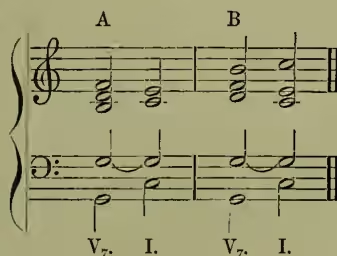
A is an example of 'close,' B of 'open' or 'extended' harmony. Because the discord on G seems thus to demand the chord of C as its resolution, the note G (or similarly the fifth degree in any scale) is called the dominant () of that key, and the chords and discords built on it constitute the dominant harmonies. Position B is the most satisfactory to the ear, because of the effect of finality induced by the resolution to the first position of the triad; and the two chords together form the dominant or authentic cadence—the most important of those terminal phrases which serve in music much the same end as commas, semicolons, and periods in composition. 'God save the Queen' offers examples of two other important cadences, showing at the same time how these mark the completion of more or less final musical periods.
The first period is closed at A by a 'half' or 'imperfect' cadence—i.e. the order V.—I. is reversed; the second at B by a 'false' or 'deceptive' cadence—i.e. the dominant chord, instead of proceeding to the tonic, 'deceives' the ear by proceeding to another chord; the third period is brought to a close by the authentic cadence at C.
The dominant chord can also bear the more elaborate dissonances of the ninth, eleventh, and thirteenth, as well as the seventh.
Key F. Gounod's Faust.
Root C (V.).....Root F (I.)
It is impossible here to enter into the varieties of discord—'suspensions,' 'double-root chords,' &c., into the analogous discords which may be built on the tonic as a ground-note, or the chords belonging to the minor scale. Suffice it to say the effects which can be evolved from the almost innumerable inversions and involutions of single chords and combinations of chords are subject to natural laws as stringent as those governing the growth of flowers and trees, and the possibilities of variety in this unity are as infinite.
Modulation.—One branch of the subject can hardly be left without mention—i.e. modulation or change from one key (or 'mode') to another. Our modern scales have had the relation of their intervals so modified (see TEMPERAMENT) as to be approximately alike. By the addition of a single sharp or flat any melody can proceed from the key of C to G (with F♯), F (with B♭), or A minor (with G♯). These—the dominant, subdominant (next below the dominant), and the minor of the sixth degree—are the keys of the first relation, as out of the seven notes which constitute each scale six are present in the scale of C, thus providing as it were six more or less convenient bridges by which to pass from one key to the other. The conventionality of these modulations makes them inadequate to convey the more passionate colouring of modern music, and more striking changes to remoter keys are necessary. A favourite device with modern composers is to take advantage of the 'tempered' system, and by using one note in two significations (e.g. F × E♯) to secure means of starting and also of very tender effects in modulation.
History.—The complete Greek scale as formulated by Pythagoras is represented by three octaves of our scale of A minor, beginning at the A in the first space of the bass clef, and using no black notes. Various sets of eight notes selected from this extensive scale were called after districts of Greece, and in the 4th century St Ambrose adopted four of these names when he laid the foundation of modern music in what are called the Gregorian Modes. They received their name from Pope Gregory, who added four others beginning on the respective dominants, and called them plagal, as distinct from the authentic modes of St Ambrose. The most important of these are
Authentic.
| DORIAN. | LYDIAN. | PLAGAL. |
| HYPODORIAN. | ÆOLIAN. | HYPOLYDIAN or IONIAN. |
The Dorian and Aolian, and less frequently others even more at variance with our conventional scale, are still in occasional use; and peculiarly plaintive effects can be obtained from the absence of the 'sharp seventh' to which our modern ears are so accustomed.
In Counterpoint, the science which preceded harmony, attention was given altogether to the correct progression of the individual voices or parts, while the combinations made by the voices at any moment were regarded as merely accidental. But unconsciously the ear of musicians was being cultivated, and the richness of Palestrina's simpler writings must have shown the possibility of obtaining undreamt-of effects from chords as integral units in a march of harmonies, rather than accidental combinations of independent melodies. One of the fundamental rules of counterpoint was that a dissonance must either be 'prepared'—i.e. it must appear as a consonance in the previous chord—or else it must be approached very gradually. This rule of the old science was disregarded by Monteverde (1608), who used unprepared discords, and thus at one blow the new feeling for chords was released from its bondage to counterpoint.
The chords at * present the same discord—the eleventh and seventh on A, the dominant of D. The first is carefully prepared, and so has a smooth effect; the second is quite 'free' in its entry, and has a sudden and startling effect.
Only one who understands counterpoint and harmony can appreciate the full importance of the new departure. It meant that discords were no longer mere variations of concords, but individual creations with an individual's rights and duties. The discord most easily used was the dominant seventh, the first discord produced by nature's harmonics; and so the relation of dominant to tonic—the central idea of all harmony—developed from an increasingly general tendency into a recognised rule. During the 17th century many experiments were made by Monteverde's followers, until at the end of the century Rameau's famous treatise called attention to the fact that all chords are derived from some note which is the generator or root, and the relationships of these roots govern the progressions of the harmonies. The less known, but hardly less important, researches of Tartini formed a good supplement to Rameau's theory; and the basis of scientific harmony established by these two works has not been seriously disturbed even by the thorough investigation and the astonishing discoveries of Helmholtz, who has extended the foundation and built a complete superstructure thereon. In the meantime, while theorists fought each other with great fierceness just as their successors do to-day, the science made extraordinary progress under such practical harmonists as Bach, Mozart, and Beethoven. Bach's daring but nuerving feeling for harmony, his grasp of the mysteries of chord-relationship, and his unequalled skill in part-writing enabled him as early as the beginning of last century to transform an ordinary progression of simple chords into such a passage as
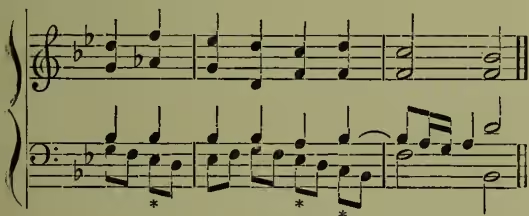
The accented dissonances (*), so smoothly introduced and yet so striking, are extremely effective. Haydn's work, and Mozart's also, is considerably softer; their use of discord proved insufficient for the expression of the great passion which is the feature of Beethoven's later work. The romanticism of Schumann required still freer scope, and Wagner, who handles any number of parts as easily as did Bach himself, has enlarged the possibilities of harmony so far that it is difficult to conceive of any further advance. Theoretical harmonists have followed fast in the train of these great composers, and, as system after system proved inadequate for the analysis of new harmonies or new uses of old harmonies, the revered names of each generation have been pushed aside more or less contemptuously by succeeding schools.
Among the most famous works on harmony are those by Rameau, Logier, and Dr Day; Richter's text-book—long used at Leipzig Conservatorium—is a very good example of last generation's guide; and it is England's proud boast to-day that the attempt to reconcile theory with practice is most successful among her musicians. Sir George Macfarren's Harmony is founded on Dr Day's system; Sir Frederick Ouseley's is even more scientific; and probably the most successful, as well as certainly the most readable of all, is Sir John Stainer's Theory of Harmony. Sir George Macfarren's six Lectures, delivered at the Royal Institution, give an exhaustive and popular account of the progress of harmony; and more technical readers will find much that is instructive in Dr Parry's brilliant article in Grove's Dictionary of Music.