Harpy, a fabulous creature in Greek mythology, considered as a minister of the vengeance of the gods. Various accounts are given of the numbers and parentage of the Harpies. Homer mentions but one, Podarge; Hesiod enumerates two, Aëlo and Okypete, daughters of Thaumas by the Oceanid Electra, fair-haired and winged maidens, very swift of flight. Three are sometimes recognised by later writers, who call them variously daughters of Poseidon or of Typhon, and describe them as hideous monsters with wings, of fierce and loathsome aspect, with their faces pale with hunger, living in an atmosphere of filth and stench, and contaminating everything that they approached. The most celebrated tradition regarding the Harpies is connected with the blind Phineus, whose meals they carried off as soon as they were spread for him, a plague from which he was delivered by the Argonauts, on his engaging to join in their quest. The Boreads Zetes and Calais attacked the Harpies, but spared their lives on their promising to cease from molesting Phineus. Virgil locates them in the Strophades.—A harpy in heraldry is represented as a vulture, with the head and breast of a woman.
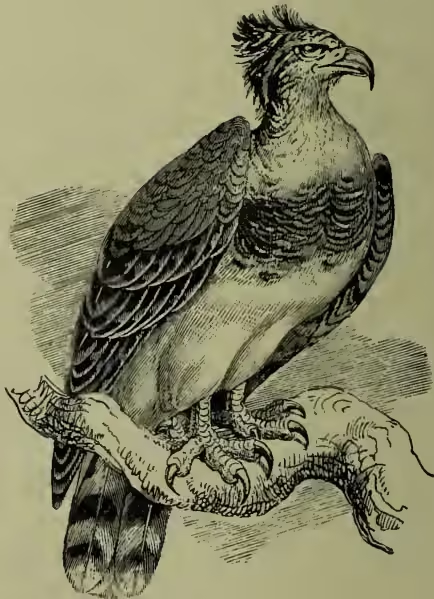
The name harpy is also applied to a raptorial bird of the family Falconidæ (Thrasaëtus harpyia), an inhabitant of the great tropical forests, where it preys upon all quadrupeds, except the most powerful, chiefly, however, on monkeys and sloths; even children are said to have been carried off by it. It is somewhat larger than the golden eagle (measuring 38 inches in length as against 32), and its beak and talons are exceptionally large, giving it a ferocious aspect; but its wings are comparatively short, and its flight, for a hawk, is slow and heavy. Its colour on the back and sides of the neck, on the back and on the wings, is black; the head gray; the front of the neck, breast, and belly white; the tail black and gray above, black and white in transverse bands below. Around the eyes the feathers are disposed in a radiating fashion, and form a crest on the back of its head, increasing the ferocity of its aspect. It inhabits the tropical regions of South America.