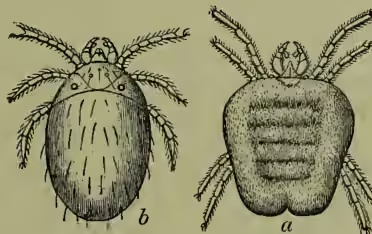
b, larva, full grown (Harvest-bug).
Harvest-bug, the larval form of the silky Trombidium (Trombidium holosericeum—Linn.) of the family Trombidiidae, order Acarina. It is of minute size, scarcely discernible by the naked eye, and of a bright scarlet or vivid crimson colour. In the hot months of summer it is found in gardens and on wild vegetation, being most plentiful in hot dry seasons in places near the sea and in chalky districts. It specially torments people with delicate skins, and the wound it produces causes a good deal of local irritation and also, in warmer countries, a considerable amount of constitutional disturbance. The most unpleasant symptoms are only observed in climates warmer than Britain; but the mite is troublesome enough in some parts of Scotland. M. P. Mœgnin has investigated the life-history of the harvest-bug, or rouget, as it is called in France (see Annales des Sciences Naturelles, 6th series, vol. iv. 1876). He found the silky Trombidium (T. holosericeum), a bright scarlet species, from spring till July and August, when it suddenly disappeared. In April he found some males with many young females, in the end of May and in June only gravid females. In June and July eggs were laid, which hatched, producing the rouget or harvest-bug formerly described as Leptus autumnalis, an almost spherical six-legged larva, which soon found a host into whose skin it thrust its sharp mandibles. Forthwith its abdomen began to swell with the fluid imbibed, reaching ultimately to about five times its original bulk, the head and thorax remaining of the same size as before. After hibernation, during which it digested and assimilated the nutritive juices stored up during its parasitic existence, it became the eight-legged nymph, exclusively a vegetable feeder and sexually complete. The harvest-bug infests not only human beings, but also dogs, cats, hares, and other smaller mammals, and even insects. The remedy employed for its bite is to extract the animal from the skin by means of a needle, and to allay the itching by rubbing the part affected with some essential oil. The ravages of the harvest-bug appear to be not confined to Europe, since a small animal found in Mexico, and called by the Indians Thalsahuate, seems to be, if not identical with, at least similar to the harvest-bug in its processes and effects.