Hawaii, HAWAIIAN ISLANDS, or SANDWICH ISLANDS, a small archipelago in the North Pacific, till 1898 forming the kingdom of Hawaii (so called from Hawaii, the chief island of the group), and named Sandwich Islands by Captain Cook after Lord Sandwich, then First Lord of the Admiralty. The islands, twelve in number, form a rich, beautiful, and interesting chain which runs from south-east to north-west, and lies in to N. lat. and to W. long. Their total area is about 7000 sq. m., or about that of Wales. The names and areas of the eight principal islands (the other four being merely barren rocks) are as follows: Hawaii (the 'Owhyhee' of
Captain Cook), 4210 sq. m.; Maui, 760; Oahu, 600; Kauai, 590; Molokai (the 'Lepers' Island'), 270; Lanai, 150; Kahulani, 63; Niihau, 97.
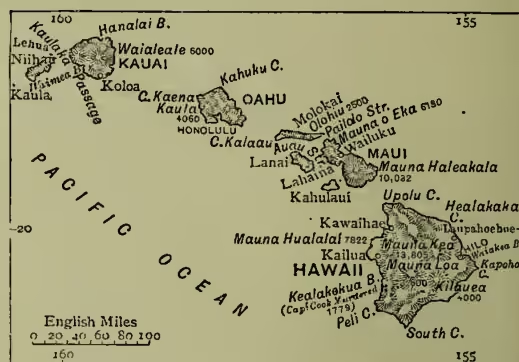
Hawaii is the southernmost of the group; it is in shape a rough triangle, with the apex pointing north-west.
Geography, Mountains, Rivers, &c.—The Hawaiian Islands are situated on the course of ships passing from San Francisco and Vancouver Island to China and Japan, as well as to New Zealand and Australia. They lie in mid-ocean, between the coasts of Asia and America, but are nearer to the American coast, from which they are about 2100 miles distant; they consequently form a convenient station for the coaling and repairing of vessels on their way across the Pacific. The islands are of volcanic origin, with coral-reefs partly lining most of them, but entirely encircling none. They suffer from want of good harbours, the best being the harbour of Honolulu, situated on the island of Oahu, with feet of water in its shallowest parts. This harbour, which is entered through a narrow channel in the reef, is the only really well-protected harbour in the group; during the time of the trade-winds, however, which blow from north-east to south-west for about nine months in the year, the roadsteads on the south shores of the islands afford safe anchorage almost anywhere. The larger islands are mountainous, and contain some of the largest volcanoes, both active and extinct, in the world. The two highest mountains, Mauna-Kea and Mauna-Loa, are in the island of Hawaii, and are 13,805 and 13,675 feet high respectively. This island is also traversed by other mountains, which give it a rugged and picturesque appearance, and in places bold cliffs from 1000 to 3000 feet high front the sea. Speaking generally, however, the high ground in each of the islands is in the centre, and the mountains are divided by rich valleys leading down to a sandy shore. On the eastern slope of Mauna-Loa, in Hawaii, is the far-famed Kilauea, the largest active volcano in the world. It is over 4000 feet above sea-level. Its crater is of oval shape, 9 miles in circumference, bounded by a range of cliffs, and containing within it a fiery lake of molten lava rising and falling like the waves of the sea. Mauna-Loa itself is an active volcano, the scene of various eruptions, notably of one in February 1877, when the glare caused by the fiery outburst is said to have been plainly visible on the island of Maui, 80 miles distant. On Maui is the crater of Haleakala ('house of the sun'), by far the largest known in the world. It is from 25 to 30 miles in circumference, from 2000 to 3000 feet deep, and is 10,032 feet above sea-level. Within this huge gulf are about sixteen basins of old volcanoes, whose ridges form concentric circles. Several of the islands, especially Hawaii and Kauai, are well supplied with rivers.
These afford great facilities for irrigation, but owing to the small size and the conformation of the islands they are in no case navigable.
Climatic, Soil, &c.—Lying as they do in the middle of the Pacific Ocean, the Hawaiian Islands, though within the tropics, enjoy a fairly temperate climate. In the hot season the temperature seldom rises above 90° F., while in the cool season it seldom falls below 52° F., the average temperature for the year being 74.3° F. Rains, brought by the north-east trade-wind, are frequent on the side of the mountains which faces that quarter, but on the other parts of the islands little rain falls, and the sky is generally cloudless. The yearly rainfall at Honolulu, being on the leeward side of Oahu, is under 40 inches; that of the islands generally about 54 inches. The soil, whose constituent parts are mainly scoria, decomposed lava, and sand, is generally thin and poor, but at the bases of the mountains and in the valleys there are extensive tracts as fertile as they are beautiful. In Hawaii alone, on the Waimea plains, thousands of sheep of the merino breed find grazing ground; and on most of the islands, while the upland slopes of the mountains are clothed with dense forests, the lower levels spread into grassy plains rich with sugar and rice plantations.
Natural History, Products, &c.—The islands are separated from other lands by a broad expanse and great depth of sea, consequently their natural history has many special features of its own. In the high mountains there are some species of plants akin to those of the American continent. The forest-trees are mainly to be found on the windward, being the rainy side of the mountain-ranges. Tropical fruits are numerous. There are now, as has been stated, numerous sugar and rice plantations on the islands. The staple food of the natives consists of poi, a kind of thick paste made from the root of the taro plant (Arum esculentum) and raw or dried fish. The only indigenous animals are rats, mice, bats, dogs, and hogs, but others have been added since white men came to the islands; cattle, sheep, &c. having been introduced by Vancouver and other navigators. There are large numbers of semi-wild horses in the kingdom, and in some parts of the mountains wild dogs are also to be found. Reptiles are few, including on land one species of lizard and a few of the gecko; and the native birds, of which there were nineteen species, are rapidly disappearing, though foreign importations more than supply their place. The archipelago has unfortunately no mineral resources. Coral rock is the material chiefly used for building purposes, and to a less extent basalt, compact lava, and sandstone. There is a large variety of sea-shells, some of which are of exquisite beauty.
Trade, Finance, &c.—The commerce of the islands is gradually increasing. Up to the year 1876 the most important trade was that of the vessels engaged in the whale-fisheries of the Pacific, which now are almost extinct. In 1876 a Reciprocity Treaty was concluded with the United States, and since that date there has been an enormous development of the sugar export trade. Over 200,000,000 lb. of sugar, being eight-ninths of the total value of the exports, were grown and exported in some years, the other chief articles of export being rice, wool, molasses, coffee, hides, tallow, and bananas. The total value of produce exported from the islands ranges from 8,000,000 to 18,000,000 annually. The imports, which consist principally of dry-goods, reach about half that amount. Nineteenths of the trade is with the United States. In the foreign carrying traffic some 300 vessels were employed in 1895, while about 60 Hawaiian ships ply between the different islands. On the larger islands there are good roads, and in the islands of
Hawaii and Maui there are about 75 miles of railway, the first line having been opened in 1879. Telegraphs have been established in these two islands, and in Honolulu the telephone is in common use. The coins current in the islands are American dimes, quarter-dollars, half-dollars, and dollars. The estimated revenue of the kingdom fell between 1890 and 1895 from over 4,400,000 to under 3,700,000, the expenditure being calculated annually at a little less than the income. The chief sources of revenue are customs and internal taxes. The public debt in 1895 was $3,590,000.
History, Constitution, &c.—The islands are said to have been discovered by Gaetano in 1542, and rediscovered by Captain Cook in the year 1778. Cook met his death at the hands of the natives in Kealakekna (Karakakoa) Bay in the year 1779. In early times each island had a king, but under Kamehameha I. the islands were formed into one kingdom. He died in 1819, and was succeeded by Liholiho, who adopted on his accession the name of Kamehameha II., and whose reign was famous for the abolition of idolatry simultaneously throughout all the islands. Vancouver, who arrived with Cook in 1778, and returned in 1792 and again in 1794, had made sincere attempts to enlighten the islanders, and succeeded so far that he was requested by the king and his chiefs to send out religious teachers to them from England. The first missionaries, however, who visited the islands came from the nearer shores of America. On their arrival in 1820 they witnessed the singular phenomenon of a nation without a religion. The instructions of Vancouver had, it would seem, not been forgotten, and had opened the eyes of the idol-worshipping natives to the grotesque absurdities of their system. But the spontaneous movement of 1819–20 'was no triumph of Christianity—for Christianity had not yet claimed or even approached the Hawaiian Islands.' The nation had voluntarily cast off the religion of their ancestors, and had not yet adopted—were not even acquainted with—any other system. The missionaries were well received, and the work of instruction was at once begun. In less than forty years they taught the whole Hawaiian people to read and write, to cipher and sew. Kamehameha II. and his queen visited England, and both died in London in July 1824. Prior to the year 1838 the government was a simple despotism, but in 1840 Kamehameha III. granted a constitution consisting of king, assembly of nobles, and representative council. In 1843 the independence of the Hawaiian kingdom was formally guaranteed by the French and English governments. Kamehameha IV. (1854–63) was succeeded by his brother Kamehameha V., with whose death in 1873 the line of the Kamehamehas became extinct, a high chief, Lunalilo, being elected to the vacant throne. On his death in 1874 another high chief, Kalakaua, was elected king. About 1886 the unsatisfactory state of the public finances under the existing system demanded some measure of reform, and in 1887 the king was called upon to dismiss his cabinet and constrained to grant a more popular constitution. In January 1893 the queen Liliokalani, sister of Kalakaua I., who had reigned for two years, was dethroned by a revolution. Annexation to the United States failing through the opposition of President Cleveland, a Republic was inaugurated in 1894. In 1898, however, the islands were formally annexed to the United States, and in 1900 the territory of Hawaii was organised.
Population and Condition of the People.—The total population of all the islands amounted in 1890 to 89,990, of whom 58,714 were males and 31,276 females. Of this total 34,436 were natives, and among the foreign members of the community the most numerous element was the Chinese, numbering 15,301, mainly employed in working the sugar-plantations; next to the Chinese, among foreign residents, came Portuguese, Americans, Germans, English, in the order given. The natives of the Hawaiian Archipelago belong to the brown Polynesian stock, and are akin to the New Zealand Maoris in race and language. They were once far more numerous than at present, having, it is said, at the time of Captain Cook's visit numbered probably some 200,000. There is no doubt that they have rapidly decreased, while the number of foreigners in the islands is continually increasing. Physically the Hawaiians are a remarkably fine and handsome race. In character they are indolent, joyous, and contented. The dress of the native men, where they have not adopted 'civilised' attire, consists merely of a wide strip of cloth round the loins, while the native women dress in a long ungirdled gown ('holoku') reaching from the neck to the ankles. Excellent day-schools have been established all over the islands, and there are very few natives who cannot read and write in their own language.
The decrease of the population is probably due in part at any rate to the introduction of foreign diseases. At the present time, however, the disease most rife among the people is leprosy. It was not till the year 1865 that the Hawaiian government set aside the island of Molokai for the segregation of lepers in order to prevent to some extent the further spread of this terrible malady. Here they lived in a state of abject misery until the arrival of Father Damien (q.v.), whose work was taken up by others after his death in 1889. The prevention of leprosy is now attracting the serious attention of the Hawaiian government and their board of health; large numbers of lepers have been removed to the Molokai settlement, where over 1000 live.
See Mrs Bishop, Six Months in the Sandwich Islands (1875); Miss Gordon Cumming, Fire Mountains (1883); J. D. Dana, Hawaiian Volcanoes (1890); Sauvin, Un Royaume Polynésien (1893); Guilleminard, Malaysia and the Pacific Archipelagoes (in Stanford's 'Compendium,' 2d ed. 1895); Staley, Five Years' Church Work in Hawaii; Manley Hopkins, Hawaiian Islands; Thrum, Hawaiian Almanac and Annual; the Narrative of the Cruise of the Challenger; the Statesman's Year-book, &c.