Hawk-moth (Sphingidae), a family of lepidopterous insects, forming along with the clear-winged moths (Aegeriidae) and the burnets and foresters (Zygænidæ) the tribe Sphinges. They have stout bodies, large heads with prominent eyes, and stout short antennæ. The wings are long, narrow, more or less pointed, and have always a retinaculum.
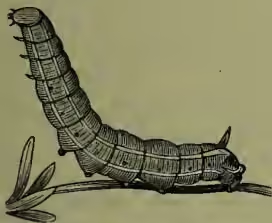
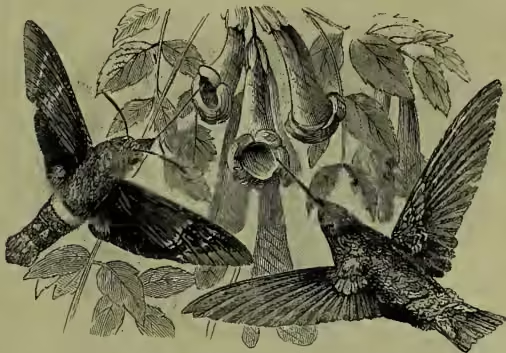
They are insects generally of rapid flight, and fly about in the twilight; some species also during the day. Their caterpillars are sixteen-legged, flat, smooth, often green, with transverse stripes on the sides and nearly always a horn on the back of the second last segment. They change to pupæ either on the surface of the ground or in a cell underground which they form for the purpose. The common species of the Humming-bird Hawk-moth (Macroglossa stellatarum) in Britain has brown fore wings and reddish tawny hind wings, and, unlike all other hawk-moths except the Bee Hawk-moths (Hemaris or Sesia fuciformis and bombyliiformis), has a spreading tuft of hairs at the end of the body. Most of the foreign species are similarly coloured; and some of the South American species resemble humming-birds so closely that they cannot on the wing be distinguished from them, the natives there and even educated whites firmly believing that the one is transmutable into the other. Smerinthus is the only genus of the British hawk-moth with dentated wings. One of the most remarkable hawk-moths is the Death's-head (q.v.) (Acherontia atropos), the largest moth found in Britain. It sometimes measures nearly six inches across the wings; the fore wings are brown, the hind wings pale brown with black bands; and on the back of the thorax is a pattern in gray and black having a certain resemblance to a skull. The Privet Hawk-moth (Sphinx ligustri), the type of the family, measures about four inches across the fore wings, which are of a pale brown colour with darker markings; the hind wings are pale pink crossed by three black bands. Its green caterpillar, with white and lilac streaks on the sides and a black horn on the back, feeds on privet and lilac, and the position it assumes when resting suggested that of the mythological Sphinx to the old naturalists, who applied this name to the insect.