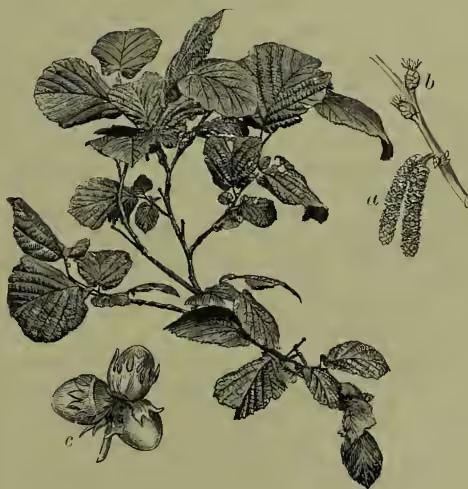
a, male and b, female flowers; c, fruit.
Hazel (Corylus), a genus of trees of the natural order Cupuliferae, of which the fruit is a nut in a leafy and laciniated cup, the enlarged involucre of the female flower. The male flowers are in cylindrical catkins; the female flowers appear as mere clusters of coloured styles at the extremities of buds.—The Common Hazel (C. Avellana) is a low tree, a native of Britain, and of all the temperate parts of Europe and Asia; it is common also in North America. There are ten or twelve improved varieties cultivated extensively in Kent, especially around Maidstone and in some other parts of England. Of these there are two types—one with round nuts, named eobs; the other with elongated nuts, named filberts. The cup or involucre of the former is shorter, more open, and not so much lacerated as that of the latter. Of either type there is a variety in which the pellicle enclosing the kernel is deep red; and both of these are highly esteemed. These particular varieties are propagated by suckers which are more or less freely produced, by layers, and by budding and grafting. The tree is extensively grown in some parts of England for coppice-wood, being reared for this purpose from seed. The young straight stems and branches are employed for making crates, baskets, hurdles, hoops, stakes, &c.; and the larger wood for charcoal, which is in great request for forges, for the manufacture of gunpowder and artists' crayons. Chips of the wood are in Italy sometimes put in turbid wine for the purpose of fining it; and the roots are used by cabinet-makers for veneering. Magical properties have been ascribed to hazel-rods by the credulous, as it was of them the Divining-rod (q.v.) was formed for the purpose of discovering water, minerals, or buried treasure. From the wood an empyreumatic oil is extracted, which is a vermifuge, and alleged to be a cure for toothache. Hazel-nuts yield, on pressure, about half their weight of a bland fixed oil, often called nut-oil in Britain, the hazel-nut being popularly known by the term nut alone; but in Germany it is walnut-oil which is usually called nut-oil. Hazel-nut oil has drying properties, and is much used by painters; it is also used by perfumers as a basis with which to mix expensive fragrant oils; and it has been employed medicinally in coughs.
The larva of a weevil (Balaninus nucum) feeds on the kernels of hazel-nuts. The parent female makes a hole into the nut by means of her long snout, and there deposits an egg. Great numbers of nuts are thus destroyed.
The Beaked Hazel (C. rostrata), a species having a very hairy fruit-cup prolonged into a long beak, is a native of the northern parts of America. Its kernel is sweet.—The Constantinople Hazel (C. colurna), the nuts of which are considerably larger than those of the common hazel, is a native of the Levant, from which the fruit is imported into Britain. It is much used for expressing oil, but is a less pleasant fruit than many kinds of cob-nut and filbert. A Himalayan species of hazel (C. ferox) has a spiny fruit-cup, and an excessively hard nut.—Barcelona nuts are the nuts of a variety of the common hazel, kiln-dried before their exportation from Spain. Hazel-nuts not subjected to this process cannot be kept long without losing in part their agreeable flavour, and contracting a sensible rancidity, except in air-tight vessels, in which they are said to remain fresh even for years.