Hedgehog, the European representative of the genus Erinaceus, the type of the family Erinaceidae, order Insectivora (q.v.). The chief characteristics of the genus are: body capable of being rolled up into a ball by the action of a powerful muscle arising from the head and neck on either side, and forming a loop around the posterior extremity; ears distinct; teeth, three incisors on each side in either jaw, the central pair long and prominent, molars, seven on each side above, five below, with rounded tubercles; zygomatic arch of the skull complete; legs short, with five toes on each foot; the two leg bones ankylosed; tail short; back covered with spines, the remainder of the body with hairs and bristles.
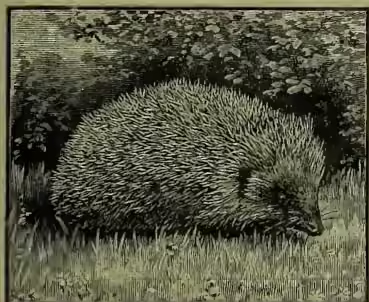
(Erinaceus europæus).
There are fourteen species, none of which occur in the New World or Australia. The Common Hedgehog (Erinaceus europæus) has a sharply pointed muzzle and ears less than half the length of the head. The eyes are small and black. The animal is at most about a foot long, and some six inches high. The spines which cover its back attain a maximum length of about an inch; they are sharply pointed and remarkably firm and elastic, so much so that they constitute a cushion upon which the animal will allow himself to fall from a considerable height with impunity. They are finely grooved along the sides, and have a pin-head-like root so attached to the muscle of the back that when the latter contracts they radiate outwards in all directions.
The animal eats small vertebrates, such as mice, young birds, and frogs, insects, worms, and sometimes vegetable matters. It is very useful in a garden or in a house infested by cockroaches. It has even been known to attack and devour snakes, seeming to have some special power of resisting not only the poison of the viper, but also other noxious substances. It is nocturnal in its habits, and hibernates throughout the winter, and, according to the Gypsies, with whom it is a special delicacy, it does store up birds, mice, crab-apples, &c. It inhabits hollows of trees or crevices in the rocks, but in default of these will excavate itself a burrow. The pairing season is from the end of March to the beginning of June; and the period of gestation is seven weeks. Three to six (rarely eight) young are born at once; they have both the eyes and ears closed. The spines are at first quite white and soft, and since they point backwards and the young are born head first there is no risk of injury to the mother during parturition.
Its area of distribution extends over the whole of temperate Europe and the greater part of Asia north of the Himalayas. Fossil hedgehogs have been found in the Tertiary formations.