Heligoland (Ger. Helgoland; native name, det Lunn, 'the Land'), a small island in the North Sea, belonging since 1890 to Germany, is situated about 36 miles NW. of the mouth of the Elbe, in 54° 11' N. lat. and 7° 51' E. long. It is about a mile long from north to south, and one-third of a mile from east to west, and three-fourths of a square mile in superficial area. The Oberland is a rock 206 feet in height, on which stands a town of 400 houses, and access to which is obtained by 192 steps or by a steam-lift; while the Unterland is a patch of shore with 70 houses south-east of the cliff. The resident population was (1860) 2172, and (1890) 2086; though in the bathing season Heligoland is visited by upwards of 12,000 summer visitors—attracted by the admirable bathing facilities offered, not by Heligoland itself, but by the 'Sandy Island,' or Düne, a small sandbank with scrubby vegetation, separated from the main island by a channel about a mile wide. Sandy Island was formerly connected by land, but the inroads of the sea have gradually isolated it. The same agent, together with the heavy rainfall, the variations in the weather, and the disintegrating power of the frost, is still reducing the size of Heligoland itself. The western cliff has, according to Lindemann, receded 7 feet in the forty years preceding 1888. The soil on the flat top of the rock of
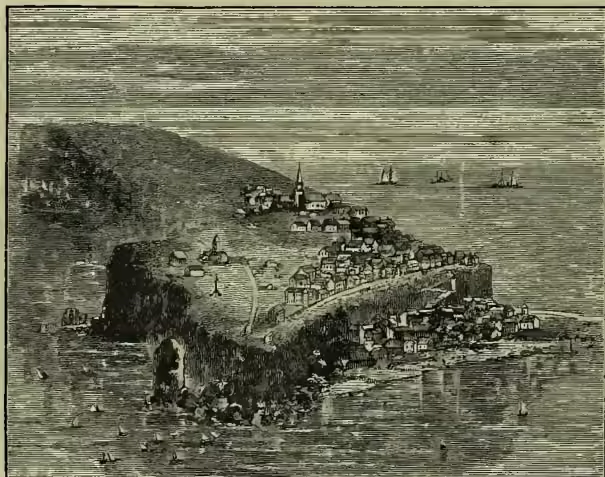
Heligoland suffices for a little pasture-land, and for growing potatoes and cabbages. There are some sheep on the island, and a few cows. Wheelbarrows are the only wheeled vehicles. The spit of the Unterland gives partial shelter to two harbours, one to the north, the other to the south. The inhabitants are supported chiefly by the lobster and other fisheries, and by the summer visitors, pilotage having almost ceased, and the public gaming-tables, established in 1830, having been suppressed in 1871. There is practically no poverty, disease, or crime, and the people are very long lived. A lighthouse stands on the cliff near the village. The island, which was taken by the British from the Danes in 1807, and was formally ceded to England in 1814, was ceded to Germany; 1st July 1890, in return for concessions made to Britain in East Africa. Heligolandish, a dialect of North Frisian, is the native tongue, but German is currently spoken. Steamboats run to and from the North Frisian islands of Sylt and Föhr, and Hamburg.—Heligoland was anciently sacred to the goddess Hertha. According to tradition, the island was once vastly larger, great tracts of country having been swallowed up by the sea between 700 A.D. and the end of the 17th century. Christianity was first preached here by St Willibrod in the 7th century, after whose time the island received its present name of Holy Land. The inhabitants of Heligoland are divided into two classes, differing both in race and occupation—the one being fishers, the other tradespeople, small shopkeepers, &c. The first are Frisians, a tall and muscular race of hardy seamen, simple and primitive in their habits, and holding land-labour and soldiers in contempt. The merchant class consists of immigrants from Hamburg and other places on the mainland, or their descendants. There is a curious and picturesque church, on the roof of which is still the Dannebrog painted by the Danish authorities when the island belonged to Denmark. The people, though they had been very loyal to Great Britain, accepted without opposition the annexation to Germany; and after a visit from the
Emperor, Heligoland was formally incorporated with the kingdom of Prussia and the province of Sleswick-Holstein. See Black's Heligoland (1888); German books by Lindemann (1889) and Lipsius (1892); and H. Gätke, Heligoland as an Ornithological Observatory (trans. 1895).—Under the early kings of Norway (10th century onwards) the name Helgeland was given to a district north of Throndhjem, extending from about 65° N. lat. to the neighbourhood of Svartisen glacier.