Hellebore, a name applied to two distinct genera of plants. The genus to which it more properly belongs, and to which it has belonged since very ancient times, Helleborus, is of the natural order Ranunculaceæ, and is characterised by a calyx of five persistent sepals, often resembling petals; a corolla of eight or ten very short, tubular, honey-secreting petals; numerous stamens and three to ten pistils; a leathery capsule, and seeds arranged in two rows. The species are perennial herbaceous plants, mostly European, generally with a short root-stock; the stem mostly leafless, or nearly so, but sometimes very leafy; the leaves more or less evergreen, lobed, the flowers terminal. A familiar example of this genus is the Black Hellebore—so called from the colour of its roots—or Christmas Rose (H. niger), a favourite in flower-gardens, because its large white flowers—which have in recent years been greatly improved by florists in point of size and purity of colour—are produced in winter. The leaves are all radical; the stalks generally one-flowered; the flowers white or tinged with red. Black hellebore formerly enjoyed a higher reputation as a medicinal agent than it now possesses. Melampus is represented as employing it in the treatment of madness centuries before the Christian era. The root is the part used in medicine, and it is imported into
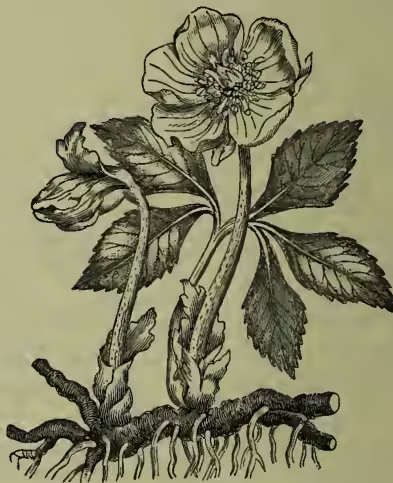
Britain from Hamburg, and sometimes from Marseilles. It consists of two parts—the rhizome or root-stock, and the fibres descending from it. The former is nearly half an inch thick, several inches long, and knotty, with transverse ridges and slight longitudinal striæ. The taste is slight at first, then bitter and acrid. It is not much employed at the present day, but it has been found of service (1) in mania, melancholia, and epilepsy; (2) as an emmenagogue; (3) in dropsy—its action as a drastic purgative, and its stimulating effect on the vessels of the liver, rendering it useful; (4) in chronic skin diseases; and (5) as an anthelmintic. Ten or fifteen grains of the powdered root act as a sharp purgative. The tincture, which is obtained by maceration in spirit, is usually given when its action as an emmenagogue is required. In an excessive dose it acts as a narcotic acid poison, and causes vomiting, purging, burning pain in the stomach and intestines, faintness, paralysis, and death.—Stinking Hellebore (H. fatidus) grows on hills and mountains in the south and west of Europe, in some of the chalk districts of England, and in several places in Scotland. It has a very disagreeable smell, and green flowers somewhat tinged with purple. The stem is many-flowered and leafy.—Green Hellebore (H. viridis), also found in the chalk districts of England, has a leafy stem, with a few large greenish-yellow flowers. The celebrated hellebore of the ancients was probably a species peculiar to Greece and the Levant, H. orientalis or H. officinalis; all the species, however, have similar medicinal qualities. From the abundance of the plant around the city of Anticyra, hypochondriacal persons were said to need a visit to Anticyra.
White Hellebore (Veratrum album) belongs to the natural order Melanthaceæ. The genus has polygamous flowers, with six-leaved perianth, six stamens, three pistils cohering at the base, a three-horned capsule separating into three many-seeded follicles, and compressed seeds winged at the apex. White hellebore has a leafy stem, sometimes 4 feet high, ovate-oblong leaves, a long terminal compound panicle, and yellowish-white flowers. It abounds in the mountains of the centre and south of Europe, but is not found in Britain. The root was once much used in medicine, but now rarely, although it seems to act powerfully in some diseases. It is a very acrid and active poison. Its powder is used to destroy lice, and by gardeners for killing caterpillars. A decoction and ointment of it are sometimes used in itch and ringworm. Caution is necessary even in handling the powder of white hellebore, and very unpleasant effects ensue from its getting into the eyes or nose.—American Hellebore, or Swamp Hellebore (V. viride), known also as Indian Poke or Itch Weed, is frequent in damp grounds from Canada to Carolina. Its root has properties similar to those of white hellebore. These properties seem to depend chiefly on an alkaloid called Veratria (q.v.).