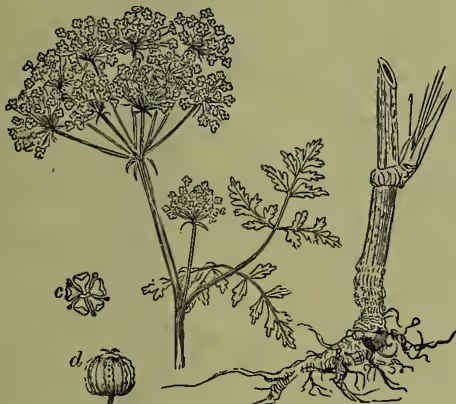
(Conium maculatum):
c, a flower; d, a seed.
Hemlock (Conium), a genus of plants of the natural order Umbelliferae, having compound umbels of small white flowers, small general and partial involucre, the limb of the calyx merely rudimentary, and a compressed ovate fruit with five prominent wavy ridges and no vitta. The best-known and only important species is the Common or Spotted Hemlock (C. maculatum), which grows by waysides, on heaps of rubbish, and in other similar situations in Britain and on the continent of Europe, in some parts of Asia, and now also as a naturalised plant in North America and in Chili. It has a root somewhat resembling a small parsnip; a round, branched, hollow, bright-green stem, 2 to 7 feet high, generally spotted with dark purple; the leaves large, tripinnate, of a dark shining green colour; the leaflets lanceolate, pinnatifid. All parts of the plant are perfectly destitute of hairs, and it is the only British species of the order Umbelliferae which has the stem smooth and spotted with purple. Both the general and partial umbels have many rays. The general involucre consists of several small leaflets, the partial involucre of three small leaflets, all on one side. The whole plant has a nauseous smell, particularly if rubbed or bruised. The leaves and fruit are the parts of the plant employed in medicine. The former should be gathered just before the time or at the commencement of flowering, and after the removal of the larger stalks they should be quickly dried by a heat not exceeding 120°. They should then be preserved in perfectly closed tin canisters. The fruit is gathered when fully developed, but still green, and should be carefully dried.
The most important ingredient in hemlock is the alkaloid conine, a volatile, colourless, oily, strongly alkaline substance, , but it also contains two other alkaloids—methylconine and conhydrine. The fruit contains about one-fifth per cent. of it, the other parts of the plant merely traces. It is obtained by distilling the seeds with water which contains a little potash in solution; the conine passes over with the water in the form of a yellowish oil, and is purified by redistillation. Conine has lately been prepared artificially by Schiff. Conhydrine, , is a solid volatile alkaloid, and is much less poisonous than conine.
Conine and methylconine are extremely poisonous, and cause death by their action on the nervous system. The action of conium depends of course on the combined effects of the active principles contained in the plant. The symptoms of conium poisoning are weakness and staggering gait, passing on to paralysis, which gradually passes up the cord until it reaches the respiratory centre, when death ensues. Dilatation of the pupil, ptosis, and asphyxial convulsions are symptoms also seen.
In medicine, it is given internally as a sedative to the nervous system in chorea, incontinence of urine, paralysis agitans, and other affections. It is also employed as a vapour to relieve cough. It may be administered internally in the form of powder (of the leaves), succus, tincture, or extract, while externally it may be applied as a soothing application to ulcers, painful piles, &c., in the form of ointment or poultice. The succus is considered the best preparation, the others often containing no active principle.
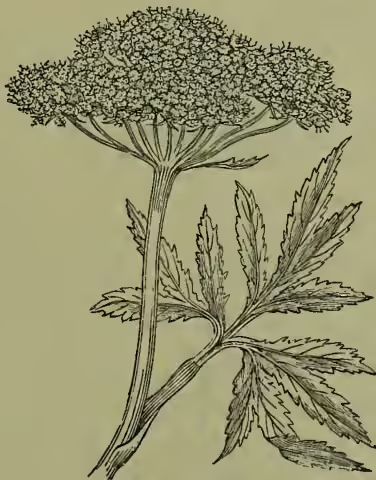
In cases of poisoning by hemlock, the evacuation of the stomach is the first thing to be attended to. Among the ancient Greeks, poisoning by hemlock was a common mode of death for condemned criminals, and thus it was that Socrates died.—Water Hemlock, or Cowbane (Cicuta virosa), is also an umbelliferous plant, of a genus having much-vaulted umbels, a five-toothed calyx, and almost globose fruit, each carpel with five broad flattened ribs and evident single vitta. Water hemlock grows in ditches, on the margins of ponds, and wet grounds in Europe and the north of Asia. It is more common in Scotland than in England. It has a large fleshy white root, covered externally with fibres; an erect much-branched stem, 2 to 5 feet high; tripinnate leaves, with linear-lanceolate regularly and sharply serrated leaflets; no general involucre, or only a single small leaflet, partial involucre of many short narrow leaflets; and white flowers. It contains an active principle, Cicutoxine, and an essential oil. It causes tetanic spasms, insensibility, vomiting, and diarrhoea. Fatal results have occurred from eating the root. Another species, C. maculata, is common in North America, growing in marshy places. It has a spotted stem, like that of true hemlock, the name of which it very generally receives in North America. The leaves are triternate, the leaflets ternate. It is a very poisonous plant, and is the cause of many deaths.—The Cicuta of the Romans was the Conium of modern botanists (Gr. koneion), as water hemlock does not grow in Italy or Greece.
The ornamental plant, the so-called Giant Hemlock, which in good rich soil reaches a height of 12 to 15 feet in three months, is not really a hemlock at all, but a giant Cow-parsnip (q.v.).