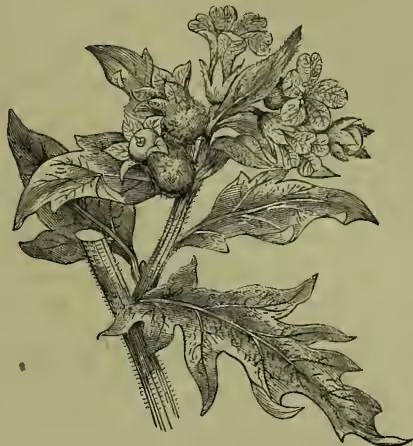
Henbane (Hyoscyamus), a genus of plants of the natural order Solanaceæ, having a five-toothed calyx, an irregular, funnel-shaped corolla, and a capsule opening by a lid and enclosed in the hardened calyx. The species are mostly annual and biennial herbaceous plants, and natives of the countries near the Mediterranean Sea. The only species found in Britain is the Common Henbane (H. niger), which is not uncommon in waste places and in the neighbourhood of towns and villages, particularly in calcareous soils, and on the sandy shores of Scotland. It is an annual plant, somewhat bushy, about 2 feet high, with large sinuated or sharply-lobed leaves without leaf-stalks, and large dingy yellow flowers with purplish veins. The whole plant is covered with unctuous hairs, and has a nauseous smell, which gives warning of its strong narcotic poisonous quality. Cases of poisoning by henbane are, however, not rare, but are more frequently owing to the proceedings of quacks than to any mistake of the plant for an esculent.
The seeds contain in largest quantity the peculiar alkaloid on which the properties of the plant chiefly depend, Hyoscyamia or Hyoscyamin, which crystallises in stellated acicular crystals of a silky lustre.
The symptoms of poisoning by henbane are similar to those produced by other narcotic poisons, and the proper treatment is the same as in cases of poisoning by opium. In medicine henbane is employed both externally and internally. The leaves are the part commonly used; they are gathered and quickly dried when the plant is in full flower. Fomentations of henbane are applied to painful glandular swellings, parts affected with neuralgia, &c., and are often found to afford relief. An extract of henbane is sometimes employed instead of belladonna to dilate the pupil of the eye. Tincture and extract of henbane are often administered in cases of annoying cough, spasmodic asthma, and other diseases requiring sedatives and antispasmodics. Henbane is also employed to calm mental irritation and to induce sleep. For many cases it has one great advantage over laudanum, in not producing constipation. The smoke from the burning seeds of henbane is sometimes introduced into a carious tooth to relieve toothache.
The other species of henbane possess similar properties. The dried stalks of H. albus are used by smoking in Greece to allay toothache.