Heredity, the organic relation between generations—especially between parents and offspring. All offspring produced by sexual reproduction, from a male and a female organism, owe half of their essential (nuclear) material to each parent. Therefore through successive generations there persists a constancy of likeness or stability of type, as expressed in the familiar saying that 'like begets like.' Besides this general resemblance between offspring and parent, there is frequently a reappearance of minute features, idiosyncrasies, and peculiar traits; yet this is not inconsistent with the occurrence of variations, which are in part due to the twofold origin of the offspring, and force us to modify the familiar saying into 'like tends to beget like.' In many cases, moreover, the offspring exhibits not only parental, but grand-parental or ancestral characteristics, which when very pronounced or remote are called 'Atavisms' (q.v.) or 'reversions.' Nor is the inheritance confined to normal characters, for diseased, pathological, or abnormal conditions of parents or grand-parents often reappear in the offspring, though this reappearance is not always due to transmission. Characteristics acquired by the parents, not as outcrops of their innate constitution, but as the results of use and disuse, or as dints from the environment, often reappear, though there is lack of evidence that they are transmitted. Finally, throughout successive generations, there is a tendency to sustain the specific average, by the continued approximation of exceptional forms towards the mean of the species.
Denials.—While a few have been so misguided by prejudice as to maintain that there was no transmission at all, and while a few have exaggerated beyond all credence the undeniable tendency of similar work and surroundings to make offspring like their parents, there is no scepticism of any importance except that which denies the trans- mission of individually acquired characters. Be it clearly understood that 'natural inheritance' is a certain fact; innate, constitutional, congenital, or germinal qualities, and the results of these in the parents, are certainly transmissible to the offspring; the disputed problem, which awaits experimental evidence, is to what degree, if any, extrinsic, functional, or environmental modifications acquired by the parents can be handed on as a legacy for good or ill to the offspring. That such acquisitions often recur is indubitable, but it is not at present certain that they recur because they have been transmitted. They may of course be the result of the action on the offspring of the same conditions as first evoked them in the parents.
Problems.—In regard to the relation between parents and offspring, there are three great problems to be discussed. What is the peculiarity of the germ-cells which enables them (in most cases after uniting as male and female elements) to develop into organisms essentially like the parents? Granting that the germ-cells are in some respects unique when compared with the ordinary cells of the 'body,' granting that the fertilised egg is in some sense a potential organism, how are we to think of the mechanism of development by which the specific type is reconstructed? Thirdly, what is the probable truth, or present state of opinion, in regard to the transmission of acquired as opposed to constitutional or germinal characters? In addition to these three great problems of individual inheritance, there are minor questions in regard to atavism, reparation of injuries, and the like, detailed practical inquiries as to the inheritance of disease, and, widest of all, those problems of social inheritance which concern the relation between large fraternities of the human species through successive generations.
Mystical Theories.—Theories of heredity, like those of many other facts, have been expressed in three sets of terms—theological, metaphysical, and more or less scientific. The ancient hypotheses, that germs were possessed and controlled by spirits, gave place to theories which invoked 'principles of heredity' and 'formative forces,' and these in turn have been displaced by more concrete conclusions. Of most historical importance are the so-called 'mystical' or 'preformation theories,' according to which the male or female germ contained a miniature model of the future organism, and indeed of succeeding generations as well, while the development was merely a gradual unfolding or literal 'evolution.' We still believe of course that the fertilised egg is a potential organism, and that it has great complexity within its apparent simplicity, but the researches of the founders of embryology were enough to show that no miniature models existed, and that development was anything but the unfolding of a bud. See EMBRYOLOGY.
Pangenesis.—Many naturalists have attempted to explain the uniqueness of the germs or germ-cells by regarding them as concentrations of units collected from the various structures of the body. The hypothetical process by which these units are given off from the various organs, travel to the seat of the germs, and are there accumulated to reproduce in the embryo structures like those whence they originated, is termed pangenesis. At such different epochs as are suggested by the names of Democritus and Hippocrates, Paracelsus and Buffon, pangenetic theories were advanced. The first clear theory, however, was that of Spencer (1864), who suggested the existence of 'physiological units,' derived from and capable of development into cells, and supposed their accumulation in the reproductive elements. But the best-known form of the theory is Darwin's 'provisional hypothesis of pangenesis' (1868), according to which (a) every cell of the body, not too highly differentiated, throws off characteristic gemmules, which (b) multiply by fission, retaining their peculiarities, and (c) become specially concentrated in the reproductive elements, where (d) in development they grow into cells like those from which they were originally given off. Somewhat later (1876) the ingenious Jäger sought to replace Darwin's gemmules by characteristic 'scent-stuffs,' which were collected from the body into the reproductive elements; he suggested, in other words, what may be called chemical pangenesis. Meanwhile (1872) Galton had been led by his experiments on the transfusion of blood and by other considerations to the conclusion that 'the doctrine of pangenesis, pure and simple, is incorrect.' While reaching forward to something better, he still allowed a limited pangenesis to account for those cases which suggest at least that acquired characters are 'faintly heritable.' He admitted that a cell 'may throw off a few germs [i.e. gemmules] that find their way into the circulation, and have thereby a chance of occasionally finding their way to the sexual elements, and of becoming naturalised among them.' In 1883 Professor W. K. Brooks proposed an important modification of Darwin's theory, especially insisting on the following three points: that it is in unwonted and abnormal conditions that the cells of the body throw off gemmules; that the male elements are the special centres of their accumulation; and that the female cells keep up the general resemblance between offspring and parent. For criticism of the numerous suppositions involved in the various theories of pangenesis, the reader is referred to the works of Galton, Ribot, Brooks, Herdman, Plarre, De Vries, and others (see bibliography); it is enough for our purpose to notice, in the light of the next step of progress, the comparative gratuitousness of any such special theories.
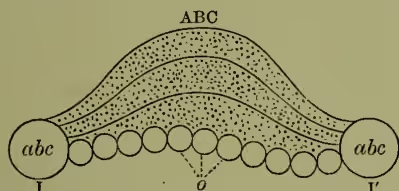
Fact of Continuity.—As far back as 1849 Owen pointed out that in the developing germ it was possible to distinguish between those cells which became much changed to form the 'body,' and those which remained virtually unchanged and formed the reproductive organs. The same distinction was emphasised by Haeckel and by Rauber, while Jäger expressed his views very explicitly as follows: 'Through a great series of generations the germinal protoplasm retains its specific properties, dividing in development into a portion out of which the individual is built up, and a portion which is reserved to form the reproductive material of the mature offspring.' This reservation, by which the germinal protoplasm is sheltered from external or corporeal influences, and retains its specific and embryonic characters unchanged from the parent ovum, Jäger called by a now famous phrase 'the continuity of the germ-protoplasm.' Brooks (1876, 1877, 1883) was not less clear: 'The ovum gives rise to the divergent cells of the organism, but also to cells like itself. The ovarian ova of the offspring are these latter cells, or their direct unmodified descendants. The ovarian ova of the offspring thus share by direct inheritance all the properties of the fertilised ova.' In the same way Galton (1872, 1875), using the term 'stirp' to express the sum total of germs, gemmules, or organic units of some kind in the fertilised ovum, maintained that a certain residue is kept apart from the development of the body, to form the reproductive elements of the offspring. The history must also include Nussbaum, who likewise called attention to the very early differentiation and isolation of the sex-elements to be observed in the development of some animals. The general notion independently suggested by the above naturalists is simple enough. At an early stage in the development of the embryo the future reproductive cells of the organism are distinguishable from those which are forming the 'body.' The latter develop in manifold variety, and soon lose almost all likeness to the fertilised ovum. The former—the reproductive rudiments—are not implicated in the up-building of the 'body,' remain virtually unchanged, and continue the protoplasmic tradition unaltered so as to start a new organism on the same lines—i.e. with the same protoplasmic material. It is evident that a fertilised egg-cell with certain characters, a, b, c, will develop into an organism in which these characters a, b, c are variously expressed; but if at an early stage certain cells are set apart, retaining the characters a, b, c in all their entirety, then these will be on the same footing as the original fertilised egg-cell, able like it to give rise to an organism, and necessarily to a similar organism. This explanation of heredity is at once so simple and so satisfactory that it becomes a most important question to determine how far the above facts are actually true among plants and animals. The answer is that they are as yet demonstrable only in a minority of cases. Thus, it is true that an early appearance or insulation of reproductive cells, materially continuous and presumably identical with the ovum itself, has been observed in some worm-types (leeches, Sagitta, thread-worms, Polyzoa), in some Arthropods (e.g. Moina among Crustaceans, Chironomus among Insects, Phalangidae among Arachnids), and with less distinctness in a number of other organisms. But it must be distinctly allowed that in most cases it is only after development has progressed for some time that the future reproductive cells make their distinct appearance. Therefore, if distinct cellular continuity be only demonstrable in a minority, it becomes necessary to modify the generalisation. The required modification is due to Weismann, whose theory must be briefly stated. (1) A small portion of the effective substance of the fertilised egg-cell remains unchanged during the development, and serves as a foundation from which the germ-cells of the new organism are produced. (2) This important substance—the 'germ-plasma'—which keeps up continuity from one generation to another, is part of the nucleus, possesses an exceedingly complex minute structure, but has great stability, for it absorbs nourishment and grows enormously without the least change in its molecular constitution. (3) But while part of this special nuclear substance or germ-plasma of the egg-cell is reserved unchanged for the formation of the germ-cells of the resulting organism, part of it is changed into the nuclei of the ordinary body-cells, where, however, it sometimes retains enough of its original efficiency to be able to repair serious injuries or start the development of a new organism in asexual reproduction. Weismann has given a more complete expression to the fact of the continuity of generations than has hitherto been proposed, but it cannot be denied that there is much that is entirely hypothetical about the 'germ-plasma' and its history. For thorough exposition, reference must be made to his translated papers, and for detailed criticism to works cited in the bibliography.
We may further notice an important work by H. de Vries (1889), which seeks to combine the fact of continuity with part of the theory of pangenesis. He maintains that every characteristic of the organism is represented by a special 'pangene,' and that the germ-cells contain samples of all. This pangenetic accummulation in the germ-cells is not, however, the result of contributions traveling from the various parts of the body, but is the result of a definite, more or less direct continuity between the germ-cells and the fertilised ovum which started the organism to which they belong.
Theories of Continuity.—It can hardly be doubted that in the more or less direct continuity between the successive sets of reproductive products lies the solution of the main problem of heredity. The germ-cells which give rise to offspring are unique in their continuity with those which gave rise to the parents and it is this continuity or the involved sameness of material which explains the production of like by like. In the simplest animals or Protozoa, organism A buds and hands on a fraction of its living matter to A1, which, being so really part and parcel of A, must grow up into a similar adult Protozoan. With higher animals the same holds true, though the continuity, as expressed in
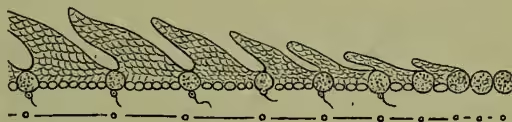
The continuous chain of dotted cells at first represents a succession of Protozoa; further on, it represents the ova from which the 'bodies' (undotted) are produced. At each generation a spermatozoon fertilising the liberated ovum is also indicated. the figure, is less direct. At various levels of analysis suggestions have been made which attempt to render the fact of continuity more luminous. Thus, Professor Hering and Samuel Butler suggested about the same time a psychical aspect of hereditary continuity, according to which memory is regarded as a general function of organised matter, and the reproduction of parental likeness as due to an unconscious recollection of the past. Haeckel also emphasised the luminous metaphor of 'organic memory,' but sought to express this in terms of molecular motion. The invisible activity of the organic molecules he compares to a complex wave-motion, harmonious and persistent from generation to generation, though capable of incorporating the results of fresh experience. The periodic wave-motion of the molecules he describes characteristically as 'the perigenesis of the plastidules.' In metaphorical language, the molecules remember or persist in the rhythmic dance which they have learned. Most naturalists, however, have been content to express the continuity in terms of the cells or of the nuclei, or of yet smaller elements. Galton and Jäger, Brooks and Nussbaum, Hertwig and Herdman, Nägeli and Weismann, and others have all contributed to making the fact of continuity more precise. Hopeful also are the suggestions of Jäger, Bertold, Gautier, and Geddes, which make towards a chemical expression of the continuity between germ and germ. Within present limits it is impossible to criticise any of the above elaborations. Behind all the suggestions, whether of 'organic memory,' 'persistent wave-motion,' 'stable germ-plasma,' or 'constancy of chemical processes,' there stands the great fact of the real continuity of generations.
The Problem of Reconstruction.—How is it that the germ-cell divides and redivides as it does, and how does the development of the embryo retain its architectural constancy? Part of the answer has just been given: because the germ is virtually continuous with, and made of the same stuff as, the parent germ; therefore it must behave in precisely similar fashion. The rest of the answer involves difficulties which cannot fairly be laid on the shoulders of students of heredity, but belong to that most intricate of problems, the mechanics of development. Referring to the article EMBRYOLOGY for notice of some of the pioneer investigators of this problem, we can do little more than reiterate the caution of Professor His: 'To think that "heredity" will build up organic beings without mechanical means is a piece of unscientific mysticism.' We must also protest against the careless diction which makes 'heredity' now into a 'principle' and again into a 'power,' which calls it sometimes a 'law' and next time a 'cause.'
Inheritance of Acquired Characters.—Changes or variations in an organism may be roughly referred to three origins: (a) they may be the results of external or environmental influence; (b) they may be the outcome of use and disuse, or of functional increase or decrease; or (c) they may be due to internal, constitutional, or germinal conditions, of which one of the most important is the mingling of two different kinds of living matter in the fertilisation of the egg-cell. It is granted by all that an individual plant or animal may exhibit these three kinds of variation—environmental, functional, and organismal; and it is also true that the majority of naturalists have till recently believed that an individual gain or loss from any of the above origins might be transmitted from parent to offspring. Now, however, there is a widespread scepticism as to the inheritance or transmission of any but organismal, congenital, or germinal variations. This scepticism, mainly emphasised by Weismann, and now prevalent among naturalists, is by no means novel. The editor, whoever he was, of Aristotle's Historia Animalium seems to have differed from his master as to the inheritance of injuries and the like. Kant also maintained the non-inheritance of extrinsic variations, and Blumenbach cautiously inclines to the same negative position. In more recent times, His expressed a strong conviction against the inheritance of acquired characters, and Pflüger is also among the sceptics. A few sentences from Galton (1875), whose far-sightedness has been insufficiently acknowledged, may be quoted. The inheritance of characters acquired during the lifetime of the parents 'includes much questionable evidence, usually difficult of verification. We might almost reserve our belief that the structural cells can react on the sexual elements at all, and we may be confident that at the most they do so in a very faint degree—in other words, that acquired modifications are barely, if at all, inherited in the correct sense of that word.' Weismann, however, has brought the discussion to a climax. He goes even further than Galton in scepticism as to the inheritance of acquired characters, for he denies that any such transmission occurs. This denial is in part justified by the absence of experimental evidence to the contrary, but it is also suggested by Weismann's theory of continuity. For if a portion of the germ-plasma of a fertilised ovum is preserved unchanged during development to form the rudiments of the reproductive cells of the new organism, and if the germ-plasma is as stable as Weismann makes out, then there is a strong probability that no variations produced in the body by use or disuse or by outside influences can be transmitted. For they could only be transmitted by affecting the germ-cells, and this is a possibility which Weismann denies. He makes, however, two admissions: (a) that the germ-plasma may be slightly modified by changes of nutrition and growth in the body, and (b) that external conditions such as climate may influence the germ-cells along with, though not exactly through, the body-cells. These admissions are of course different from the once prevalent opinion that changes in the body were able to affect the germ-cells, and thus become transmissible, though it may be questioned whether the two saving clauses which Weismann allows are not sufficient to damage seriously the stringency of the conclusion on which he insists throughout—that no acquired characters are transmissible.
If this conclusion be true, then the influences of function and environment on the body of an organism affect the individual only, not the species. They have therefore no evolutionary value; the source of variation and the origin of adaptations must be sought elsewhere. To Weismann the sole source of evolutionary change is the intermingling of germ-plasma which occurs in fertilisation, and the condition of progress is found in the action of natural selection on the germinal variations which thus arise. There are, however, evolutionists who regard species as the necessary results of persistent variation in some definite direction, 'according to the laws of organic growth,' 'according to the conditions of protoplasmic change,' 'according to the opposition between nutrition and reproduction,' and so on. Those who take this view, even if they admit Weismann's conclusion about acquired characters, will not find it necessary to lay the entire burden of progress on the shoulders of natural selection.
As Weismann's conclusion that acquired characters are not transmitted is one of vast importance both theoretically and practically, it is necessary to notice some of the counter arguments. (a) There are very numerous cases on record where the effects of mutilation are said to be inherited, but it must frankly be allowed that no case is known which is not open to serious objection. Circumcision has a very ancient origin, but its effects on the Jewish race are imperceptible; while the same is true of mutilations inflicted for many generations on domesticated animals. And even the numerous cases of tailless kittens produced from artificially curtailed cats have little cogency in face of the fact that tailless sports may also arise from normal parents. (b) Various pathologists have brought forward instances of what appeared to them to be the transmission of acquired disease, but their arguments, as in the case of Virchow's, have evidenced misunderstanding as to Weismann's real position. There is no doubt that many malformations and weaknesses appear through numerous generations, but there is no evidence that such variations were not to start with germinal. If so, Weismann of course admits their transmissibility. Colour-blindness has been known to occur in the males only of six successive generations, deaf-mutism for three, finger-malformations for six, and so with harelip and cleft-palate, and with tendencies to consumption, cancer, gout, rheumatism, bleeding, &c. But none of these prove the transmission of characters acquired by use or disuse, or impressed by the action of surroundings. (c) Various naturalists have brought forward what appear to them to be examples of the genuine transmission of individually acquired characters. Thus, Detmer and Hoffmann among botanists, and Eimer among zoologists, may be quoted. Even the title of Eimer's recent work, The Origin of Species, on the Basis of the Inheritance of acquired Characters, according to the Laws of Organic Growth, shows how far he is from giving up the case. It must be confessed, however, that, in default of fresh experiments, cogent evidence to negative Weismann's scepticism is still wanting, though some suggestive arguments in support of the old-fashioned belief in the inheritance of acquired characters are forthcoming, especially perhaps in connection with instinct and the growth of intelligence. (d) Another mode of argument often adopted against Weismann's conclusion is to shift the ground to the study of evolution, and there to demonstrate steps of progress which seem to many inexplicable on Weismann's sole formula of natural selection acting on variations produced by the intermingling of male and female germ-plasmas in fertilisation. (e) Finally, it may be urged that the unity of the organism, the connectedness of its elements, the common medium of the blood, and other facts make it difficult to believe that the germ-plasma can live on in the reproductive organs, unchanged by any of the deep environmental and functional variations which sometimes modify the structure of the body. Those who seek to maintain the transmission of some acquired characters have obviously to submit their cases to all the stern criticism which Weismann's valuable work involves. But if such cases be proved, it need not, of course, lead to any departure from some form of the doctrine of continuity, on which Weismann has so well insisted, nor to a return to the supposition of travelling 'pangenes.' It does not affect the theory of continuity to admit that decisive variations produced by environment or function may send their roots deep into the system, penetrating through the body to the reproductive cells themselves. Such cases are confessedly at present dubious, but there is no a priori reason why the sex-cells should not share in the results of altered nutriment and waste products, and even become saturated or infected by the characteristic chemical results of environmental and functional variations.
Social Aspects.—All the important biological conclusions, such as that of germinal continuity, or the fact that the two parents contribute almost equal shares to the starting of the offspring, and also the scepticism about the transmission of acquired characters, have an obvious human interest. The first result enables us to realise that the germ is virtually as old as the parent, and that
Fig. 3.
, the bodies of successive generations; , the germ-cells between which the real continuity obtains. the main line of hereditary connection is not that between parent and child, but 'that between the sets of elements out of which the personal parents had been evolved, and the set out of which the personal child was evolved.' 'The main line,' Galton says, 'may be rudely likened to the chain of a necklace, and the personalities to pendants attached to the links.' To this fact social inertia is largely due, for the organic stability secured by germinal continuity hinders evolution by leaps and bounds, either forwards or backwards. That a good stock is pre-eminently valuable is an obvious truth. The fact that each parent contributes almost equally to the offspring emphasises the two-sided responsibility of parentage; but the fact has to be corrected by Galton's statistical conclusion that the offspring inherits a fourth from each parent, and a sixteenth from each grand-parent. Inherited capital is thus not merely dual, but multiple, like a mosaic. Again, if we believe with Weismann that no acquired characters are inherited, we are saved from the despair which the abnormal functions and environments of our civilisation are apt to suggest. But if the influences of function and environment do not readily become entailed or ingrained, we are all the more urged to practical action, which will secure improved conditions of life for each successive crop of individuals.
The fact that pathological conditions innate or congenital in an organism certainly tend to be transmitted suggests that popular opinion should be informed and educated as to undesirability of parentage on the part of abnormal members of the community. All congenital malformations and defects due to germinal faults tend to be transmitted, and the list includes not a few of evident practical importance, such as poverty of teeth, abnormal fingers, harelip and cleft-palate, and defective sense-organs. Still more important, however, are congenital or constitutional, as opposed to acquired, diseases. Certain forms of insanity and diseases of the nervous system and sense-organs, deaf-mutism, colour-blindness, gout; muscular weakness, unusual liability to certain contagious diseases, tendencies to consumption, cancer, and dipsomania, are illustrations from a long list of inheritable diseases or weaknesses. Some diseases are transmissible with greater probability than others—i.e. in a larger percentage of cases; some appear to take a firmer grip of the constitution, and may persist for many generations, while others are more readily counteracted or 'washed out' by hygienic régime or by intercrossing; some are transmitted along tolerably constant lines—e.g. father, daughter, grandson—i.e. in alternate sexes, or father, son, grandson—i.e. along similar sexes, while others are quite irregular in their occurrence. In reference to lines of transmission, Galton is inclined to conclude that 'the female influence is inferior to that of the male in conveying-ability.' In the case of a disease like consumption, which decimates our British population, it ought to be noted that in about 50 per cent. of cases it is individually acquired, not inherited; that, as the disease is bacterial, only a consumptive tendency at most is transmitted; that, even when the phthisis 'runs in families,' its propagation is sometimes due to maternal or other infection; that environmental conditions, such as the nature of the soil, seriously affect its frequency; that, with care in regard to climate, surroundings, diet, exercise, &c., even children with a consumptive tendency may rejoin the healthy stock. None the less is it inadvisable that consumptives should be parents, least of all along with other consumptives. Allowing, again, for the undeniable influences of early nutrition, upbringing, and surroundings, all authorities admit that dipsomania or its results tend to be transmitted, often with the final consequence of extinguishing the family. Yet, in regard to the inheritance of pathological conditions, it ought to be noticed (a) that Virchow and others have hinted at an 'optimism of pathology,' since some of the less known abnormal variations may be associated with new beginnings not without promise of possible utility; (b) that, by the intercrossing of a tainted and a relatively pure stock, a recuperative or counteractive influence may act so as to produce comparatively healthy offspring, thus illustrating what may be called the 'forgiveness of nature.'
Social Inheritance.—The widest problems of heredity are raised when we substitute 'fraternities' for individuals, or make the transition to social inheritance. For lack of reliable statistics, and experts capable of wielding the statistical method, the complex problems of the relation between successive generations of a society have rarely been essayed. The most important pioneering is that of Galton, whose unique papers have been recently summed up in his Natural Inheritance (1889), a work which, in its emphatic transition from the study of individuals to that of fraternities, well illustrates that science is indeed 'a social phenomenon.' Galton derived his data from his well-known Records of Family Faculties, especially concerning stature, eye-colour, and artistic powers; and his work has been in great part an application of the statistical law of Frequency of Error to the above-mentioned records. If we leave out of account the problem of estimating the share contributed to the offspring by each ancestor, and that of determining accurately the degrees of near kinship, the great problem of Galton's work relates to the curious regularity observed in the peculiarities of great populations during a long series of generations. 'The large do not always beget the large, nor the small the small; but yet the observed proportion between the large and the small, in each degree of size and in every quality, hardly varies from one generation to another.' In short, a specific average is sustained. This is not because each individual leaves his like behind him, for this is certainly not the case. It is rather due to the fact of a regular regression or deviation which brings the offspring of extraordinary parents in a definite ratio nearer the average of the stock. A few sentences must be quoted to explain this 'law of regression' which Galton has established. 'However paradoxical it may appear at first sight, it is theoretically a necessary fact, and one that is clearly confirmed by observation, that the stature of the adult offspring must on the whole be more mediocre than the stature of their parents—that is to say, more near to the median stature of the general population.' Or again, 'each peculiarity in a man is shared by his kinsmen, but on the average in a less degree. It is reduced to a definite fraction of its amount, quite independently of what its amount might be. The fraction differs in different orders of kinship, becoming smaller as they are more remote.' Yet it must not be supposed that the value of a good stock is denied or underestimated by Galton, for he shows how the offspring of two ordinary members of a gifted stock will not regress like the offspring of a couple equal in gifts to the former, but belonging to a poor stock, above the average of which they have risen. Yet it is true that the fact of regression tells against the full hereditary transmission of any signal talent. Children are not likely to differ from mediocrity so widely as their parents. 'The more bountifully a parent is gifted by nature, the more rare will be his good-fortune if he begets a son who is as richly endowed as himself, and still more so if he has a son who is endowed more largely.' The other aspect of the case must not, however, be overlooked. 'The law,' Galton says, 'is even-handed; it levies an equal succession-tax on the transmission of badness as of goodness. If it discourages the extravagant hopes of a gifted parent that his children will inherit all his powers, it no less discourages extravagant fears that they will inherit all his weakness and disease.'
The study of individual inheritance, as in Galton's Hereditary Genius, may tend to develop an aristocratic and justifiable pride of race when a gifted lineage is demonstrable for generations, or it may tend to absolute despair if the records of family disease be subjected to investigation. The study of social inheritance is at once more democratic and less pessimistic. The nation is a vast fraternity, with an average towards which the descendants of all nobles gradually tend, but to which the offspring of the under-average will also approximate. It seems a corollary that practical measures which beneficially affect large numbers are more hopeful than those which artificially select a few. It should be noticed also that, if Weismann's scepticism be thoroughly justified, it by no means leads us to depreciate the effect of work and surroundings, but emphatically increases the urgency of conserving healthful function and stimulating environments of every kind—all the more important if their influences must needs be repeated on each fresh generation. Nor should one forget how much a plastic physical and mental education (along with which M. Guyau includes hypnotic suggestion) may do to counteract disadvantageous inherited qualities, or augment those which are beneficial. Finally, it will be allowed that much requires to be done in educating public opinion, not only to recognise the results of the science of heredity, but also to admit the value and necessity of the corresponding art which Mr Galton calls 'eugenics.'
See BIOLOGY, EMBRYOLOGY, ENVIRONMENT, EVOLUTION, &c. For bibliography, J. Arthur Thomson, 'History and Theory of Heredity,' Proc. Roy. Soc. Edin. (1889); E. Roth, Die Thatsachen der Vererbung (2d ed. Berlin, 1885). See also W. K. Brooks, The Law of Heredity (Baltimore, 1883); S. Butler, Life and Habit (Lond. 1878); C. Darwin, Variation under Domestication (Lond. 1868); G. H. T. Eimer, Die Entstehung der Arten (Jena, 1888); F. Galton, Natural Inheritance (Lond. 1889; and his other works there noticed); E. Haeckel, Generelle Morphologie (Berlin, 1866), Die Perigeneisis der Plastidule (Berlin, 1876); W. A. Herdman, Philos. Soc. Liverpool (1883); E. Hering, Das Gedächtniss als eine allgemeine Funktion der organischen Materie (Vien. 1870); O. Hertwig, Lehrbuch der Entwicklungsgeschichte (Jena, 1888); W. His, Unsere Körperform (Leip. 1875); G. Jäger, Zoologische Briefe (Vien. 1876; Kosmos, 1877, 1879); Zeitschr. wiss. Zool. xxvii.; Lehrbuch der Zoologie (Leip. 1878); Prosper Lucas, Traité philosoph. et physiol. de l'Hérédité naturelle (Paris, 1847; the first serious treatise on heredity); C. Nägeli, Mechanisch-physiolog. Theorie der Abstammungslehre (Munich, 1884); Th. Ribot, L'Hérédité psychologique (3d ed. Paris; trans. Lond. 1875); H. Spencer, Principles of Biology (Lond. 1866); R. Virchow, Descendenz und Pathologie; Virchow's Archiv. ciii. (1886); H. de Vries, Intrazellulare Pangenesis (Jena, 1889); A. Weismann, Papers on Heredity (1882-1889; trans. Oxf. 1889). For pathological inheritance, see, conveniently, Felkin, 'Heredity in Health and Disease,' Health Lectures (Edin. 1887); R. A. Douglas Lithgow (Lond. 1889); Windle, 'Malformations and Heredity,' Proc. Birmingham Phil. Soc. (1888). For heredity in relation to education, see M. Guyau, Éducation et Hérédité (Paris, 1889). For social inheritance, see Galton's Hereditary Genius and Natural Inheritance. For critiques of Weismann, see Eimer, Virchow, opp. cit.; Spencer, Factors of Organic Evolution (1886); M'Kendrick, General Physiology (1888); Vines, Turner, and Mivart in Nature, vols. xl. and xli. See also Weismann, The Germ-plasm, a Theory of Heredity (1893), and the articles VARIATION, WEISMANN.