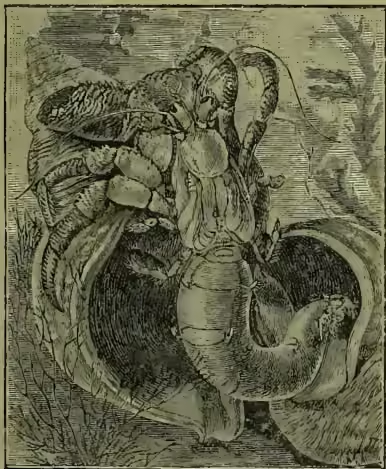
Hermit-crab, a name applied to the members of a family of crustaceans (Paguridae), notable for their habit of sheltering themselves in gasteropod shells, and for the soft-skinned and generally unsymmetrical tail, probably in part the cause and in part the consequence of this curious custom. The eyes are borne on long stalks; the great claws are very large and generally unequal, one being used to close the entrance of the shell into which the hermit can wholly retract himself; the abdominal appendages are practically aborted, with the exception of those at the tip of the tail, which hold so firmly on to the spire of the inhabited shell that it is difficult to pull out the crab unbroken. There are a great many different kinds of hermit-crabs, and these utilise many forms of gasteropod shell, not always keeping constant to one type of house. The commonest species (Pagurus or Eupagurus bernhardus) is usually found tenanted the shells of the whelk (Buccinum); while another very common species (P. or E. prideauxii) may be found inside shells of Fusus, Murex, Cancellaria, Turbo, Buccinum, &c., and is also very interesting as an illustration of partnership or Commensalism (q.v.) with a species of sea-anemone which forms a cloak round the shell. It masks the hermit-crab, and may also be useful on account of its stinging-cells, while the hermit-crab repays the anemone by carrying it about, and doubtless also with debris of food (for illustration, see ANEMONE). This habit of helpful partnership has been observed even in Pagurus abyssorum from a depth of 3000 fathoms. As hermit-crabs grow they have not only to cast their own armature in the usual crustacean fashion, but they must periodically shift to a successively larger and larger house. In looking out for a new shell to tenant hermit-crabs are naturally in a hurry, being then in a position of defencelessness unusual for them; and it has been observed that they do not always seek for an empty mollusc shell, but may evict the rightful owner of one which strikes their fancy. The common hermit-crabs feed on molluscs and animal debris. They are most interesting inmates of aquaria, but their voracity is very apt to reduce the population.
Some of the deep-sea hermit-crabs, brought up by the Challenger, Blake, and other explorations, are of much interest, especially perhaps inasmuch as several retain the symmetry which the more familiar forms tenanted spiral shells have lost. As such shells are rarities at the bottom of the deep sea, some of the hermits retain the doubtless original free life. Such is Tylaspis anomala, from the south Pacific at a depth of 2375 fathoms, which has a very much shortened abdomen, with distinct segments, however, and well-developed symmetrical appendages. From the West Indies the Blake obtained Pylocheles agassizii, living in straight tubes of compacted sand, and quite symmetrical. Even more interesting is the symmetrical Xylopagurus rectus, living at depths of 300 to 400 fathoms, in open tubes of wood or bamboo-stem, into which the animal retreats head foremost, and guards the opening with firm plates on the end of the tail.
The members of the genus Cenobita, from the shores of the Indian Ocean and other warm seas, live in all sorts of houses, including the shells of marine gasteropods (Murex, Purpura, &c.), of landsnails, of sea-urchins, or even nuts. One species, Xylopagurus rectus in its case (a) and free (b). C. rugosa, is famous for its fondness for cocoa-nuts, and for its excursions ashore. In another genus, the robber hermit-crab (Birgus latro), from the West Indies, lives in holes in the earth under trees, has an almost lung-like modification of the gill-cavity for breathing air directly, yet visits the sea periodically by night. It feeds on cocoa-nuts, though it does not climb for them, and is itself eaten in Amboyna and elsewhere. Darwin has graphically described how it tears the husk from the cocoa-nuts, and hammers on the round depressions at one end until entrance is effected. Out of a biscuit-box, the lid of which was fastened down with wire, a robber-crab made its escape, actually punching holes in the tin and turning down the edges.
See COMMENSALISM, CRAB, CRUSTACEA; J. R. Henderson, Challenger Report on Anomura; Agassiz, Voyage of the Blake; Marshall, Das Tiefsee und ihr Leben (Leip. 1888); and Darwin, Voyage of the Beagle (Lond. 1845).