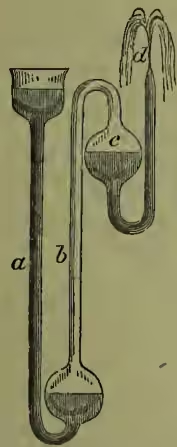
Hero OF ALEXANDRIA (Gr. Herōn), a great mathematician and natural philosopher, was a pupil of Ctesibius, and flourished about 100 or 150 B.C. He seems to have invented a great number of machines and automata, among which are Hero's fountain; a steam-engine on the same principle as Barker's mill; a double forcing-pump used for a fire-engine, and various other similar applications of air and steam. Among his works which have come down to us the most notable is on Pneumatics; Hultsch edited the remaining fragments of his geometrical works in 1864.—Another Hero, called Hero the Younger, who wrote on mechanics and astronomy, long had the credit of writing some of his namesake's books. According to some authorities he flourished at Alexandria in the 7th century A.D.; according to others, at Constantinople in the 10th.—HERO'S FOUNTAIN is a pneumatic apparatus, through which a jet of water is supported by condensed air. A simple mode of constructing it by means of glass tubes and a glass-blower's lamp is shown in the annexed figure. The column of water in the tube a compresses the air in b; this presses on the surface of the water in c, and causes it to gush out at d.