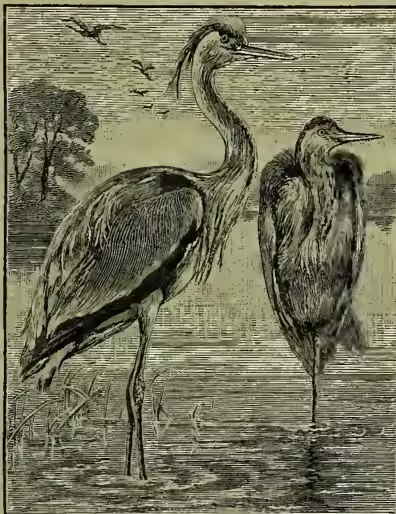
Heron, a genus (Ardea) and family (Ardeidæ) of birds of the order Herodiones. The Herodiones (which includes also the families of storks, spoon-bills, and flamingoes) are large birds covered with long loose down, with large wings, and a hard horny bill longer than the head, compressed from side to side, and united to the skull by firm broad bones. The Ardeidæ are distinguished from the other families by their large hind-toe, which rests on the ground and has a large claw equal in size to the claw of the middle toe, and by the inner margin of the middle toe having a pectinated or comb-like structure. The family comprises five genera—the Herons (Ardea), the Night Herons (Nycticorax), the Bitterns (Botaurus), the Boatbills (Cancroma), and the Tiger-bitterns (Tigrisoma). In the Heron genus—which includes the species commonly known as Egrets—the plumage is beautiful, but seldom exhibits very gay colours, white, brown, black, and slate, finely blended, generally predominating. The body is small in proportion to the length of the neck and the limbs. The neck is usually curved. See the article FLYING (with illustration) for the position of the neck, wings, &c. in flight—when the long legs are carried straight out, projecting like a tail. Herons are very voracious, feeding mostly on fish and other aquatic animals; but they also often prey on snakes, frogs, rats, and mice, and the young of other birds. They are usually shy, solitary birds, going about singly, but at nesting-time congregating in numbers, possibly more from community of purpose than from the true gregarious instinct. The Common Heron (Ardea cinerea) measures about three feet from the point of the bill to the tip of the tail. It is of a delicate gray colour on the upper parts, the quill-feathers are black, the tail of a deep slate colour, and the long plume is glossy dark. It generally builds its nest on a high tree; and as many as eighty nests have been counted on a single oak. Though in the days of falconry, when it was the chief game pursued, it was highly prized for the table, the common heron is now the object of almost universal hostility. Its geographical distribution is wide, extending from Britain to the countries of northern and southern Europe, being most plentiful in Holland, extending into northern Africa, Caucasus, India, Japan, and Java.—The Purple Heron (A. purpurea) is a somewhat rare British species.—The Great White Heron or Great Egret (A. alba), an extremely beautiful bird with perfectly white plumage, much of it loose and flowing, is an accidental visitor to Britain. It is more common in Turkey and Greece and in some parts of Asia, where its upper tail coverts are much worn as plumes.—The Little Egret (A. garzetta), a smaller copy of the great egret, and frequenting the same localities, is about two feet long, and rather quicker in flight than the larger species.—The Buff-backed Heron (A. aquinoctialis) of southern Europe is an insect feeder, and by no means so shy as other species.—America has many species of herons, most numerous in its warmer parts. A common species of the temperate parts is the Green Heron (A. virescens), whose flesh is much esteemed. Other important species are the Great Blue Heron (A. herodias), the Great White or Florida Heron (A. occidentalis), the Great White Egret (A. egritta), and the Little White Egret (A. candidissima).—The Peacock Heron (A. helias) of South America, a small heron of exquisitely graceful shape and mien, with plumage variegated with coloured spots and bars, is a favourite pet-bird of the Brazilians.