Hessian Fly (Cecidomyia destructor), a dipterous insect, which in its larval state is one of the most important crop-pests, attacking stems of barley, wheat, and rye. The eggs are usually laid on the leaves twice a year, in May and September, and the larvæ, which hatch in a fortnight, bore into the stem, suck the juices, and destroy the plant. The larvæ turn to pupæ in the end of July, or in spring, and thence the flies develop in about ten days. The egg is very minute, about th of an inch, and pale red towards hatching. The larva or maggot has a shining, oval body, white or yellowish, with a soft fleshy head and twelve segments.
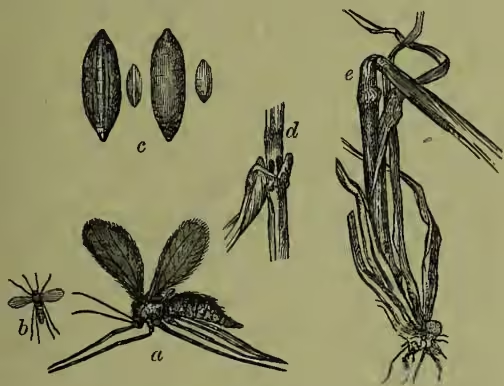
The mouth parts are very delicate, but near the hind end is a chitinous 'anchor process,' which is probably used as a digger or scraper. The pupa-cases, which are called 'flax-seeds,' are about th of an inch in length, of a long oval shape, and of a brownish or chestnut colour. The fly itself is a little stout-made black and brown gnat, about th of an inch in length.
The fly was first known as a scourge in North America during the years 1786 and 1789, and owes its name to the erroneous supposition that it was imported by the Hessian troops, mercenaries of Great Britain. In England it appeared in 1788, and was described by Sir Joseph Banks. 'It is now known to exist in the south of France, Austria, Hungary, and southern Russia, and its original habitat is considered most probably to have been southern Europe and western Asia.' In 1886 it occurred in Britain, and in some districts is said to have caused a loss of several bushels per acre. In some years the loss in America has been enormous; as in the years 1790, 1821, 1844-45, 1871-72, 1876-78. Late sowing, 'ploughing in' infested stubble, the use of 'bait' patches of corn, rotation of crops, the selection of strong-stemmed corn, and the like are suggested preventions of the scourge.
See CECIDOMYIA, CORN INSECTS; E. A. Ormerod, The Hessian Fly (Lond. 1886); A. S. Packard, 'The Hessian Fly, its ravages, &c.' in U.S.A. Third Rep. of Entomolog. Comm. (Washington, 1883); H. A. Hagen, 'The Hessian Fly not imported from Europe,' in Canad. Entomologist (1880); B. Wagner, Die neue Getreide Gall-Mücke (1861).