Hibiscus, a genus of plants of the natural order Malvaceæ, the type of a tribe or sub-order distinguished by a double calyx and fruit of three or more many-seeded carpels united into a many-celled capsule. The species are numerous, natives of warm climates, some of them trees or shrubs, but most of them large herbaceous plants, annual or perennial. The flowers of many are very beautiful; in the South Sea Islands they are much used for personal adornment. H. syriacus, sometimes but erroneously called Althæa frutex, a native of Syria and Carniola, has long been in cultivation as an ornamental shrub, and proves sufficiently hardy in many parts of Britain. Many are favourite hothouse plants. The characteristic mucilaginous and fibrous properties of the Malvaceæ are very strongly developed in this tribe. The fruit of H. esculentus (or Abelmoschus esculentus) is in general use both in the East and West Indies as an article of food; its name in the West Indies is Gobbo. It is an annual plant, with a soft herbaceous stem, 3 to 5 feet high, crenate leaves, axillary sulphur-coloured flowers, and pyramidal, somewhat podlike capsules. It is cultivated in some parts of the south of Europe.
The fruit is used in an unripe state. It is generally much esteemed, but is disliked by some on account of its viscosity. It enters, as an important ingredient, into the pepper-pot of the West Indies. The ripe seeds are sometimes used in soups as barley. The bark of H. tiliaceus—a tree 20 feet high, with a very thick bole—so abounds in mucilage that by chewing it the natives of the South Sea
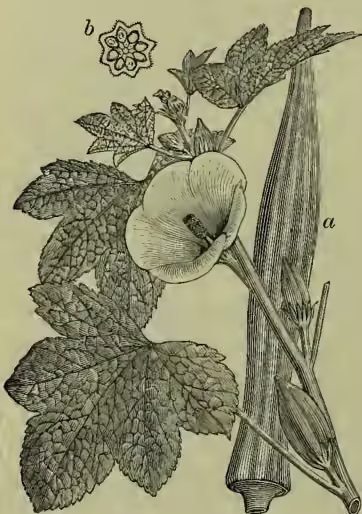
a, unripe fruit; b, section of do.
(Bentley and Trimen.)
Islands obtain nourishment in times of scarcity. This tree is one of the most abundant trees of the South Sea Islands; and the wood, being light, tough, and durable, is much used for many purposes. From its fibre the Tahitians manufacture matting fine and coarse, the latter for sleeping upon, the former for protection from wet during the rainy season, and they also make ropes and twine of the same. The bark is very fibrous, and cordage and matting are made of the fibre in various tropical countries. Many other species yield fibres, some of them coarse, some of them fine and beautiful, which are used in different countries; but the most important in this respect is H. cannabinus, the Deccan Hemp of western India (see FIBROUS SUBSTANCES). H. sabdariffa is very generally cultivated in warm countries, on account of its calyx, which, as the fruit ripens, becomes fleshy, and acquires a very pleasant acidity. It is much used for making tarts and jelly, and a decoction of it, sweetened and fermented, affords a refreshing beverage, well known in the West Indies as Sorrel Cool Drink, the plant being called Red Sorrel; and in the Madras territories it is used for similar purposes, and is named Rozelle or Rouselle. H. Abelmoschus (or Abelmoschus moschatus), sometimes called Musk Seed, another plant common in widely separated tropical countries, is cultivated for its seeds, which have a fragrance between that of musk and that of amber. They are much used by perfumers, and are called Ambrette or Graines d'Ambrette. In Egypt and Arabia they are mixed with coffee, and stimulant and stomachic qualities are ascribed to them. The petals of H. Rosa-Sinensis possess astringent properties, and they are also used by the Chinese to stain their eyebrows and their shoes black.