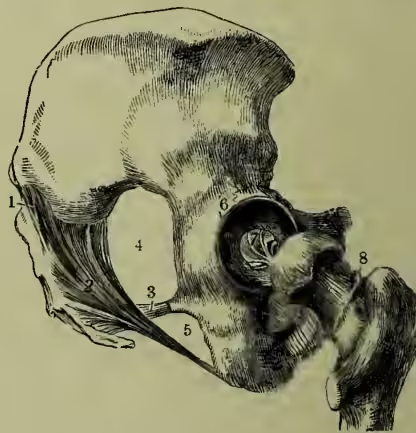
Hip-joint is a ball-and-socket joint formed by the reception of the globular head of the thigh-bone (or femur) into the deep pit or cup in the os innominatum, which is known as the acetabulum. If the variety of the movements of this joint—viz. flexion, extension, abduction, adduction, and rotation inwards and outwards, and at the same time its great strength are considered, it may well claim to be regarded as the most perfect joint in the whole body. The reader will form a tolerably clear conception of the relative forms of the acetabulum and the head of the thigh-bone from a glance at the figure, in which the surrounding parts are cut away, and 1, 2, 3, pelvic ligaments; 4, 5, the greater and lesser sacro-iliac ligaments; 6, the cotyloid ligament; 7, the round ligament; 8, the cut edge of the lower part of the capsular ligament. the thigh-bone is drawn out of its socket. The ligaments are usually described as five in number—the capsular (consisting of circular and longitudinal fibres, of which the most important are the ilio-femoral or Y-shaped band), teres or round, cotyloid, and transverse ligaments. Of these the capsular ligament, supposed to be removed in the figure, is the most important, and extends from the edge of the cup to the circumference of the neck upon which the ball is carried, enclosing the bony parts in a strong sheath. The great use of the capsular ligament is to limit the extension of the hip-joint, and thus to give steadiness to the erect posture. The teres or round ligament is in reality triangular rather than round, and has its apex attached to the head of the thigh-bone. The joint is much strengthened by a large number of surrounding muscles, some of which are of considerable power. The experiments of Weber show that atmospheric pressure is the real power by which the head of the femur is retained in the acetabulum when the muscles are at rest.
DISEASE OF THE HIP-JOINT.—Hip-disease differs in many points of importance from other joint-diseases. Its connection with scrofula is more distinctly marked than that of most other joint-diseases, and it almost always occurs before the age of puberty. It comes on, in children or young persons of a scrofulous constitution, from very slight causes; thus, it is often traced to over-exertion in a long walk, a sprain in jumping, or a fall; and in many cases no apparent cause can be assigned. In the early stage of the disease the whole of the structures of the joint are inflamed, and by proper treatment at this period the morbid action may be sometimes subdued without any worse consequences than a more or less rigid joint. Usually, however, abscesses form around the joint, and often communicate with its interior; and the acetabulum and the head and neck of the thigh-bone become disintegrated, softened, and gritty. In a still more advanced stage dislocation of the head of the thigh-bone commonly occurs, either from the capsular ligament becoming more or less destroyed, and the head of the bone being drawn out of its cavity by the action of the surrounding muscles, or from a fungous mass sprouting up from the bottom of the cavity, and pushing the head of the bone before it. It is of extreme importance that the symptoms should be detected in an early stage of the disease.
As the disease advances abscesses occur around the joint. True shortening of the limb now takes place, which at the same time becomes adducted and inverted. From this stage, if the health is pretty good, and the lungs are sound, the patient may be so fortunate as to recover with an anchylosed (or immovable) hip-joint; but the probability is that exhaustion and hectic will come on, and that death will supervene, from the wasting influence of the purulent discharges occasioned by the diseased bone. The duration of the disease may vary from two or three months to ten or more years.
As the treatment must be left entirely in the hands of the surgeon it is unnecessary to say more than that the most important points are perfect rest to the affected part, which may be effected in various ways, the internal administration of cod-liver oil and tonics, and the application of counter-irritation by means of an issue behind the great trochanter.