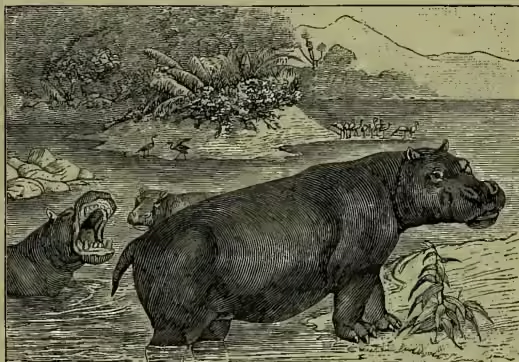
Hippopotamus (Gr., 'river-horse'), a genus of artiodactyle ungulate mammals, constituting a family by itself. Till of late only one species was known as now existing, although the fossil remains of others indicate the greater abundance and wider distribution of the form in other periods of the earth's history. The largest and best-known species, H. amphibius, is—or, within historic periods, has been—found in almost all parts of Africa, to which quarter of the globe it is entirely confined. A smaller species, H. liberiensis (distinguished by some as a distinct genus, Chaeropsis), was described in 1844 as an inhabitant of the rivers of western Africa within the tropics, and differs from the common species, and from all the fossil species, in having only two incisors, instead of four, in the lower jaw. But as the missing teeth occasionally exist there seems no valid reason for separating this form generically. The common hippopotamus is one of the largest of existing quadrupeds, the bulk of its body being little inferior to that of the elephant, although its legs are so short that its belly almost touches the ground, and its height is not much above five feet. It is extremely aquatic in its habits, living mostly in lakes or rivers, often in tidal estuaries (where the saltness of the water compels it to resort to springs for the purpose of drinking), and sometimes even in the sea, although it never proceeds to any considerable distance from the shore. Its skin is very thick—on the back and sides more than two inches; it is dark brown (albino and piebald individuals have been seen), destitute of hair, and exudes a reddish fluid, which has been said to have given rise to the legends of sweating blood. The tail is short. The feet have each four toes, nearly equal in size, and hoofed. The neck is short and thick. The head is very large, with small ears, and small eyes placed high, so that they are easily raised above water, without much of the animal being exposed to view. The muzzle is very large, rounded, and tumid, with large nostrils and great lips concealing the large front teeth. The hippopotamus cuts grass or corn as if it were done with a scythe, or bites with its strong teeth a stem of considerable thickness neatly through. The skull, while it is distinguished by remarkable peculiarities, corresponds in the most important characters with that of the hog. The respiration of the hippopotamus is slow, and thus it is enabled to spend much of its time under water, only coming to the surface at intervals to breathe. It swims and dives with great ease, and often walks along the bottom, completely under water. Its food consists chiefly of the plants which grow in shallow waters and about the margins of lakes and rivers; and it probably renders no unimportant service in preventing slow streams from being choked up by the luxuriance of tropical vegetation, the effect of which would, of course, be an increase of the extent of swampy land. It often, however, leaves the water, chiefly by night, to feed on the banks, and makes inroads on cultivated fields, devouring and trampling the crops. It is a gregarious animal; and the havoc wrought by a herd of twenty or thirty is very great, so that wherever cultivation extends war is waged against the hippopotamus, and it disappears from regions where it formerly abounded. Thus it is no longer found in Lower Egypt, although still abundant farther up the Nile. It is taken in pits, which are dug in its usual tracks; it is killed by poisoned spears, is pursued by means of canoes, is harpooned, and is shot. The flesh is highly esteemed; the fat, of which there is a thick layer immediately under the skin, is a favourite African delicacy, and when salted is known at the Cape of Good Hope as Zee-koe speck ('Lake-cow bacon'). The tongue and the jelly made from the feet are also much prized. The hide is used for a variety of purposes; and the great canine teeth, which sometimes weigh 8 or even 12 lb., are particularly valuable as ivory, and are a very considerable article of African commerce.
The hippopotamus is lively and playful in its native waters; it soon learns to avoid man; and, when it cannot retire among reeds for concealment, it dives and remains long under water, raising only its nose to the surface when another breath becomes necessary. The female may sometimes be seen swimming with her young one on her back. The hippopotamus is generally inoffensive, but is occasionally roused to fits of rage, in which it becomes extremely dangerous, particularly to those who pursue it in boats. The voice is loud and harsh, and is likened by Burckhardt to the creaking and groaning of a large wooden door. That the animal is capable of being tamed, and of becoming much attached to man, has been sufficiently proved by the instances of living specimens in London and Paris. The first specimen brought to Europe in modern times, a young one from the Nile, arrived in London in 1850. The hippopotamus, however, sometimes appeared in the spectacles of the ancient Romans. It is very generally supposed to be the Behemoth of the book of Job.
Fossil Species.—A number of species of hippopotamus have been described from the later Tertiary strata; but in those times the distribution was not, as it is now, limited to the African con- tinent. Their remains have been found in India and Madagascar as well as Europe. They occur in fresh-water marls, and in the bone-caves, into which they had been carried for food by the carnivorous animals that used the caves as dens. One species found in England and in considerable abundance in the southern countries of Europe was of a size as much greater than the living species as its companion, the mammoth, was greater than the living elephant.