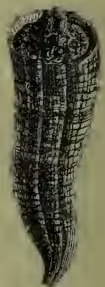
Hippurites, a very remarkable genus of fossil bivalves, peculiar to the Cretaceous strata, and so abundant in some of the Lower Chalk beds of the Pyrenees and other places that the series has received from some continental geologists the name of Hippurite Limestone. The external form of the shell is so anomalous that the genus has been tossed about by naturalists in an extraordinary manner; some having called it a coral, others an annelid, others a barnacle, and so on, though the majority held it to be at least a mollusc. The investigations of S. P. Woodward showed that the Hippurites were divergent bivalves. The right valve is very large, and elongated into a cone, while the left valve is inconspicuous, often like a lid, and perforated by radiating canals. Including allied genera or sub-genera—e.g. Radiolites and Caprinella—there are over a hundred species, all restricted to the Chalk and Chalk-marl.