Holly (Ilex), a genus of trees and shrubs of the natural order Aquifoliaceæ, chiefly natives of temperate climates; with evergreen, leathery, shining, and generally spinous leaves; small flowers which have a four- to five-toothed calyx, a wheel-shaped four- to five-cleft corolla, four or five stamens, and the fruit globose and fleshy, with four or five stones (nuts). The Common Holly (I. aquifolium), the only European species, and a native also of some parts of Asia, is a well-known ornament of woods, parks, and shrubberies in Britain, the stiffness of its habit being so compensated by the abundance of its branchlets and leaves as to make it one of the most beautiful evergreens. It is found as a native plant in Scotland, although Britain is nearly its northern limit; and it attains a greater size and displays greater luxuriance in the northern than in the southern parts of its geographic range, often appearing in the former as a tree of considerable size, 20 to 50 feet high, whilst in the latter it is generally a mere bush. It prefers light soils.
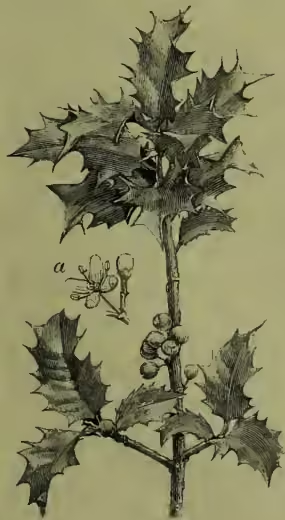
a, a flower.
There are numerous varieties of holly produced, or at least perpetuated, by cultivation, exhibiting great diversity in the leaves, of which the Hedgehog Holly may be mentioned as extremely sinuous and spinous, whilst others are prized for their colour, golden, silver-blotted, &c. The flowers of the common holly are whitish, axillary, nearly umbellate, and often dioecious by abortion of the pistil; hence the barrenness of certain varieties, and occasionally also of individual trees of others which are remarkable for having the stamens only or the pistils only perfect as the case may be; the former of course never bear fruit. The fruit is small, scarlet, rarely yellow or white. The abundance of the fruit adds much to the ornamental character of the tree in winter, and affords food for birds: but to man it is purgative, emetic, and diuretic, and in larger quantities poisonous. The leaves are inodorous, have a mucilaginous bitter and somewhat austere taste, and have been used medicinally in cases of gout and rheumatism, as a diaphoretic, and also as an astringent and tonic to correct a tendency to diarrhea, &c. The leaves and small branches, chopped, are sometimes used for feeding sheep in severe winters. The root and bark are emollient, expectorant, and diuretic. Birdlime (q.v.) may be made from the inner bark. The wood is almost as white as ivory, very hard and fine-grained, and is used by cabinetmakers, turners, musical-instrument makers, &c., and sometimes for wood-engraving. Handles of tools and handles of metal teapots are very often made of it. The holly is often planted for hedges, as it bears clipping well, and makes an excellent fence. A holly hedge may either be kept low, or, as is the case at Tynninghame, in East Lothian, allowed to grow to the height of 20 or 30 feet. In the gardening of former days hollies were often clipped into fantastic shapes. The name holly used to be derived from the very ancient use of the branches and berries to decorate churches at Christmas (said to be connected originally with the Roman Saturnalia), from which the tree was called Holy Tree. Really holly (O. E. holyn) shows the same root as in Irish cuilean, German hülse, Old French houle (see EVERGREENS, and the illustration there). The American holly (I. opaca) is common along the Atlantic coast from Maine southwards.—Maté (q.v.), or Paraguay Tea, is the leaf of a South American species of holly (I. paraguensis). I. vomitoria has been erroneously named South Sea Tea, from the impression that it was the same as I. paraguensis. The Indians smoked it as a substitute for tobacco. I. cassine and I. Duhoon are natives of the same region of the United States. I. gongonha, which grows in the provinces of Minas Geraes and São Paulo, Brazil, has leaves which have been substituted for Paraguay Tea. The fruit of I. macronea contains a great quantity of tannin, and mixed with a ferruginous earth is used to dye cotton.
According to the Darwinian theory of the origin of thorns, spines, and prickles, these structures serve either as a protection against the attacks of the larger animals (the view expressed in Southey's 'Holly-tree') or as climbing organs. The ancestors of the holly are supposed to have had spineless leaves which were eaten by large browsing animals, and thus the holly ran the risk of extermination, until some individuals, dwarfed and checked in growth from the losing of their tender shoots, developed spines which protected them from the attacks of animals. These spine-producing hollies had an advantage over their spineless neighbours and became the survivors. In support of this theory is the fact that many varieties of holly above a certain height develop leaves without spines; and this is explained by saying that these leaves were beyond the reach of animals which attacked the plant, and therefore spines were not formed on these higher leaves because they were unnecessary. A more recent view of the origin of spines denies altogether the agency of animals. According to this view the bitter nature of holly leaves is sufficient to repel any animal from making food of them. The presence or absence of spines on the leaves is the result of the metabolism of the plant. Those plants which have grown in rich soil under favourable climatic conditions are vigorous individuals with large spineless leaves; while hollies which have grown in poor soil under unfavourable conditions have shrubby stems and small curled spiny leaves. The former plants are healthy and well fed; the latter half starved and ill conditioned. The former are the highly anabolic, the latter the katabolic individuals.