Holothurians (Holothurioidea), a class of animals belonging to the sub-kingdom Echinodermata (q.v.), from the other members of which they are readily distinguished by a more or less worm-like appearance. They are popularly known as Sea-cucumbers or Sea-slugs. The word holothourion was used by Aristotle for a marine animal which we are now unable to identify, and the Latinised form was appropriated as a generic title by Linnaeus in 1758. His genus was practically co-extensive with the present class. As in all Echinodermata, the symmetry of the adult body is apparently pentagonal, but, instead of presenting the appearance of rays diverging in one plane from a common centre, these are bands running along the sides of a cylinder. Very frequently they are not equidistant from each other, and then the radiate symmetry passes over into a bilateral one. The most common arrangement is for three rays to be approximated to each other on the ventral and two on the dorsal aspect. The body of a Holothurian consists of a sac of leathery consistency (whence the name Scytodermata sometimes used for them), made up of a cuticle, layers of cells, connective tissue, nerve-fibres, and calcareous plates and muscles. The calcareous plates are the sole remnants of the skeleton which is so largely developed in other Echinoderms. They are of various shapes, resembling wheels in Chirodota, plates and anchors in Synapta, and spines in some other genera; in Psolus there are overlapping scales. The mouth is ordinarily at one end of the body, but occasionally on the ventral surface; it is surrounded by a ring of tentacles whose number is some multiple of five, and opens into a gullet surrounded by a circle of calcareous plates. The digestive tract is ordinarily disposed in a loop; the last portion before the vent (cloaca) is a large space, which has been observed to contract rhythmically. To it are appended (except in two subdivisions) a pair of branched outgrowths, the respiratory trees, and certain processes of unknown function, known as the Cuvierian organs.
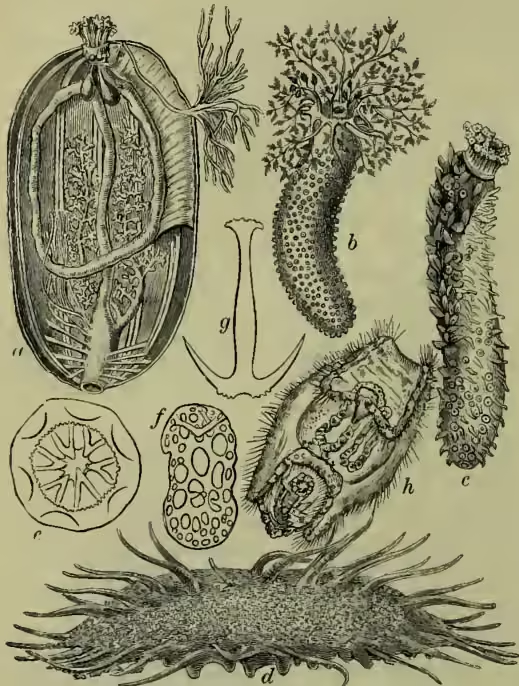
The gullet is surrounded by the ring-shaped central nervous system, and also by a tube belonging to the ambulacral or water-vascular system, which is so generally distributed among the Echinodermata. It gives off a branch forwards to each tentacle, and sends one backwards along each of the five radii of the body, to supply the tube-feet, the principal locomotor organs. The annular tube bears also a reservoir, the Polian vesicle, and communicates either with the body-cavity, or sometimes with the outside by means of a canal. The sense- organs consist of auditory vesicles situated near the anterior end of the body, and containing small calcareous corpuscles (otoliths), and of the tentacles above mentioned. These may be either simple or branched, and in a few cases they are furnished with suckers. In the Elasipoda tactile organs are present in the form of dorsal papillae.
The generative organs consist of a bunch of tubes, with one end closed; their duct opens either within or just outside the circle of tentacles. The egg develops as a rule into a curiously-formed bilaterally symmetrical larva, formerly described as a distinct animal under the name Auricularia. In a few cases the development is direct; in Cucumaria crocea the young are borne among the tentacles of the parent, whilst in Psolus ephippifer they are carried in a special pouch on the back.
The class is subdivided as follows :
- I. ELASIPODA, primitive deep-sea forms; bilaterally symmetrical; tube-feet on the ventral surface, papillae on the dorsal. No respiratory trees. A very large number of genera and species have been obtained by the Challenger and other deep-sea expeditions.
- II. PEDATA, with well-developed tube-feet and papillae.
- (1) Aspidochirotae, with tentacles bearing a disc, and ten calcareous plates round the gullet. The genus Holothuria as now understood belongs here.
- (2) Dendrochirotae, with arborescent tentacles—e.g. Cucumaria, Psolus.
III. APODA, devoid of tube-feet and papillae.
- (1) Pneumonophora, with respiratory trees—e.g. Molpadia. (2) Apneumona, with neither radial water-vascular canals, respiratory trees, nor Cuvierian organs—e.g. Synapta, Chirodota.
The Holothurians are all marine, and have a world-wide distribution; traces of them have been found fossil as far back as the Carboniferous deposits of Scotland. They either take in large quantities of sand and absorb the nutritive matters mixed with it, or devour small animals. On strong contraction, caused by sudden irritation, the whole digestive canal and its appendages are not infrequently ejected; but these are regenerated after a time. In some species the cloaca is inhabited by a small parasitic fish of the genus Fierasfer. Trepang (q.v.), or bêche-de-mer, a great delicacy among the Chinese, consists of dried Holothurians.