Honey-eater, or HONEY-SUCKER, the name of a large family of birds (Meliphagidae), tribe Tenniostres, order Insectivores, characterised by their long, sharp, slender, curved bills, and their long cleft extensible tongue terminating in a pencil of bristle-like filaments. They are entirely confined to Australia and the islands included in the Australian region, where they are very abundant, living on honey and insects, which they are particularly well adapted for gathering from the flowers of such trees as the Eucalyptus and Banksia. Twenty-three genera and 190 species are enumerated. Several of the genera are confined to Australia, others to New Zealand, and a few range over the whole Australian region. In India and Africa they are replaced by the Sun-birds (Nectariniidae). They are birds of active habits and generally very beautiful plumage. One species, called by the Australians the Riflemans or Rifle-bird (Meliphaga or Ptiloris paradisus), is said to be the most gorgeously-plumaged of all known birds; the female is more sombre in dress. Another species (Myzanthus melanophrys) is called the Bell-bird, because its voice resembles the tinkling of distant sheep-bells.
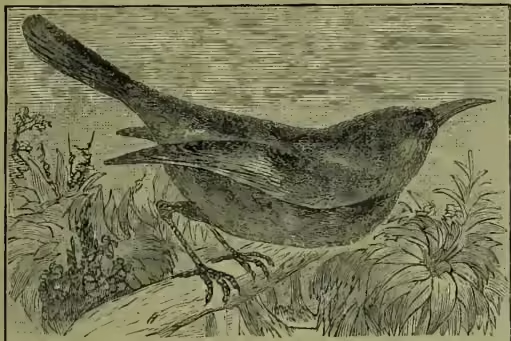
To this family is referred the Parson-bird or Tui (Prosthemoderus Novae Zeelandiae), a bird larger than a blackbird, and of a bluish or greenish-black colour, with white streaks on the back of the neck, a white spot on each wing, and two tufts of snow-white downy curly feathers ornamenting the sides of the throat. Unlike most of the Meliphagidae it is a bird of fine song. It has also great powers as a mocking-bird, readily learns to speak many words, and becomes very familiar in domestication.