Honeysuckle (Lonicera, or, according to some botanists, Caprifolium, which others make a sub-genus of Lonicera), a genus of plants of the natural order Caprifoliaceæ. They are shrubs, often twining, and have the flowers two or more together in axillary heads. The calyx is short and 5-toothed; the corolla tubular-funnel shaped, 5-cleft, generally two-lipped; the fruit a 2- or 3-celled berry, containing one or very few seeds. The Common Honeysuckle, or Woodbine (L. Periclymenum), is very abundant in woods and thickets in most parts of Britain. On account of its beautiful cream-coloured whorls of flowers, and their delicious fragrance, it is often planted in shrubberies and trained against walls. It is said to be the 'twisted eglantine' of Milton. The phenomena observed in its growth have been adduced in proof of a perceptive power in plants; the branches shooting out till they become unable to bear their own weight; and then, on their meeting with any other branch, twining around it, from right to left; but if they meet only with one another, twining in different directions, one to the right, and another to the left.—Very similar to this is the Perfoliate Honeysuckle
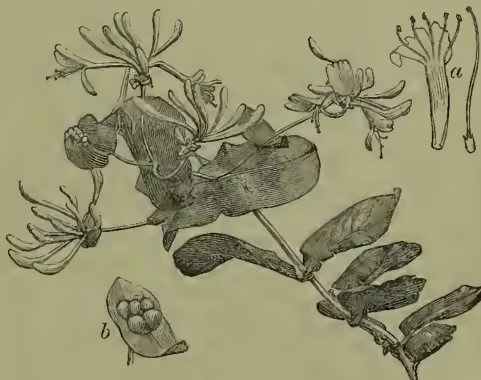
a, flower; b, fruit.
(L. caprifolium), with paler whorls of flowers, and remarkable for having the upper leaves united so that an opposite pair form one leaf, through the middle of which the stem passes. This peculiarity is confined to the flower-bearing shoots, and does not occur on the young runners; it is also most perfect nearest the flower. This species is a native of the south of Europe, but is now naturalised in many parts of Britain, and much planted, as, although less powerfully fragrant than the Common Honeysuckle, it flowers earlier.—There are numerous other species, natives of Europe, Siberia, and North America. The Fly Honeysuckle (L. Xylosteum) is an erect shrub, a native of Europe and Asia, scarcely indigenous in Britain, but common in shrubberies. Its branches are not unfrequently used in some parts of Europe for tubes of tobacco-pipes; and it is said to make good hedges in dry soils. Other erect species are not unfrequently planted in shrubberies.—The Trumpet Honeysuckle (L. sempervirens), called in America the Coral Honeysuckle, is a native of the southern states of North America, often planted in Britain on account of its beautiful flowers, red on the outside, and scarlet within, which, however, have no fragrance. It is a twining evergreen shrub.—The berries of the honeysuckles are nauseous.—The name honeysuckle is also given to shrubs very different from this genus, but of which the flowers abound in honey, as to species of Banksia in Australia. Azalea viscosa is called Swamp Honeysuckle in North America. See also FRENCH HONEYSUCKLE.