Hong-kong, or HIANG-KIANG ('sweet waters'), an island of southern China belonging to Great Britain, situated on the east side of the river Canton, and about 90 miles S. by E. from the city of Canton. It consists principally of a rugged ridge of granitic rocks, extending from northwest to south-east, and has an area of 29 sq. m. Barren and desolate, with scarce any traces of cultivation, the island itself presents a striking contrast with the beauty of its harbour, a magnificent sheet of water, 10 sq. m. in extent, one of the finest in the world, which stretches between the northern shore of Hong-kong and the peninsula of Kowloon on the opposite mainland. The straits that separate the two are scarcely half a mile wide on the east, but expand greatly towards the west.
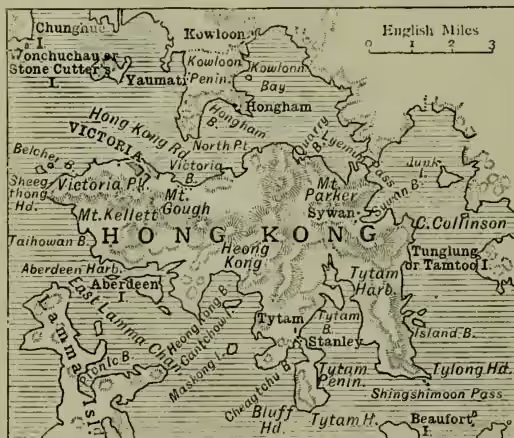
It is to the excellence of its harbour, to the fact that it has been made a free port, and to its being the headquarters of European finance in eastern Asia, that Hong-kong owes its importance as the principal commercial entrepôt of southern China, if not of eastern Asia. The annual value of the merchandise brought into Hong-kong ports exceeds £19,000,000, and the value of that carried thence is more than £22,000,000. The trade between Hong-kong and Great Britain amounts to a value of 3 million pounds sterling for exports from Hong-kong, and more than 1½ million for imports into Hong-kong. The principal objects of commerce are opium (imported) and tea and silk (both exported); the Chinese trade in these last two commodities is almost exclusively in the hands of Hong-kong merchants. Other articles of trade are sugar, flour, rice, salt, hemp, copper, lead, iron, woollens, earthenware, nut-oil, amber, cotton, sandalwood, ivory, betel, vegetables, live-stock, granite, and shipping stores. The last named, together with sugar, rum, ice, and ropes, are the chief manufactures on the island. Hong-kong is in regular steam communication with Europe, India, Singapore, Australia, Japan, Canada (Vancouver), and San Francisco. Every year several thousand Chinese coolies pass through the port going abroad and returning home. In the five years ending 1890 the emigrants averaged 66,700 annually; in 1894 the immigrants were more than 96,000. The mean annual temperature is 75° F. The summer is hot and generally rainy; but the island is not unhealthy upon the whole, except at certain seasons. In 1894 it was ravaged by a bubonic plague like that of the Middle Ages (see Eitel's Europe in China: the History of Hong-Kong, 1895). Thunderstorms are frequent, and typhoons occasionally work great havoc. An observatory is maintained on the island. From 5000 in 1841 the inhabitants increased to 37,058 in 1851, and to 123,511 in 1861, to 123,898 in 1871, to 160,402 in 1881, and 221,441 in 1891—210,995 being Chinese (partly British subjects), and 1901 Indians. Of the whites, half are of Portuguese origin, and a third English. Hong-kong is the seat of a British governor and is a British naval station (see COALING STATIONS). The city of Victoria, the capital of the island, stretches some 4 miles along the northern shore, and from its situation on the slopes and terraces of the hills overlooking the harbour and its handsome streets and houses, is justly entitled to be called one of the finest cities in the East. Here dwell all the Europeans and most of the Chinese portion of the population. On the mainland the extremity of the peninsula of Kowloon, embracing an area of 2½ sq. m., was ceded to Great Britain in 1861, and now forms administratively part of the dependency of Hong-kong. The island was first occupied by Great Britain in 1841, and was secured to her in the following year by the treaty of Nanking.