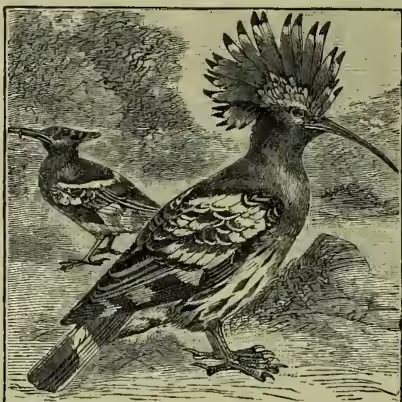
Hoopoe (Upupa), a genus of semi-terrestrial insectivorous birds of the family Upupidae, tribe Tenuirostres, and order Insectores, most nearly related to the Hornbills, but presenting a strong contrast to those ungainly birds by their graceful carriage, elegant figure, and beautiful crest. They are most characteristic of the Ethiopian region, but they are found in central and southern Europe and in Asia as far as Ceylon and Mongolia. The six species are most at home in desert country, where their sand-coloured plumage is a protection to them. The Common Hoopoe (Upupa epops) is about a foot long; its plumage exhibits a fine mixture of white, buff, and black; on the tawny-coloured head is an enormous erectile crest, the feathers of which have a black tip beyond a narrow white bar. The plumage of the female is a little paler in colour than that of the male. This bird visits Britain during the spring and autumn migration, but seldom breeds in any part of the island. The Hoopoe derives its name from the very frequent utterance of the sound hoo-hoo-hoo which it produces, puffing out the sides of its neck and hammering on the ground with its bill at each note.