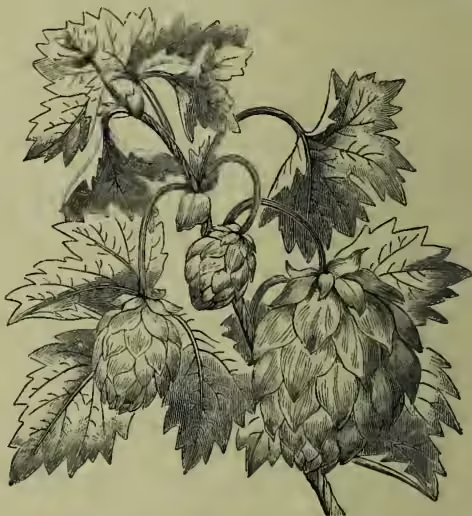
Hop (Humulus lupulus), a perennial dioecious plant of the natural order Cannabinaceae, the only species of its genus. It has long, rough, twining stems, and stalked 3- to 5-lobed rough leaves, and is a plant of luxuriant growth and abundant foliage. The male flowers grow in loose branching axillary panicles, and consist of five stamens surrounded by a 5-lobed perianth. The female flowers are in strobiles, or cones, with large persistent, concave, entire scales, which enlarge as the fruit ripens. The part of the hop so much used in brewing, and sold under the name of hops, is the ripened cone of the female plant. Female plants alone, therefore, are cultivated to any considerable extent, it being enough if a few male plants are scattered over a field.
The hop is first mentioned by Pliny as one of the garden plants of the Romans, who ate the young shoots as we eat asparagus; as, indeed, many country people in England do at the present day. It is a native of Europe and of some parts of Asia, a doubtful native of Britain and of North America. It is extensively cultivated in the south of England, the total area under hops being 66,696 acres in 1880, and 57,724 in 1889 (Kent, 35,487; Sussex, 7282; Hereford, 6850; Worcester, 2939; Hants, 2905; Surrey, 2101, &c.). Hops are also grown to a considerable extent in Germany (116,000 acres), France, Flanders, and southern Russia, and now successfully in the United States (46,800 acres in 1880; about four-fifths in western New York), and in Australia and New Zealand.
The cultivation of the hop was introduced into England from Flanders in the time of Henry VIII., but did not become sufficient for the supply of the kingdom till the end of the 17th century. For some time after hops began to be used in brewing a strong prejudice existed against the innovation; and parliament was petitioned against hops, as 'a wicked weed, that would spoil the taste of the drink, and endanger the people.'
The hop requires deep rich soil on a dry bottom, and succeeds best in a sheltered situation with a south or south-west aspect; yet there should be a free circulation of air. The ground is generally well pulverised and manured to a considerable depth by the plough or spade before planting. The plants are usually set in stools of from three to five, a few inches apart, in rows six feet asunder, with the same space between the stools. They are obtained from cuttings or suckers taken from the healthiest old stools, and are usually planted out somewhat closely in nursing lines for twelve months before being planted permanently. They make very little growth the first year, and not until the third year do they come to full bearing, when from four to six poles from 14 to 18 feet long are required for each stool. The most favoured timber for hop-poles is Spanish chestnut, which is extensively grown in hop-districts as coppice-wood for this purpose. The poles are set to the plants in spring before growth commences, and removed when the stalks are cut away in autumn. The plants are then dressed with manure, and the soil between the stools is stirred lightly with the fork. In Germany the poles are fewer and much taller than in England—from 23 to 27 feet high.
The cones are known to be fit to gather when they acquire a brown amber colour and firm consistency. The stalks are then cut at the base, and removed along with the poles and laid horizontally on frames of wood, to each of which is attached by tenter-hooks a large bag-like cloth into which the hops fall as they are picked by women and children, who are employed in great numbers at this work. When picked the hops are immediately conveyed to the kiln to be dried, as otherwise they are liable to heat and become spoiled in a few hours, especially when they are picked in a moist state. The operation of drying hops is similar to that of drying malt, and the kilns are of the same construction. Great care is required in drying to prevent overheating, by which the essential oil is liable to be volatilised. The hops are spread on hair-cloth from 8 to 12 inches deep, and when the ends of the stalks have become shrivelled and dry they are taken off the kiln, and laid on a wooden floor till they become quite cool, when they are put in bags or pockets.
The produce of no British crop is more precarious than that of the hop. In a good season it may be as much as 20 cwt. per acre, in a bad season none or at most perhaps 2 or 3 cwt. The plant has many enemies, both insect and fungoid parasites, which prey upon it, and destroy the crop season after season. It is calculated that on an average the hop-crop fails every five or seven years. This, in conjunction with the heavy expense of the first formation of a plantation, precludes any but those having considerable capital from taking up its cultivation. But the produce of plentiful years, if properly preserved, may be kept to meet the demand when scarcity may raise the price from £2 or £3 to £20 or £30 per cwt.; consequently to those who can wait few crops are equally profitable.
The best varieties of the hop are the Hill Golding, the East Kent Golding, Golden Hops, Jones's Hops, Grape Hops, and Farnham White Bine. The Goldings are the best and richest. The Jones's are valued for their habit of short growth, requiring shorter poles. The Colegates and Grape Hops are hardy and prolific on poorer soil than any of the others.
The fibre of the stems is employed to some extent in Sweden in the manufacture of a coarse kind of cloth, white and durable; but the fibres are so difficult of separation that the stems require to be steeped in water for a whole winter.
The fruit of the hop is a little nut, not larger than a grain of mustard-seed, and between its outer shell and the kernel there is a small quantity of a peculiar granular substance which also exists as a sort of efflorescence on the surface of the scales themselves; much of the value of the hop depends upon the abundance of this substance. It is not a mere powder, but each grain is a little organised cellular body, of an oval or round form, and, when seen under the microscope, having a reticulated surface. The powder contains some 10 per cent. of lupuline, the bitter principle to which hops seem to owe their tonic properties. The oil of hops is sedative, anodyne, and narcotic; the pleasantly aromatic odour has somewhat of the same qualities, hence the value of pillows stuffed with hops in cases of mania, sleeplessness, &c. The bitter principle is not narcotic, but tonic. The oil and bitter principle combine to make hops more useful than camomile, gentian, or any other bitter, in the manufacture of beer; hence the medicinal value of extra hopped or bitter beer. The tannic acid contained in the strobiles or cones of flowers also adds to the value of hops, particularly as causing the precipitation of vegetable mucilage, and consequently the clearing of beer. Hop bitters are used as a tonic. See also BEER.
Until the year 1862 hops paid an excise duty, and formed an important part of the revenue, although a very variable crop, owing to the serious check it is liable to from insects, fungi, diseases, and the weather. Large quantities of hops are imported into the United Kingdom for home use and for exportation to the colonies and other countries. In 1896 hops imported amounted to 207,041 cwt. of a declared value of £591,482. The annual exportation of hops is about 20,000 cwt., chiefly to Australia, Belgium, and the United States.
HOP-FLEA, or TOOTH-LEGGED BEETLE (Phyllostreta or Haltica concinna), a very small coleopterous insect, not quite one-tenth of an inch long, which often does much mischief in hop-plantations in spring, devouring the tender tops of the young shoots. It is of the same genus as the turnip-fly (Phyllostreta nemorum), so destructive to turnips.
HOP-FLY (Aphis or Phorodon humuli), a species of Aphis (q.v.) or plant-louse, important on account of the injury it inflicts in some seasons on the hop-plantations. The general colour is pale green, as the common name 'green fly' indicates.
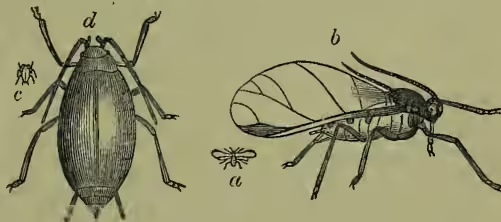
The males, which are winged, appear in autumn, and pair with wingless females. These lay eggs, which develop next spring into swarms of winged females. These produce parthenogenetically and viviparously great numbers of larvae, 'lice' or 'nits,' which usually remain wingless, but rapidly mature, and soon become the virgin and viviparous parents of fresh swarms. Males and sexual reproduction reappear in autumn. Both larvae and adults ruin the plants. No efficient method of preventing the ravages of this pest has yet been discovered; but the beneficial service to man of lady-birds and other natural foes of this fly has been long and widely recognised.