Horn, a general term applied (1) to certain structures, whatever their composition, growing on the heads of oxen, sheep, giraffes, rhinoceroses, &c., and to similar structures on other animals such as beetles; (2) to a substance of a certain definite chemical composition forming 'horns,' hoofs, nails, claws, and other similar structures.
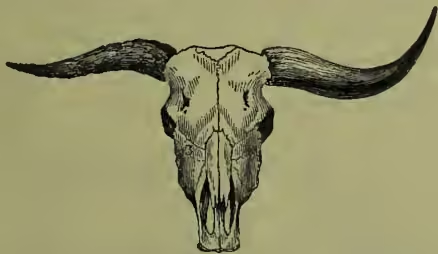
(1) Of horns as they exist among mammals there are two distinct classes: (a) horns formed of epidermal tissue; and (b) bony horns or antlers. (a) Epidermal horns are of two kinds. The horn of the rhinoceros, which is an example of the first kind, consists of a compact, uniform agglutination of epidermal fibres or bristles. The slightly concave base of the horn fits over a slightly-projecting roughened portion of the nasal bones underneath. In the growing horn, while the fibres at the back decay, new fibres are so added at the front and sides that, relatively to the fore-part of the head, the position of the horn remains always the same. In grown animals new material is added only at the base, and the whole outer surface is smooth and rounded. The horn is median in position and symmetrical in shape. In the female it is usually shorter and smaller. When a second horn is present it is usually shorter and smaller in size, and is situated behind the first one and on the frontal bones. If we imagine the rough part of the bone underneath and the vascular tissue immediately over it growing upwards into the epidermal horn and hollowing it out, we have the second kind of epidermal horn—the hollow horn found in the Cavicornia (Bovidae, Ovidæ, Antilopidae). In the case of these horns the bony part, or horn core, is developed as an outgrowth from the frontal bone; in the Bovidae and Ovidæ the cores are hollow or spongy, and their spaces communicate with the air-spaces in the frontal bones, while in the Antilopidae the cores are solid or only slightly excavated at the base. Hollow horns are usually unbranched and persistent, but in the Prong-horn Antelope (Antilocapra americana) the horny sheaths are shed annually while the bony cores grow and their vascular coverings persist and give rise to the new horns; these horns show, after the first year, a small branch or snag analogous to the brow-antler of the deer. In the Chickara (Antelope [Tetraceros] quadricornis), an Indian species of antelope, two pairs of horn cores are developed from the frontal bones. The gigantic extinct antelopes Bramatherium and Sivatherium had two pairs of horns like the Antilope quadricornis, and the hinder pair possessed the branched character now exhibited only by the Prong-horn. Hollow horns are found usually in both sexes, but in some genera of antelopes (Tragelaphus, Cervicapra, Cephalophus, &c.) only in the male. In the Prong-horn the horns of the female are almost hidden in the hair of the head; they are small, short, and unbranched, as in the yearling buck. (b) Bony horns or antlers (see ANTLERS, and DEER) are of two kinds, exemplified by the horns of the deer and giraffe respectively. In these the horns are developed from membrane bones which grow up covered by the skin, and nourished by vessels from it. In the giraffe they grow just over the junction of the frontal with the parietal bones, and become united to them by means of cartilage. The integument over the antler is terminated by a tuft of coarser hair, and is persistent. Horns are present in both sexes, and the young giraffe is the only animal born with horns. The antlers of the deer differ from those of the giraffe in that the membrane bones become firmly united by bony growth to the frontal bones, the integument—or velvet—does not persist, and the horns are shed annually.
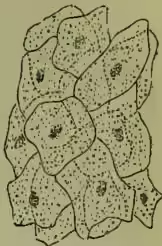
(2) True horny tissue is a modified form of epidermic tissue. The term includes not only true horn, as noted above, but also hoofs, nails, claws, hair, wool, beaks of animals generally, the carapace of tortoises, the scales of the pangolin, the spines of the hedgehog and the quills of the porcupine, the feathers of birds, the 'castors' of horses and other animals, and other epidermic thickenings and growths, whether occurring normally as the callosities over the breastbone of camels and the hips of some monkeys or pathologically as the 'corns' and 'horns' of the human subject. This tissue largely consists of an albuminoid substance termed 'keratin,' which is composed of carbon (from 50.3 to 52.5 per cent.), hydrogen (from 6.4 to 7 per cent.), oxygen (from 20.7 to 25 per cent.), nitrogen (from 16.2 to 17.7 per cent.), and sulphur (from .7 to 5 per cent.). Keratin may be obtained from the structures above enumerated by the successive action of boiling water, alcohol, ether, and dilute acids, and is probably a compound body that has not yet been resolved into its components. Viewed under the microscope, horny tissue is seen to consist of numerous parallel bundles of fine threads. These threads, under the action of a concentrated solution of caustic potash or soda, unfold into small plates which gradually expand into regular nucleated epidermic cells shown in the figure.
Cattle are frequently dishorned to prevent them from constantly goring and injuring each other when confined in open courts; the whole or part only of the horn and horn core may be removed, but the usual method is total dishorning by sawing off the horns close to the head, at their junction with the skull. If the operation is skilfully performed, and if proper precautions be taken to prevent inflammation following, the operation is affirmed by many to be by no means a very painful one (much less so than many others, such as branding), the skin being the most sensitive structure involved. It should not therefore, it is argued, be considered within the category of cruelty to animals forbidden by law. In 1889, however, the Queen's Bench division decided against this view, the judges denouncing the practice as cruel and demoralising. The Scottish Court of Session in 1890 came to an opposite conclusion, which was appealed from.
HORN MANUFACTURES.—The horns of the ox, buffalo, sheep, goat, and antelope are hollow, tough, and capable of being split into flexible slices. Rhinoceros horn, though solid through nearly its whole length, resembles that of the ox in its nature. From the most remote ages the horns of animals have been employed by man for various purposes. Numerous examples of poniards, handles, pick-axes, dart-heads, 'batons of authority,' and implements of unknown use made of reindeer and red-deer horns have been found in river-gravels among other prehistoric remains of the Neolithic period. But the most remarkable of the productions of Neolithic man which have yet been found are pieces of reindeer horn and mammoth tusks with carvings or etchings of animals upon them.
Horns of the ox, as well as those of the sheep and goat, can be split up into sheets or plates after they have been soaked and boiled. When made very thin such plates were at one time used for window-panes, for the construction of lanterns, and for covering Hornbooks (q.v.). Two pieces of horn can also be welded together at the edges by steeping them in hot water and applying pressure. Another valuable property of horn is that when heated it can be pressed into a die or mould. In this way it is formed into ornamental handles for knives, forks, umbrellas, and walking-causes; also into drawer-knobs, spoons, boxes, buttons, and many other useful articles. The manufacture of combs from horn is already described under COMB.
It may be stated here that the hoofs of oxen are likewise manufactured on a large scale into combs, and to some extent into other articles such as buttons.
In their natural form, but cleaned and polished, horns are used as drinking-cups and snuff-boxes, and in past times they were very largely employed for holding gunpowder. They also served as wind-instruments. Many of the Scotch powder-horns in use during the 16th and 17th centuries are beautifully and elaborately carved. A considerable number of these are illustrated in Drummond's Ancient Scottish Weapons (1881). In India buffalo and other horns are used for ornamental work of various kinds. Rhinoceros horn again is a favourite material with Chinese carvers, who form the base of it into elegant cups, and sometimes make a very effective ornament of the entire horn, which admits of being very boldly carved. The deer horn so much worked up at Sheffield into handles for carving and pocket knives is chiefly that of the Axis deer (Cervus axis) of India. Deer horns are employed in France and Germany to decorate furniture. In Great Britain the antlers or horns of the stag, the roe, and the fallow deer—generally with the skull attached—are favourite ornaments for the decoration of entrance-halls.
The average annual imports of horns and hoofs into Great Britain at the close of the 19th century amounted to 5000 tons, valued at more than £150,000. To show the size to which some horns attain, a pair on a Cape ox measures 9 or 10 feet from tip to tip. The horns of a large-sized Indian buffalo, though curved, are about as long. They are 8 or 9 inches broad at the base, and a single horn may weigh 11 or 12 lb. See Rowland Ward's Horn Measurements of the Great Game of the World (1892).