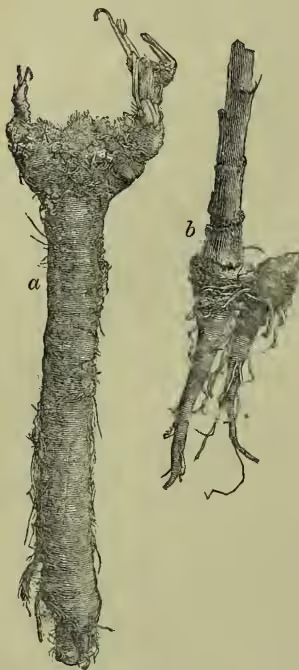
Horse-radish (Cochlearia Armoracia), a perennial herbaceous plant, belonging to the natural order Cruciferae and to the same genus as scurvy-grass. It possesses the same antiscorbutic properties as the latter, but is better known popularly on account of its use as a condiment with roast-beef. It is highly stimulant, exciting the stomach the roots of Monkshood (q.v.) for those of horse-radish. The former are powerfully poisonous; but there is no resemblance between the two plants in any respect. The roots of horse-radish are long, tapering, cylindrical, with a cream-coloured skin. Those of monkshood are short, irregular in shape, blunt at both ends, and have a nut-brown skin. The root-leaves of horse-radish are from 9 to 18 inches long by from 4 to 6 inches broad, entire, but often toothed on the margins. Those of monkshood are roundish in outline, divided to the base into five to seven deeply-cut, linear, finely-pointed segments. The flowers of horse-radish, which are sparingly produced in Britain or the United States, are borne on branching stems about 2 feet high, and composed of four pure white spreading petals. Monkshood bears its flowers freely in handsome racemes, at the extremities of usually simple or unbranched stems; the colour is deep blue, and the unopened flower strongly resembles a helmet or hood.