Horse (Equus), an ungulate or hoofed mammal of the order Perissodactyla, characterised by having an odd number of toes; the family Equidae formed the group Solidungula of old writers, owing to the presence of only a single hoof, which marks them off quite sharply from all allied animals. The English name is found in Anglo-Saxon as hors, and is cognate with the Icelandic hross, German ross; it is sometimes referred to Sanskrit root hresh, 'to neigh,' but, according to some, with more probability, to a Teutonic root har, 'to run,' cognate with Latin eurrere. The Latin name is no doubt from the root ak, conveying the idea of swiftness; Sanskrit acva; Gr. hippos or hikkos; Lat. equus.
The existing species of the genus Equus are about half a dozen in number: (1) The Horse (E. caballus) is characterised by the tail being furnished with long hairs quite from its base; by the long and flowing mane; by the possession of a bare callosity on the inner surface of the hind as well as of the fore legs; and by the head and ears being smaller and the limbs longer than in the other species. (2) The Ass (E. asinus) is almost as widely distributed as the horse; it is probably of African origin, being almost certainly conspecific with the Abyssinian form, E. tæniopus. (3) The Asiatic Ass (E. hemionus) differs from the common ass in being of a more reddish colour, in the absence of the shoulder stripe, and in having smaller ears. By some zoologists it is split up into three species—the Syrian Wild Ass (E. hemippus), the Onager (E. onager), and the Kiang or Dziggetai, to which the term E. hemionus then becomes restricted. (4) The Quagga (E. quagga) has dark stripes upon the head and shoulders on a brown ground; it is said to be now extinct. (5) Burchell's Zebra (E. Burchelli) is white, with stripes on the body and the upper parts of the limbs; it extends from the Orange River to Abyssinia.
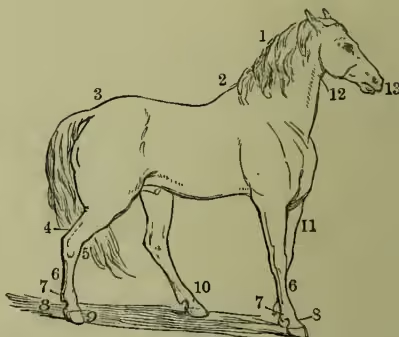
(6) The Mountain Zebra (E. zebra) is white, with long black stripes reaching down to the feet. It is limited to the Cape Colony, and is rapidly disappearing. These last three are sometimes united into a special genus, Hippotigris. (7) The explorations of the Russian traveller Przhevalski (Prejevalsky) in 1881 added another species to the list of Asiatic forms, which has been called after him. The long hairs of the tail begin only half-way down it; the mane is short and erect, and there is no forelock; the head is large and heavy; the ears smaller than those of the ass. It inhabits the dry sultry regions of the Dzungarian Desert, living in companies of fifteen to twenty, each led by a stallion. Only two herds were observed, and only one specimen was secured. The resemblance which this species presents to the horse of early sculptures has been pointed out by several observers. 1, crest; 2, withers; 3, croup; 4, hamstring; 5, hock; 6, cannon; 7, fetlock; 8, pastern; 9, hoof; 10, coronet; 11, arm; 12, gullet; 13, muzzle.
The anatomical structure of the horse has been the subject of many elaborate treatises, and only a very brief outline of its more salient features can be offered here. The skull is remarkable for its great length, especially as regards the bones of the face, which occupy an extent twice as great as those of the cranium. The orbit is approximately circular and complete behind, a fact which distinguishes the horse from the tapir and rhinoceros, as well as from its fossil allies. The co-operation of the zygomatic process in the formation of the lower part of the orbit is an unusual if not a unique feature. The great cheeks are formed mainly of the maxillary bones, though the lachrymal and malar bones occupy a considerable area in the upper portion. The nostrils are roomy, provided with extensive turbinal bones, and roofed in by the nasal bones, which are broad behind, pointed in front. In the naked skull the anterior openings of the nostrils extend far back at either side between the nasal and premaxillary bones. The palate, like the floor of the cranium, is long and narrow, forming a kind of valley between the two rows of elevated molar teeth. Below the brain-case there is a distinct canal through the alisphenoid bone for the internal maxillary artery. In the region of the ear the tympanic and periotic bones are fused together, but are loose from the skull, being held in position only by the descending process of the squamosal bone. The hyoid bone is well developed, especially as regards its anterior arch, and the basal segment sends a process forward into the tongue. The rhinoceros and tapir have a similar, but smaller, process. The mandible is very large, and the lower and hinder part is expanded into a broad flat plate for the attachment of the masseter muscle. The vertebral column is made up of seven cervical, eighteen dorsal, six lumbar, five sacral, and fifteen or more caudal vertebrae. Most of the vertebrae are more or less hollowed behind, this character being more marked in the fore than in the hinder part of the spine. The dorsal processes of the vertebrae in the forepart of the chest are very high, and to them is attached the great elastic ligament (ligamentum nuchæ) which relieves the muscles of the heavy weight of the head and neck. The sternum consists of six segments, the anterior one being shaped something like the prow of a boat. There are no collar-bones, these being in fact absent from all hoofed mammals (Ungulata). The shoulder-blade is long and narrow, and bears a prominent rounded tubercle, representing the coracoid bone. The humerus is short and stout; of the two bones of the forearm the ulna is well developed behind, where it forms the great process (olecranon), projecting backwards from the elbow-joint, but it tapers gradually away below, and is firmly fused with the radius. The wrist ('knee' of common speech) consists of six bones, disposed in two rows of three each; in the second row the middle bone (os magnum) is very large, and supports the cannon-bone, whilst the two laterals are small, and each supports a splint-bone. The fore-foot of the horse consists of only one fully-developed digit, corresponding to the middle finger of the human hand. The metacarpal bone of this finger is known as the 'cannon-bone,' and approximated to its upper end are the thin tapering rudiments of the second and fourth metacarpals, commonly known as 'splint-bones;' the cannon-bone is succeeded by three phalanges, known respectively as the 'large pastern,' 'small pastern,' and 'coffin-bone.' Behind the foot are three small bones (sesamoids), two behind the joint between the cannon-bone and large pastern (commonly called the 'fetlock'), and a single one placed transversely behind the joint between the small pastern and the coffin-bone, commonly called the 'navicular.' In the hinder limb the thigh-bone has a prominent flattened process on its outer side, about one-third down; this is known as the 'third trochanter,' and is characteristic of all odd-toed ungulates. What is really the knee is known as the 'stifle joint.' The fibula is rudimentary. The tarsus consists of seven bones. The os calcis has a well-marked flattened heel-process, commonly known as the 'hock.' The bones of the hind-foot resemble very closely those of the fore-foot, and have the same names. A very strong ligament passes down the hinder surface of the foot, and the two smaller sesamoid bones above mentioned are imbedded in it. It is commonly known as the 'suspensory ligament of the fetlock;' occasionally muscular fibres are found in its substance, and this fact, taken in conjunction with its position and attachments, shows that it is the representative of the interosseous muscles of the human hand. The navicular bone lies in the tendon of the deep flexor muscle of the foot.
The hoof is the representative of the claws or nails of other animals. The last segment of the toe is widened out to form a foundation for it, and this is increased by cartilaginous side-pieces and a fibrous and fatty sole-piece. The integument is, of course, continuous with the skin of the limb, but it is extremely vascular, and its surface is developed into papillæ or laminae, which secrete the horny matter of the hoof. The chief share in this process is taken by the 'coronary cushion,' or thickened ring round the upper part of the foot, and by the cushion in the sole. The result of this is that the hard external tissue of the hoof is renewed from within as fast as it wears away on the outside. The lower surface which comes into contact with the ground is hollow, and its centre is occupied by the 'frog,' a triangular eminence with its apex directed forwards, and consisting of pavement epithelial cells arranged concentrically. Other horny structures are the so-called 'chest-nuts,' hard oval warts situated on the inner surface of all four legs in the horse (E. caballus), and of both fore-legs in the other members of the genus.
The teeth of the horse when the series is complete are forty-four in number: three incisors, one canine, four premolars, and three molars on either side of each jaw. The incisors form a semicircle: they have a pit in the apex partially filled up with bony matter, and this it is which produces the well-known appearance of concentric rings as the tooth wears away, and their disappearance when the wearing has carried the surface of the tooth beyond the bottom of the pit. The canines are either rudimentary or absent in the females. Between them and the grinding-teeth is a wide gap (diastema) in which the bit is placed. The first premolars are either quite rudimentary or absent; when present they are usually lost before maturity, so that the grinding-teeth in actual use only amount to six in number. They have very long crowns, which are gradually pushed up as the surface wears away; this peculiarity in structure is only seen in the teeth of the more recent horses, and is probably to be associated with the removal of the animal from swamps to drier plains, and hence from soft moist vegetation to food more difficult of mastication. The enamel of the teeth forms a curved folded plate, the pattern being derivable from that seen in other Perissodactyles; and it is this which produces the characteristic pattern seen in the surface of the horse's molars. The temporary or milk teeth are twenty-four in number—three incisors and three milk-molars on either side of each jaw. At birth the first and second molars are present; at one week old the central incisors appear; at six weeks the two next incisors; at three months these incisors are level, and a third molar has come into view; at six months obliteration is apparent in the central incisors; at eight months the lateral incisors have erupted, making the full number of six in each jaw; at one year the fourth molar is visible; at eighteen months the mark is very faint in the central incisors; at two years old there are five molars; at three years the permanent central incisors replace the temporary ones; at three and a half and four and a half years respectively, the same happens with the second and the lateral incisors, and at the latter date the canines appear in the male; at five years the mark is nearly, and at six years quite effaced in the central incisors; at seven years the like has happened to the next incisors; and at eight years the mark has disappeared from all the teeth, and the canines have become blunted. Hence by the presence of the different teeth and their condition as regards wear, it is possible to tell the age of a horse with considerable accuracy up to six or eight years of age, but after that no reliable conclusions can be drawn from these organs.
The lips are flexible; the palate long and narrow, and transversely ridged; the soft palate has no uvula, and, except during the actual process of swallowing, embraces the epiglottis, so that respiration is carried on entirely through the nostrils. Three pairs of salivary glands are present, the parotid being by far the largest. The stomach is simple and a good deal curved upon itself: at the oesophageal opening is a kind of muscular valve to which is commonly attributed the difficulty which a horse experiences in vomiting. The small intestine is eighty or more feet in length, and terminates in a large cæcum with sacculated walls. The liver is almost symmetrical, and there is no gall-bladder. The heart is rather longer; the aorta gives off almost immediately a large trunk (the so-called 'anterior aorta'), which subsequently divides into the two axillary and two carotid arteries. The anterior apertures of the nostrils are large, and can be dilated by special muscles; immediately within the opening on the upper and outer side is a blind pouch ('false nostril') 2 or 3 inches in depth and of unknown function; in the ass it is even larger. There are also air-sacs in the hinder and upper part of the pharynx which spring from the Eustachian tubes. The time of pairing falls between the end of March and beginning of June. The period of gestation is eleven months, and only one foal is born at once. The mare is capable of breeding at three years old, but the stallion is not usually allowed to pair until four years of age. The average age of a horse may be put down at twenty years; the greatest age on record is believed to be sixty-two.
The senses of the horse are acute, though many animals excel it in this respect; but its faculties of observation and memory are both very highly developed. A place once visited or a road once traversed seems never to be forgotten, and many are the cases in which men have owed life and safety to these faculties in their beasts of burden. Even when untrained it is very intelligent: horses left out in winter will scrape away the snow to get at the vegetation beneath it, which cattle are never observed to do. Perhaps this may be inherited from their ancestors in the Siberian plains; but curiously enough the very same habit is observed in the horses of the Falkland Islands, whose ancestors in La Plata could have had no occasion to show the same instinct for many generations back.
With patience and kind treatment the horse can be trained to go through quite complicated feats of memory and perception. That it possesses also an accurate sense of time is clear from the facility with which it can be taught to walk, trot, and dance to music, or take part in concerted evolutions. Its knowledge of tunes is evinced by its comprehension of military signals. It is very timid and cautious and suspicious of every new sight or sound; while in respect of moral qualities it is scarcely too much to say that horses are as diverse as men.
The history of the horse can be traced back, though with extensive gaps, to the beginning of the Tertiary geological period, where we find the remains of a small ungulate no larger than a fox, to which the appropriate name Eohippus has been given. It was of very generalised structure, having for example four complete toes and a rudimentary fifth on the fore-feet. In Miocene times it was succeeded by Miohippus and Anchitherium, which in their turn gave place to the Pliocene Hippapion and Pliohippus, each of these showing an increase in size and a closer approach in structure to the modern horses. The history of the feet in particular furnishes one of the best examples of the gradual evolution of a specialised from a more generalised organ (see FOOT). The skull and neck became coincidentally more elongated, and the teeth underwent changes which have been already alluded to.
The etymological synopsis above given shows that the horse was known to the Aryan people before their dispersal. Incised figures of the horse upon bones have been found in cave-deposits referred to the Palæolithic age, and there is evidence to show that at this period the animal was an object of the chase and a source of food. It was probably small and heavy, with a large head and an upright or hog-mane; and attention has been already called to the resemblance which some of the sculptured figures of antiquity bear to the Equus przewalskii above described.
The horse reappears in Neolithic remains in the Swiss lake-dwellings and elsewhere, but here apparently still as an object of the chase. The precise date of its domestication is uncertain. On Egyptian monuments no trace of it appears before the expulsion of the Hyksos or shepherd kings; and it is generally stated that the animal was previously unknown to the Egyptians, though it can hardly be considered as proved that it was introduced by the Hyksos.
In Scripture the horse is only referred to in connection with warfare; witness the poetic description of the war-horse in the Book of Job. The earliest mention of the animal in Holy Writ occurs in connection with the famine in Egypt, when Joseph gave the people corn in exchange for their horses; and its use for riding is alluded to in 2 Kings, xviii. 23.
In Homeric times the horse was not used for riding; indeed, at the battle of Marathon (490 B.C.) the Persians, but not the Greeks, used cavalry. After 450 B.C., however, the art was practised in Greece, and a treatise upon it, of somewhat later date, from the pen of Xenophon, still exists. The war-horses of the Britons and the chariots, their wheels armed with scythes, are described by Cæsar. Athelstan paid special attention to the breed of English horses, and even imported animals from Spain for its improvement. In this he was followed by other monarchs, as John and Edward III. In the reign of this latter king a law was passed forbidding the exportation of horses, and a number of Spanish jennets were introduced. Henry VIII. made various enactments for improving the condition of the English horse, particularly relating to the pasturing of entire horses upon commons and open lands, where a good deal of promiscuous and detrimental breeding had taken place. In the reign of Elizabeth it was penal to make over a horse 'to the use of any Scottishman,' a prohibition naturally repealed by her successor, who further signalised himself by bringing over to England the 'Markham Arabian,' believed to have been the first of that breed introduced. He did not prove a success; but still the experiment was repeated from time to time, and in William III.'s reign the 'Byerly Turk,' the first of a celebrated trio, was brought over to England. At the very beginning of the 18th century came the 'Darley Arabian' (the sire of Flying Childers, 1715), and later the 'Godolphin Arabian,' or Barb (1724-53). The first of these was the great-grandfather of the celebrated racer 'Eclipse' (foaled 1764), from whom so many winners of important races have descended. Indeed, it is not too much to say that from one or other of these horses, in most cases from all three, all horses at present on the turf trace their descent in the male line. Since the commencement of the 19th century an accurate record has been kept of the descent of all racehorses, and an attempt has been made to carry the history about a century further back.
There has been much discussion and speculation as to the kind of animal from which the domestic horse has been derived. Colonel Hamilton Smith supposed that the modern breeds have descended from about five primitive differently-coloured stocks, but this view finds no supporters nowadays; rather is it maintained that 'the similarity in the most distinct breeds in their general range of colour, in their dappling, and in the occasional appearance, especially in duns, of leg stripes and of double and triple shoulder-stripes, taken together, indicate the probability of the descent of all the existing races from a single, dun-coloured, more or less striped primitive stock, to which our horses still occasionally revert.'
Whether the actual species thus alluded to is still living in the wild state is extremely uncertain; indeed it is held by many competent judges that no primitively wild horses now exist, the herds of horses that roam over the Russian steppes being supposed to be the descendants of animals which were once domesticated, and have relapsed into the feral state, as is known to be the case with the mustangs of South America.
The Tarpan, or wild horse of southern Russia, is a small animal, with thin, but strong, long-jointed legs, longish thin neck, and comparatively thick head, pointed ears directed forwards, and small vicious eyes. The coat in summer is close, short, and wavy, especially behind; in winter it is thick and long, forming a kind of beard under the chin; the mane thick and bushy, the tail of moderate length; the colour generally pale brown or yellowish in summer, almost white in winter. It is found in southern Russia, but (according to Radde) is absent from Central Asia, even from the north of the Gobi, where the dziggetai is found. It lives in large herds, often numbering several hundreds, subdivided into little groups or families, each presided over by a stallion, who protects his retinue valiantly, but permits no irregularities in their behaviour; young horses keep at a distance on the outskirts of the herd until they are able to undertake the cares of a family for themselves. The stallions are ever on the alert with nose and ear to detect the approach of danger, of which they give notice by a loud neigh, upon hearing which the whole herd takes to flight, sometimes disappearing as if by magic from the crafty manner in which they take advantage of irregularities in the ground. The story that they protect themselves by forming a ring with heads directed inwards has no foundation in fact, although the stallions will defend the mares and foals from impending attack. The stallions fight vigorously among themselves with teeth and hoofs, and each as he attains maturity must win his position in the herd by a series of duels. They present all the appearance of truly wild animals, and are regarded as such by the Tartars and Cossacks, who destroy them on all possible opportunities, because they are useless for taming purposes, and because they inflict considerable damage upon these horse-rearing communities by devouring their stores of hay and enticing away their mares.
The South American wild horses, known as 'cimmarones' or 'mustangs,' are reported by Azara to be the descendants of some half-dozen individuals which were left to their own resources when the town of Buenos Ayres was abandoned about 1535. When in 1580 the town was reinstated, they were found to have increased to a very considerable number. They are of the same size as the domestic horses, but with thicker heads and legs, and longer necks and ears; all are brownish or blackish in colour. Their social system is the same as that of the tarpans. They proceed in Indian file, leaving no gaps in the series, and are avoided by travellers owing to their attempts to entice tame horses into their company, not unfrequently with success. The Indians on the pampas eat the mares and foals, and also capture a certain number in order to tame them; but the Europeans make no use of them, except perhaps to kill one when fuel is scarce in order to replenish the camp-fire with its marrow. The accounts given by travellers of these animals differ in many important particulars.
The subject of the horse's paces is one which has given rise to much controversy. It has been maintained that horses in a wild state use only the walk and gallop, the trot and others being the results of education. This question can hardly be regarded as settled even now, for the fact that quite young foals have been observed to trot beside their dams is explicable as an instance of heredity.
Six well-marked paces may be distinguished in the movements of domesticated horses—the walk, the amble, the rack or pace, the trot, the canter, and the gallop. The study of the precise movements of the different limbs in carrying out these paces is very difficult, especially in the case of those in which the motion is rapid. Marey, the French physiologist, was the first to attempt a rigorous analysis of these movements by means of apparatus. He attached to the horses' hoofs small elastic bags, connected by tubes with pointers, which made marks upon a revolving cylinder. When any one of the feet touched the ground the bag was compressed, and the pointer instantly made a corresponding mark upon the cylinder. Very valuable results were obtained by this method of study; but they need not be further detailed here, as they have been superseded by the beautiful photographic investigations of Muybridge. In these experiments the horse was made to proceed along a track in front of a row of twelve or twenty-four cameras, so arranged that, as the animal passed in succession before each of them, an instantaneous photograph of it was obtained. These pictures furnish the means of analysing the various paces, as the exact attitude of the horse is shown at very short intervals of time. In the case of an ordinary walk the horse has always two and sometimes three feet on the ground at once. The order of the succession of the footfalls is as follows: left hind, left fore, right hind, right fore; furthermore the horse is alternately supported by the two feet of the same side (laterals) and by a hind and a fore foot of different sides (diagonals); when the animal rests upon the laterals, the suspended feet appear in a side view between the supporting feet; when upon the diagonals, the suspended feet hang out one in front of and the other behind the supporting feet. These rules furnish the means of testing the accuracy of artistic representations of walking horses. The amble is a rapid walk, the length of time the feet rest upon the ground being reduced so that the body is often supported upon only one foot, and generally only on two. In the 'rack,' the fore-feet move as in a slow gallop, the hind-feet as in a trot. In the (American) 'pace,' the legs of the same side are lifted together—an action which has aptly been compared to two men running one behind the other and keeping step. The trot has been defined as a pace characterised by the synchronous movement of the diagonal limbs, though in practice the movement is rarely, if ever, quite simultaneous. It has often been maintained by experienced horsemen that a horse in trotting has always at least one foot in contact with the ground. So far, however, is this from being the case that a fast trotter is quite unsupported for more than half the distance he traverses in each stride. In the canter the order of the footfalls is the same as in the case of the walk, and the characteristic difference is due to the peculiar rhythm as well as to the final effort which propels the body at the conclusion of the stride as the fore-leg leaves the ground.
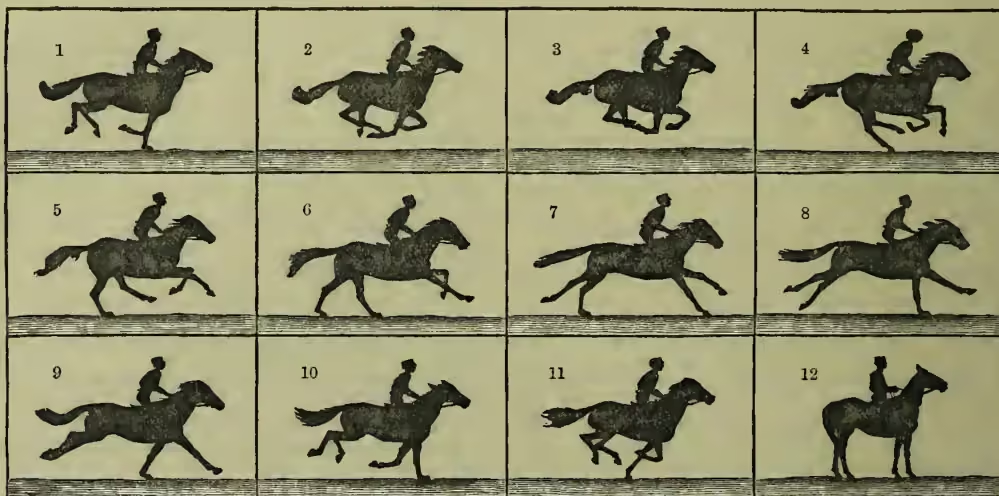
We may analyse the gallop by the aid of the accompanying reduced silhouettes copied from Muybridge, and then it will be seen that its conventional representation by artists is quite unlike any of the actual positions assumed by the moving animal. Fig. 1, it must be remembered, does not represent the start of the gallop, but merely a phase in a continuous action; the body is moving forward by impetus already acquired, and the fore-foot just leaving the ground is adding to it. Fig. 2 is twenty-seven inches further forward; the leg which was on the ground in the last became so aslant that it was obliged to quit the ground, and is now thrown backward; the hind-legs are gathering up and coming forwards preparatory to descending. Fig. 3 shows no further propulsion, but the hind-legs are still moving forwards. In fig. 4 one hind-leg has just touched the ground, the other is at its greatest extension; one fore-leg has come forward about half-way. In fig. 5 both fore-legs are being extended in advance; one hind-leg is pushing upon the ground, the other being brought down. Fig. 6 shows both hind-legs at work propelling the body forwards and upwards; one leg has nearly done its work, the other just begun; one fore-leg is at its maximum forward range, the other is being projected. In fig. 7 one hind-leg has left and the other is just leaving the ground; one fore-leg has reached the ground and is just beginning its stroke. Fig. 8 shows both hind-legs in the air, and the weight of the body supported upon one fore-leg. In fig. 9 one fore-leg is doing its stroke, the other is nearly ready to begin; the hind-legs remain much as in the last diagram. In fig. 10 one fore-leg has left the ground, the other is at work upon it; and the hind-legs are being brought forwards. This brings us to the end of the series, for fig. 11 is really intermediate between figs. 1 and 2. One or two facts may be seen from these diagrams, which, though small, are accurate. The greatest propulsive force resides in the hind-legs; as the weight of the horse descends upon any one of its feet, the strain upon the limbs is so great that the pastern joint lies quite horizontally; the legs are bent when taken up and straightened in the descent; the heels strike the ground before the toes. The length of a stride in the different paces may be approximately stated as follows: walk, 6 feet; amble, 10 feet; rack, 12 feet; trot, 8 to 18 feet; canter, 10 feet; gallop, 12 to 20 feet. In the matter of speed a horse may be said to walk 4 or 5 miles an hour, trot under saddle 6 to 12 miles, or in harness 10 to 12 or even 14; as regards a gallop, the fastest records seem to be 3 miles in 5 min. sec.; 1 mile in 1 min. 43 sec. It is stated that some of the old Cleveland horses could carry 760 lb. for 60 miles in twenty-four hours, and Lawrence gives a story of a Galloway which beat the coach from London to Exeter (172 miles) by a quarter of an hour, notwithstanding its frequent relays of fresh horses.
A few words must be devoted to the various domestic breeds of horses.
The racer is the one for which England is pre-eminently famous, and his origin from the combination of oriental with native blood has been above alluded to. The age of the racehorse whenever foaled is reckoned from the next 1st January, and hence it is advantageous that they should be born early in the year, so as to gain as much time as possible for development. In July or August of the following year the serious training for the two-year and three-year-old races now in vogue begins. Very few horses now race after four years old, but are used for stud purposes, at prices varying with the success they have attained on the turf.
Successful racehorses vary much in shape, some being small and neat, others tall and bony. In height they may be said to range from 15 to hands (the hand = 4 inches), though the most usual dimensions are between and 16 hands; the head should be light and well set on the neck, the ears small and pricked, the eye large, and the nostrils wide and expansible. The neck must be moderately long, and must combine muscular development with lightness; the windpipe broad and loose; the withers may be high and narrow; but it is imperative that the shoulder be sloping and muscular. The body should be moderately deep and straight; length should be given to it by the shoulders and hips; the loins must be broad and firm; the hips long and wide. The limbs ought to be well proportioned and cleanly modelled; the fetlock-joints large and the pasterns strong; the feet of moderate size, with no sign of contraction either in the heels or the frogs. The tail should be set on high. Most important of all is it that the different parts should harmonise together, and that the action should be good. Colour is perhaps of less consequence; still it is worthy of remark that for a long time the majority of winners have been chestnuts.
At his fastest speed a racehorse may cover a mile in 1 min. 43 sec.; the rate of a mile a minute currently attributed to Eclipse is, according to a competent authority, 'wildly incredible.'
In America the favourite form of horserace is the trotting-match, which appears to have originated in the prohibition of horseracing by the Puritans. The gradual evolution of the fast trotter is remark- able. In 1828 a bet of $2000 was made and lost that no horse could trot one mile in 3 minutes. In 1852 the time required for that distance was 2 min. 26 sec.; in 1866, 2 min. 18 sec.; whilst in 1881 it had been brought as low as 2 min. 10.5 sec. In 1843 there was one horse that could do the mile in 2½ min., whilst, in 1871, 233 horses, and in 1882 no less than 1684 could accomplish this feat. See TROTTING.
The hunter is sometimes, but not often a thoroughbred. If this be the case, he is generally a horse that has failed to stand the test of the short rapid races, and is thereafter trained for a hunter. He differs from the racer mainly in carrying-power and endurance. A deep girth, with broad hips, a back not over long, and strong legs are his most essential characters. Jumping is a most necessary accomplishment. A five-barred gate is the ordinary limit of a leap; but a few horses have been known to clear heights between 6 and 7 feet. Yet only a few will jump 10 or 12 feet of water in the hunting-field, although horses have been known to leap a distance of 36 feet.
The charger ought to be 15.3 hands high. He should be a good weight-carrier, and the paces should be easy, owing to the regulation length of the military stirrups. Furthermore, as the soldier has to devote his right hand to the management of his weapon, only the left can be used for guiding his steed, which has thus to be accustomed to take its instructions from the pressure of the leg or indications given by the heel.
Harness-horses are of all degrees of value, and of varieties of race and breed, from the tall high-stepping bays, 16½ or even 17 hands in height, which draw the four-in-hands of the wealthy, to the little pony which drags a basket phaeton. A really well-matched pair of carriage-horses of good action will fetch a very high price. For horses drawing light vehicles, 15.1 hands is an average height; those preferred for coaching are taller, and the wheelers are commonly an inch higher than the leaders.
Cart-horses, like other harness-horses, are of all kinds. The enormously heavy animals which have been developed as the result of crossing the native blood with Flemish are now to be seen almost exclusively in the drays of brewers; for the most part they are bred in Lincolnshire, and are expensive to rear, and hence to purchase. The old Cleveland breed and the Suffolk Punch are said to be now extinct, and the Clydesdale is perhaps the favourite breed for this purpose at the present time.
A pony is defined as being a horse under 13 hands high; the Exmoor ponies are a valuable breed, with well-shaped head, good quarters, and powerful locks. For small dimensions the palm is, however, carried off by the Shetland breed, the height of which is often as little as 10 hands, and not unfrequently less even than this.
In the manner of stable management it is of first-class importance that the stable itself should be in a healthy locality, and free from even the suspicion of bad smell or foul air, to both of which horses are particularly sensitive. The stalls should be roomy, and the slope of the floor no more than is needful to allow the drainage to run off; indeed an arched floor is to be preferred to a smooth slope. The stalls should be adequately lighted, but the eyes should not be strained by the use of too light paint or whitewash on the walls. Good ventilation is imperative, and should be achieved without exposing the animal to cold draughts. About 55° F. is the mean temperature to be aimed at, but it is very often impossible to keep it down nearly so low as this; in winter it is easy to keep it up, or even if this fail, the difference can be made up by clothing. In all matters pertaining to the treat- ment of a horse, regularity and moderation are the great secrets of success.
The food varies much with the nature of the work the horse is called upon to perform, and the means of his owner. A cavalry charger is allowed 10 lb. oats and 12 lb. hay per diem; an omnibus horse 17 lb. of mixed oats and maize, the proportions varying according to the relative prices of the two grains, and 10 lb. hay. A hunter is very commonly allowed 12 lb. oats, 2 lb. beans, and 6-8 lb. hay.
A certain moderate amount of exercise every day is necessary; nothing is worse than excessive fatigue one day and entire rest another. Two hours walking will as a rule suffice, but the needs and capabilities of different animals must be studied by those who have the care of them; in all cases it should be enough to prevent undue fidgetiness when the animal is used by his master.
HORSE-BREAKING, a process through which all young horses have to go before they are fit for work. The racehorse is generally broken when about eighteen months old, but carriage and dragnet horses are not broken until four-year-olds, though many farmers break their horses for light work at an earlier age. The process differs considerably in various countries, but that in use in England, though the slowest, is the most thorough, and the only one fitted to break a really valuable horse without risk. The chief requisites for a good horse-breaker are gentleness and unlimited patience, as a hasty action may undo days of work. Before the commencement of the training, the horse is accustomed to be touched by a man, and to the feel of a halter. After he is familiar with his breaker, who should on no account be changed, he is taken out with leading rein and halter until used to being led. The breaker may then commence to 'mouth' his charge—i.e. teach him to answer the pressure of the bit. This is generally done by placing a bit in the horse's mouth every day while in the stable, until he is used to the metal; he is then driven with long reins attached to his bit, by the breaker, who walks behind and turns his pupil in various directions until he answers the rein readily. After the mouthing has been thoroughly done, the horse may be mounted or harnessed and gradually accustomed to his proper work. As the majority of horses do not repay so much trouble, they have to be broken more quickly, but in the case of a high-bred animal at the risk of his courage or his temper.
In 1858-60 great attention was called to the system of an American called J. S. Rarey, who broke horses thoroughly in an hour. The essence of Rarey's method (a method published many years previously, but first introduced to the public by Rarey) was the 'casting' or throwing down of the horse, and frightening him so thoroughly that he gave no further resistance. Twenty years later much discussion was raised over an Australian system, said to differ entirely from Rarey's, but which only differed in the fact that the horse's head was tied to his tail until he fell, instead of violently casting him. Both of these systems, while of great utility in the case of a vicious horse, or where horses are plentiful and of little value, are much too severe to be undergone by a high-conjured but nervous colt, who only requires patience and gentleness to master him.
From 1784 a tax was imposed upon horses and horse-dealers; in 1869 this was fixed at 10s. 6d. on each horse or mule, and £12, 10s. was charged for a dealer's license; the tax was removed in 1874.
In the year 1888 no less than 11,505 horses were imported into the United Kingdom from various parts of the world, chiefly from Germany (6667) and Denmark (2234), the average value of the animals being £18, while 12,880 home-bred horses were exported at an average of £65. In 1891-95 from 14,000 to 23,000 were annually imported, and from 12,000 to 17,000 exported.
There are works on the horse by Sidney (new ed. 1887), Walsh ['Stonehenge'] (new ed. 1880), Youatt (new ed. 1882), Cuyer and Alix (Paris, 1886), Hayes (1893), Sidney (new ed. 1893), Tegetmeier (1894), and Tweedie (1894); on horse-management, by Mayhew (1864) and others; on the anatomy of the horse, by M'Fadyean (1884) and Flower (1892); on horse-breaking, by Moreton (1883) and Hayes (1889). See also the articles RIDING, HIPPOPHAGY, VETERINARY MEDICINE, GLANDERS, BROKEN WIND, UNSOUNDNESS, &c.; and Huth's Bibliographical Record of Hippology (1887).