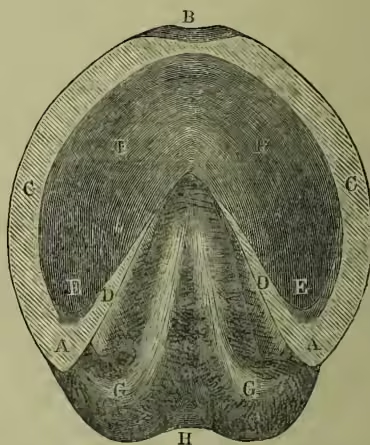
Horseshoeing. In olden times horses generally went unshod, as they now do in many eastern countries; but our macadamised roads and paved streets, fast paces and heavy loads, would speedily wear away the stoutest hoofs, and a rim of iron has accordingly been long in use as a protection. In style and pattern the horse's shoe varies almost as much as his master's boot, and like it, when badly made or unskillfully fitted, produces serious inconvenience, and even leads to accidents and diseases. When the feet are strong and properly managed nothing is better than a plain shoe of tolerably uniform breadth and thickness, carefully fashioned to the shape of the foot. But many good authorities prefer what is called a seated shoe, which has a level part for the crust to rest upon, and within that the inner half of the shoe towards the sole surface is bevelled off. This seated shoe is thus wider than the plain shoe, and hence affords greater protection for a weak or flat sole. For faulty or diseased feet special forms of shoes are made. In all healthy feet the shoe should be fitted to the foot, and not, as is commonly done, the foot cut to fit the shoe. Another frequent error must be avoided—keeping the shoe short and spare at the heels. For roadsters the toe of the fore-shoes should be slightly turned up, which greatly obviates tripping. The hind-shoes are generally thickened and sometimes turned down at the heels. The number of nails required must vary somewhat with the weight of the shoe and the soundness of the horn; five is the minimum, nine the maximum. It is important, however, that the shoes be firmly held on by as few nails as possible. In a saddle-horse with sound feet three on the outside and two on the inside should suffice to hold a well-fitted shoe. Horses for heavy draught rest upon, and within that the inner half of the shoe towards the sole surface is bevelled off. This seated shoe is thus wider than the plain shoe, and hence affords greater protection for a weak or flat sole. For faulty or diseased feet special forms of shoes are made. In all healthy feet the shoe should be fitted to the foot, and not, as is commonly done, the foot cut to fit the shoe. Another frequent error must be avoided—keeping the shoe short and spare at the heels. For roadsters the toe of the fore-shoes should be slightly turned up, which greatly obviates tripping. The hind-shoes are generally thickened and sometimes turned down at the heels. The number of nails required must vary somewhat with the weight of the shoe and the soundness of the horn; five is the minimum, nine the maximum. It is important, however, that the shoes be firmly held on by as few nails as possible. In a saddle-horse with sound feet three on the outside and two on the inside should suffice to hold a well-fitted shoe. Horses for heavy draught are generally shod in Scotland with tips and heels, which afford increased firmness of tread and greater power, especially when dragging heavy loads. To preserve the foot in a sound state the shoes should be removed every month. When the shoe is carefully taken off, the wall-surface on which it has rested should be rasped, to remove any ragged edges and any portions of adhering nails. Having for a month been protected from the wear to which the exposed portions of the foot are subjected, it will probably have grown considerably, and in a stout hoof will require to be cut down with the drawing-knife, especially towards the toe. Except in very strong feet and in farm-horses working on soft land, the surface of the sole uncovered by the shoe seldom requires to be cut. It is the natural protection of the internal delicate parts, and must be preferable to the leather and pads often artificially substituted for it. The bars must likewise remain untouched, for they are of great service in supporting weight; whilst the tough, elastic frog must be scrupulously preserved from the destructive attacks of the knife, and allowed uninjured to fulfil its functions as an insensible pad, obviating concussion, and supporting weight. When the shoe is put on and the nails well driven home, they should be broken off about an eighth or even a sixteenth of an inch from the crust, and hammered well down into it. This obviously gives the shoe a much firmer hold than the usual practice of twisting off the projecting nail close to the crust, and afterwards rasping down any asperities that still remain. When the shoe is firmly clinched the rasp may be very lightly run round the lower margin of the crust just where it meets the shoe, to smoothen down any irregularities; but all further use of the rasp must be interdicted. The clinched nails if touched will only have their firm hold weakened; nor must the upper portions of the crust, which blacksmiths are so fond of turning out rasped and whitened, be thus senselessly deprived of those external unctuous secretions which render the unrasped foot so tough and sound and so free from sandcracks. The hoof cannot be too dry and tough. From time to time various attempts have been made to fix shoes to horses' feet without nails; and a shoe has been invented, which is said to have answered the purpose; but in the opinion of many the system is still immature, and requires to be more extensively tested. An interesting exhibition of horseshoes, ancient and modern, was held in London in March 1890.
See Notes on the Shoeing of Horses, by Lieut.-col. Fitzwygram; a paper on 'Horseshoeing,' by Miles, in the Journal of the Royal Agri. Soc. (reprinted by Murray); and Williams' Veterinary Surgery.