Hosiery, in its most limited sense, refers to the manufacture of stockings (hose); but in its more general application it comprises all knitted goods, whether made by hand or by machinery. The use of hose or stockings originated in the cold countries of the north, and probably the first were made of skins, and subsequently of cloth. Illuminations in ancient MSS. show that these nether garments were worn by the Anglo-Saxons and the Normans. The art of knitting was invented (it is supposed in Scotland) in the 15th century. Certain it is that knitted stockings found their way to France from Scotland, and led to the establishment of a guild of stocking-knitters, who chose for their patron saint St Fiacre of Scotland (really an Irish monk of the 6th century, the patron of gardeners). In 1589 William Lee, of Woodborough, Nottinghamshire, entirely altered the hosiery trade by inventing the knitting-frame, or stocking-frame; and, although he did not live to enjoy much benefit himself from it, it soon became a very important feeder to the commerce of Great Britain.
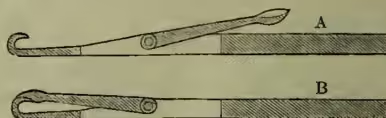
The first improvement of marked importance on Lee's machine was the ribbing apparatus invented by Jedediah Strutt in 1758. This consisted in adding a second series of needles, with an arrangement for working them, to Lee's machine, which could only make a plain, not a ribbed, web. Sir Marc I. Brunel invented, in 1816, a circular knitting-frame, to which he gave the name of tricoteur. This produced a tubular web, and was a meritorious machine, but it did not come much into use till it was improved, about 1844, by Clausen of Brussels. His further modification of it in 1847 caused it to be widely adopted, and it has received various improvements since. Several important improvements in hosiery machines are due to Townsend, chief among them being a tumbler or latch needle, patented by him in 1858, which is now largely employed in certain kinds of knitting-machines, especially those for fancy hosiery and for domestic use. Fig. 1 shows two views of this needle. A represents it with the hinged latch or tongue folded back on the stalk so that the hook may catch the thread. B shows the latch closed on the point of the hook so that it may freely pass a new loop of thread through the last-formed loop. The latch is moved by the loops of thread or yarn during the action of the machine. The modern form of Lee's needle is shown in the other figures. The most prominent name among the improvers of hosiery machines in comparatively recent times is that of William Cotton of Loughborough. Between 1851 and 1869 he devised arrangements both for narrowing and widening the fabric, and in conjunction with Attenborough made a number of alterations for the better on the general arrangements of the parts of the knitting-frame. Some of the best hosiery machines driven by steam-power now in use are on Cotton's system.
The names of two Americans appear in the list of those who have contributed to the advancement of knitting machinery. In 1858 an English patent was taken out by W. C. Gist for a circular machine, which, by using several feeders instead of one, enabled striped work with as many as sixteen colours to be made at once. Another English patent was taken out in 1877 by Almet Reid for a circular knitting-frame for making automatically articles of many different shapes, in which the loops or stitches are so locked together as not to unravel when cut or torn.
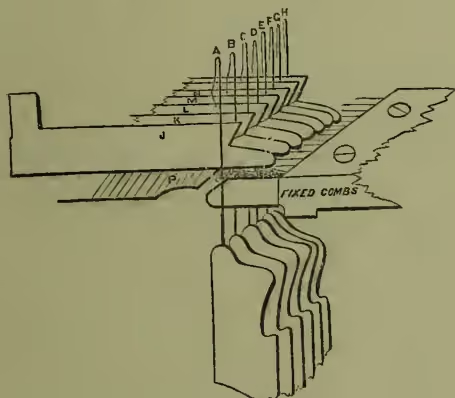
A knitted fabric of one colour consists of one continuous thread instead of a warp and a weft thread as in weaving, and the knitting done by a machine is exactly of the same nature as that done by hand. With the aid of the accompanying illustrations a brief description will suffice to explain the principle on which a knitting-machine or stocking-frame works. A perspective sketch of a part of a division of the machine is given in fig. 2. The hooked needles (Lee's) are shown at A, B, C, D, E. The 'sinkers,' J, K, L, M, N, are thin plates of steel, which have a backward and forward motion, each sinker passing between two needles. When the sinkers are moved to the left of their position in the figure a space occurs between them and the needles, along which the thread or yarn is laid. As the thread proceeds along the face of the needles the sinkers one by one advance and thrust the thread between them, thus forming a row of loops, after which the sinkers retire.
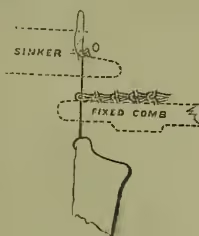
All the needles act simultaneously and in the same way; but to make the action of the machine more easily understood, figs. 3, 4, and 5 show the movements of a single needle. Fig. 3 represents, in side elevation, the position of a sinker, a comb, and a needle, at the moment when the needle has sunk between the sinkers, till the newly-formed loop of thread, O, enters the hooked portion or open eye. The needle, continuing its descent, is rocked forward till, as shown in fig. 4, the 'beard' of the hook comes against the 'presser bar' P, which presses for a moment the point of the beard into a groove on the stem, and so forms a closed eye round the loop O. The needle, in further descending, pulls this loop through the last-formed loop
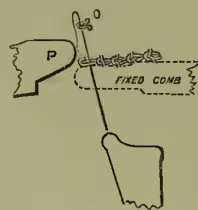
of the knitted fabric. It is in this closing of the hook to enable the one loop to be drawn through the other that the great ingenuity of Lee's invention lies. Fig. 5 shows the new loop just pulled through, and then the needle, rocking forward in the direction of the arrow, ascends, while the loop slips down its stem. The next loop is pulled through in the same way. The explanation just given of the motion of one needle applies to all the needles, as they are fixed in line on a rigid bar.
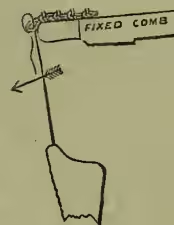
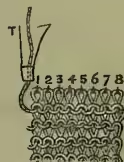
Fig. 6 shows an enlarged plan of five rows of loops, in which the triangular dots, Nos. 1, 2, 3, 4, 5, 6, 7, and 8, in the last-formed row are the needles with the thread-carrier, T, in the position where it commences to lay the thread in front of them. The knitted fabric is wound upon a roller as fast as it is formed. It would take up too much space to describe the arrangement for narrowing or widening the fabric, to bring it to the shape of a stocking for example. This is called 'fashioning.' The web, however, is often not shaped in the process of knitting, but cut, when finished, into any form required, as is done with ordinary cloth.
Some of the most improved modern knitting-frames work at a great speed. One with six divisions of 480 needles each (a usual size) has in all 2880 needles. Each of these forms loops at the rate of 90 in a minute, so that the whole machine forms 259,200 loops in a minute. An expert hand-knitter, working with wires, can hardly do more than 100 loops in a minute.
Numerous hosiery or knitting machines, varying much in their details, are now made both for factory work and for domestic use. In the volumes for 1886 and 1889 of the Textile Manufacturer, published at Manchester, several of the best of these are illustrated and described. To the pages of that journal we are indebted for the diagrams given in this article. For the history of the knitting-frame, see Felkin's Machine-wrought Hosiery and Lace (1867).
Nottingham and Leicester, especially the former, are the chief centres of the hosiery manufacture in the United Kingdom, but it extends into the adjoining counties. It is also extensively carried on in France, Germany, and other continental countries. In the United States hosiery factories are in active operation in New York, and in five or six neighbouring states. The materials used for hosiery are cotton, wool, and silk; and the number of different kinds of articles made, including stockings, gloves, shawls, hats, bonnets, and all kinds of underclothing, amounts to thousands. The result of recent improvements in the machinery for the manufacture of hosiery is shown by the fact that in 1854 it cost fully six shillings to knit a dozen pairs of stockings by the hand knitting-frame then in use; whereas the cost at the present time by power knitting-machines does not exceed one shilling and tenpence per dozen pairs.