Hound's-tongue

Chambers's Encyclopaedia, Volume 5: Friday to Humanitarians

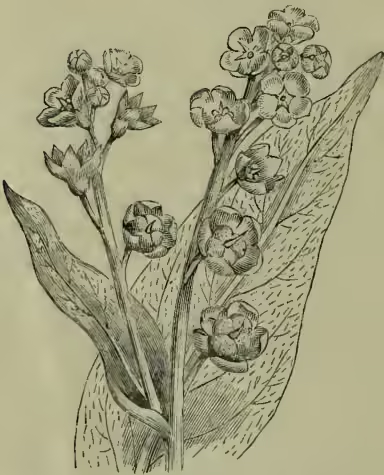
Hound's-tongue (Cynoglossum), a genus of plants of the natural order Boragineæ, of which there are many species, all of a coarse appearance, with small flowers. The Common Hound's-tongue (C. officinale) is a native of Europe, Asia, Africa, and North America; not uncommon in some parts of Britain, especially near the sea-coast. It has soft downy leaves, of a dull green colour, purplish-red flowers, and a stem about two feet high.
A detailed botanical illustration of Hound's-tongue (Cynoglossum officinale). The drawing shows a plant with several large, lanceolate leaves that have a slightly serrated margin and a prominent midrib. The leaves are arranged in a basal rosette. From the center of the leaves, a single, upright stem emerges. The stem is densely covered with small, tubular flowers. The flowers are arranged in whorls (verticillasters) at the leaf axils. The illustration is rendered in a fine-line, engraved style, showing the texture of the leaves and the structure of the flowers.
Hound's-tongue (Cynoglossum officinale).

Its odour is very disagreeable. The root was formerly administered in scrofula, dysentery, &c., and is said to be anodyne. It is also one of the pretended specifics for serpent-bites and hydrophobia.

Source scan(s): p. 0827