House-fly (Musca domestica), perhaps the most familiar and widely distributed dipterous insect. Adults are to be seen the whole year round, though naturally most numerous in summer. They feed indiscriminately on whatever they can suck up through their fleshy proboscis or scrape off with their other mouth parts. The females lay their eggs in groups, about eight days after pairing, and the whole development occupies about a month. The eggs are deposited in decaying organic matter, in dung, or in any filth, and the larvæ are hatched in a day, or even less if the weather be warm. These larvæ are smooth, naked maggots, without legs or distinct head, with small hooklets at the mouth, and a length of about one-third of an inch. They feed on organic debris, move by contracting the abdomen, and grow for about a fortnight. Then they
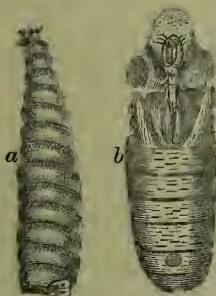
seek some dry resting-place, undergo pupation, and finally in another fortnight become winged insects.
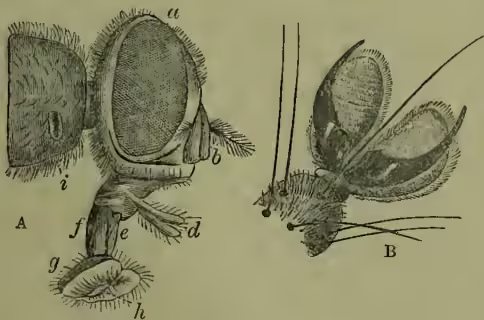
Many parts of the house-fly, such as the sucking proboscis, or the hair-covered discs of the feet by which the insects adhere to the window-pane, well deserve the attention they generally get from those who use the microscope. Though house-flies do not bite, they are often extremely troublesome. Expedients for killing them off require no advertisement. It is more important to notice that house-flies are probably sometimes responsible for disseminating disease-germs.