House-leek (Sempervivum), a genus of plants of the natural order Crassulaceæ, having a calyx of six to twenty sepals, the petals equal in number to the sepals, and inserted into the base of the calyx ; the leaves generally very succulent, and forming close rosettes.
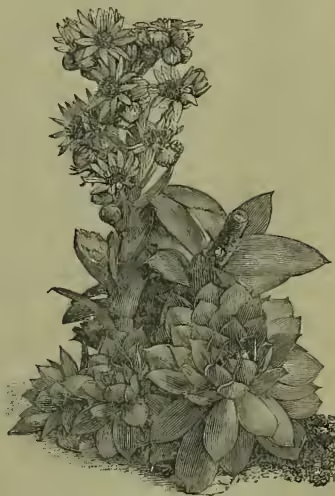
The Common House-leek or Cyphel (S. tectorum), called Fous or Fouets in Scotland, and in some countries Jupiter's Beard, grows wild on the rocks of the Alps, but has long been common in almost every part of Europe, planted on walls, roofs of cottages, &c. It sends up leafy flowering stems of 6 to 12 inches in height, bearing branches of pale red star-like flowers, equally curious and beautiful. The leaves are or bruised and applied to burns afford immediate relief, as they do also to stings by bees or wasps ; and they are beneficial when applied to ulcers and inflamed sores. They were formerly in high esteem as a remedy for fevers and other diseases ; and an edict of Charlemagne contributed greatly to the extensive distribution of the plant. The edict is in these words : Et habeat quisque supra domum suam Jovis barbam ('And let everybody have the
Jupiter's beard on his house').—Other species possess similar properties. S. soboliferum, with yellowish-green flowers, is very frequently planted on walls in Germany. The fishermen of Madeira say that nets rubbed with the fresh leaves of S. glutinosum are thereby rendered as durable as if tanned, provided they are also steeped in some alkaline liquor. Some of the species, natives of the south of Europe, Canary Isles, &c., are shrubby; others are common greenhouse plants.