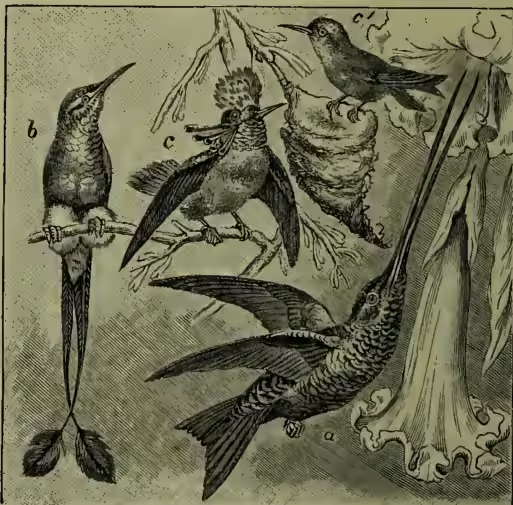
b, White-booted Racket-tail (Steganurus Underwoodi);
c, male and female Tufted Coquette (Lophornis ornata).
Humming-bird (Trochilus), a Linnean genus of birds, now constituting a family, Trochilidae. The nearest relations of the humming-birds are the Swifts (q.v.); that they form together with the swift one large group is clear from their very close resemblances in anatomical structure. Nitzsch, Huxley, Garrod, and others who have investigated the osteology, muscular anatomy, and other points concur in this opinion as to the relationship of the family; they resemble in their habit and in brilliancy of plumage the Sun-birds (q.v.), which replace them in the eastern tropical regions. The dazzling brilliancy of humming-birds, the extreme rapidity with which they dart through the air, their hovering above the flowers from which they obtain their food, with humming sound of wings, which move so quickly as to be indistinctly visible, or 'like a mist,' have attracted universal admiration since the first discovery of America. The diminutive size of almost all of them—some of them being the smallest of birds, and if stripped of their feathers not larger than a humble-bee—has still further contributed to render them objects of interest, whilst the plumage of the different species exhibits an almost endless variety of colours. Some species possess 'the most gorgeously brilliant metallic hues known among created things; some on the other hand are sombre in hue. Humming-birds are entirely confined to the American continent and West Indies, where there are about 120 genera, containing over 400 species; no less than 15 species occur in North America. Of the South American forms the majority inhabit the hotter regions, but some are confined to elevated mountain-tracts even above the snow-line.
Humming-birds have slender bills, which are also generally long, and in some extremely so, the form of the bill exhibiting a wonderful adaptation to the kind of flowers from which the bird obtains its food—straight in some, curved in others. Humming-birds do not, as was long supposed, feed on honey alone, but to a considerable extent, and some of them perhaps chiefly, on insects, not rejecting spiders, whilst they often snatch away the insects which have become entangled in spiders' webs. The tongue is very long, capable of being darted out to a considerable length; the bone of the tongue (hyoid bone) being much elongated, and its branches passing round the back of the skull to the forehead, where they meet in a point before the line of the eyes. The tongue itself consists of two hollow filaments, joined together for the greater part of their length, and separated at the tip; the structure of the tongue and hyoid bones is curiously like that of the Woodpeckers (q.v.) and the sun-birds already referred to; this affords an illustration of the fact that similar requirements often cause development of similar structures in animals otherwise distinct. The wings of humming-birds are very long and powerful, like those of the swifts, the length being particularly marked in that portion of the wing which corresponds to the hand of mammals; hence the name Macrochires which is applied to the group. Humming-birds construct their nests with nice art, generally of lichens and of fibrous substances, such as cotton. They do not lay more than two eggs. They are very bold in defence of their nests and young, and are said to strike fearlessly with their needle-like bills at the eyes of birds of prey, which they far surpass in agility and rapidity of flight. They are very easily tamed and rendered familiar, and have been known to return again in spring, after a winter migration to a warmer climate, to the window from which they had been allowed to escape. Attempts to keep tamed humming-birds have generally failed; and they have almost never been brought safely across the Atlantic. Humming-bird skins were anciently used by the Mexicans for making pictures.
See John Gould's magnificent Monograph on the Trochilidae (5 vols. 1849). Gould's collection of specimens was bought for the British Museum.