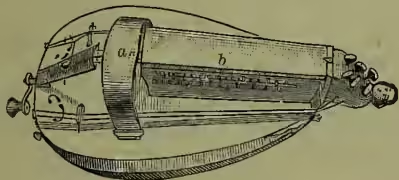
Hurdy-gurdy, a very old musical instrument of the stringed kind, something between a guitar and a lute in appearance. It has four or six catgut or wire strings attached to screw-pegs in the head; two of the strings stretch over the sounding-board to the tailpiece, and are sounded by a wooden wheel (under the cover a in the fig.) charged with rosin, which is turned by means of a handle with the player's right hand. The strings are 'stopped' by an ingenious arrangement of keys, b, manipulated with the left hand. The remaining strings are stretched out of reach of the keys, and are tuned as drones. The instrument has a range of two octaves from the tenor G upwards. The rustic simplicity of its music made it at one time a great favourite among the peasantry of a great part of Europe (see Engel's Musical Instruments). The name hurdy-gurdy is also sometimes applied to the mechanical pianos familiar on the streets. The word was probably coined to express contempt of the instrument.