Hyæna, a genus of digitigrade carnivorous quadrupeds, included in the genus Canis by Linnaeus, but now referred to the Aluroid division of the Carnivora, of which, however, it is a somewhat aberrant member, forming with Proteles (q.v.) a sub-family, Hyænina. Hyænas have six incisors and two canine teeth in each jaw, five molars on each side in the upper jaw, and four in the under. They seize an object with so firm a hold that, among the Arabs, they are proverbial for obstinacy. The vertebrae of the neck sometimes become ankylosed in old hyænas. The hind-quarters are lower and weaker than the fore-quarters of the body, so that hyænas move with a shambling gait. The body is covered with rather long coarse hair, forming a mane along the neck and back. The feet have each four toes. The claws are strong, fit for digging, and not retractile. The tail is rather short. Beneath the anus is a deep glandular pouch, contributing much to the offensive odour by which hyænas are characterised. Hyænas eat carrion, as well as newly-killed prey, and are of much use, like vultures, as scavengers, clearing away the last remnants of carcasses that if left to rot would greatly pollute the air. They sometimes attack cattle, especially if they flee, but rarely man, though they sometimes seize children. During the day they hide themselves in caves, old rock-tombs, ruined edifices, &c.; by night they roam singly or in packs in quest of prey. They prowl about towns and villages, and often dig up corpses that have not been very deeply buried. This, together with their aspect and manners, has caused them to be generally regarded with horror, and very exaggerated accounts of their fierceness have been prevalent. Instead of being untamable, as was long the popular belief, they are capable of being very completely tamed, and show an attachment to man similar to that of the dog; they have even been used as watchdogs. Hyænas are found only in Africa and the south of Asia, not extending to the farthest east of the latter continent.—The Striped Hyæna (H. striata) is found both in Asia and Africa, and there are several varieties considerably different in size, colour, &c. The smallest hyænas are of the size of a large dog. The Spotted Hyæna (H. crocuta) inhabits South Africa. It is rather smaller than the largest varieties of the striped hyæna, but is more fierce and dangerous. It is called Tiger-wolf by the colonists of the Cape of Good Hope.
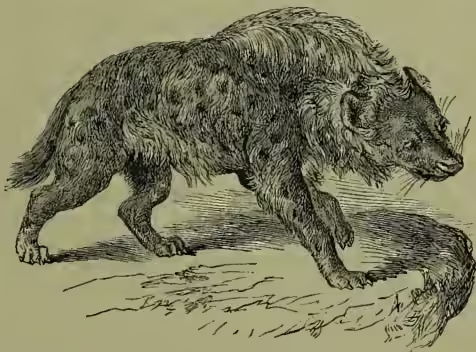
Besides its ordinary howling, which it emits very freely in its nocturnal roamings, this hyæna often indulges in an expression of gratification or of some passion, resembling hysterical laughter, whence it has acquired the name of the Laughing Hyæna. The general colour is ochry gray, with thinly scattered small round brown spots, and sooty muzzle and feet. The Woolly Hyæna (H. brunnea) is a smaller South African species.
In consequence of the bones which hyænas eat, their dung forms solid yellowish-white balls, of compact earthy fracture, the Album græcum of the old materia medica. For the Hyæna Dog, see DOG.