Hybrid (Gr. hybris, 'lust'), the offspring of two parents which belong to different varieties, or to different species, or even to different genera. Thus, according to the degree of divergence between the parents, variety-hybrids or mongrels, species-hybrids (the usual application of the term), and genus-hybrids, which are very rare, have to be distinguished. It is also useful to note with Broca that hybridisation may be (a) natural—i.e. occurring in undisturbed natural conditions, of which we know relatively few cases; (b) incited—i.e. under direct human control, on which our data as regards animals are chiefly based; and (c) artificial—i.e. by placing the pollen of one plant on the stigma of another species, or by mixing with the eggs of some animal, say frog or fish, the male elements of some related form.
Among mammals genus-hybrids find illustration in the successful crossing of he-goat (Capra) and ewe (Ovis), the offspring being fertile for several generations, both inter se and with the parent-stocks. Species-hybrids are well illustrated in the results of crossing various members of the genus Equus—e.g. male ass and mare, the offspring being a mule; or horse and female ass, the offspring being a hinny. Similarly, dog and fox, dog and jackal, lion and tiger, hare and rabbit, Indian humped cattle and our very different domesticated breeds, and not a few other more or less nearly related forms have been successfully crossed. For such names as 'leopard,' which suggest that crossing occurs or occurred somewhat freely in nature, there is little or no evidence. Nor was there any truth in the supposition that 'Jumarts' resulted from the crossing of bull and mare, or stallion and cow, for Jumarts turn out to have been nothing more than hinnies.
Among birds the common duck (Anas boschas) and a pintail (Dafila acuta), the common goose (Anser ferus) and the very distinct Chinese goose (A. cygnoides), goose and swan, canaries and finches, pheasant and hen, and other allied forms are recorded as giving rise to hybrids. Among lower animals hybrids also occur; different species of toad are often seen in sexual union, but the result is unknown; the artificial fertilisation of frog ova with the sperms of other species has at least resulted in the development of hybrid tadpoles; in several fishes hybridisation seems to occur in natural conditions, and artificial fertilisation has been effected even between genera, to the extent at any rate of starting the development of the ova. The hybrids of two moths (Bombyx cynithia and B. arvindia) have been recorded as fertile inter se for eight generations; and R. Hertwig has shown that in certain conditions the male elements of one species of Echinoderm may incite development in the ova of another.
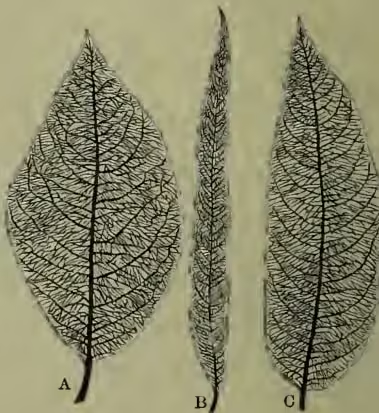
A, leaf of Salix caprea; B, of S. viminalis; C, of hybrid between these two species. (After Wichura.)
Hybridisation in Plants.—Experiment is here much easier, and a large mass of data has rewarded the investigations of Kölreuter (1761), Andrew Knight, Dean Herbert, Gärtner, Wichura, Hildebrand, Focke, and others. The subject received careful discussion from Darwin in his work on cross-fertilisation, and also from Nägeli, a summary of whose conclusions is available in the English translation of Sachs's Text-book of Botany. Only the leading results can be noted here. Hybridisation rarely occurs except between forms known to be related: variety-hybrids occur easily and abundantly; species-hybrids are less, though quite common; genus-hybrids (e.g. between the grasses Agilops and Triticum, between Rhododendron and Azalea, between Lychnis and Silene) are rare. Besides genetic relationship, some subtle harmony, which we can only call 'sexual affinity,' is essential to successful hybridisation. When one species can be fertilised by the pollen of another, the vice versa relation usually holds good; but sometimes the hybridisation is persistently one-sided. Kölreuter easily obtained seeds from Mirabilis jalapa with the pollen of M. longiflora, while more than two hundred experiments, extending over eight years, with the pollen of the former upon the stigma of the latter were futile. The results of hybrid-fertilisation exhibit many degrees; thus, the mother-plant may be affected by the strange pollen without seeds being produced, or seeds may be formed which will not germinate, or numerous, vigorous, and fertile hybrids may result. When two kinds of pollen are simultaneously applied to the stigma only one kind is potent. The hybrid is usually intermediate between the two parents, not only in structural features, such as the venation of the leaves and the shape of the flower, but in physiological peculiarities, such as the time of flowering and the mode of coloration. Focke reports a curious case where the crossing of Anagallis caerulea and A. phanicea produced hybrids which bore in part the blue flowers of the former species, and in part the reddish flowers of the latter. Hybrids are usually more variable than the parents, and the variation may be towards strength or towards weakness. Since Fairchild, at the beginning of the 18th century, first intentionally produced a cross between Dianthus barbatus and D. caryophyllus, hybridisation has often been resorted to by gardeners and arboriculturists to produce a strong stock. Very important are the numerous hybrids between European and American vines, some of which are believed to be endowed with greater powers of resisting Phylloxera and fungi than the unaltered European plants possess. There can be no doubt that species-hybrids among plants tend to be sterile, and this the more the wider the difference between the parent plants. Sometimes three or even six individualities have been gradually mingled in a multiple hybrid, and this lessens still more the chance of fertility.
Character of Hybrids.—The products of crossing, whether of species or of varieties, are undoubtedly very variable, sometimes for the better—as in many of our domesticated mongrels among both animals and plants—very often on the other hand for the worse. They are often so unstable that they tend rapidly to die out, as has been observed among some human experiments in mingling races. The saying 'God made the white man, God made the black man, the devil made the mulatto,' expresses a feeling as to the frequently inconvenient variability of variety-hybrids, but there is much to be said on the other side. Such a case as sheep-goat hybrids shows how far from accurate is the still prevalent belief that hybrids from widely-separated parent forms must be sterile. We are by no means warranted in saying more than that species-hybrids tend to be sterile so far as we know them, and that it must be remembered is for the most part in conditions of domestication, where the resulting sterility may have been due to confinement, and to prolonged interbreeding, rather than to the hybridisation itself. Nor do the facts allow us to accept the further generalisation that variety-hybrids are always fertile. Not only are there cases of the reverse, but, as Wallace justly points out, the conclusion was again based on domesticated forms, in regard to which it must be noted that the very first essential to their becoming domesticated was that they should continue fertile under changed conditions of life.
Hybrids in Relation to Evolution.—The facts of hybridism raise some of the most intricate problems connected with evolution. As only a few general statements can be noted here, the reader is referred to the cited work of Alfred Russel Wallace. (1) Fertility or non-fertility of crosses must not be exaggerated into the test between variety and species, for all species-hybrids are not sterile, nor all variety-hybrids fertile. (2) Fertility depends on some delicate mutual adjustment or complementariness of the male and female elements, and is readily disturbed by external or constitutional conditions. (3) Animals seem to prefer to breed with their like among existing varieties, and in this way it is believed that the 'swamping effects of intercrossing' have been usually obviated, though mutual infertility and geographical separation may also assist in preserving the varieties. (4) Brooks has laid stress upon the fact that both variety and species hybrids are highly variable. In his theory of 'physiological selection,' Romanes has emphasised the importance of mutual sterility in splitting up one species into several. 'Whenever any variation in the highly variable reproductive system occurs, tending to sterility with the parent form without impairing fertility with the varietal form, a physiological barrier must interpose, dividing the species into two parts, free to develop distinct histories, without mutual intercrossing, or by independent-variation.' (5) Darwin concluded that 'the sterility or infertility of species with each other, whether manifested in the difficulty of obtaining first crosses between them, or in the sterility of the hybrids thus obtained, was not a constant or necessary result of specific difference, but is incidental on unknown peculiarities of the reproductive system.' Wallace has advanced a step further in his endeavour to show that 'if we accept the association of some degree of infertility, however slight, as a not unfrequent accompaniment of the external differences which always arise in a state of nature between varieties and incipient species, natural selection has the power to increase that infertility just as it has the power to increase other favourable variations.'
See BREED, DOMESTICATION, EMBRYOLOGY, EVOLUTION, REPRODUCTION, SEX, SPECIES; P. Broca, Jour. d. l. Physiol., vols. i. ii. iii.; W. K. Brooks, Heredity (Baltimore, 1883); Darwin, Plants and Animals under Domestication (Lond. 1868), and Effects of Cross and Self Fertilisation (Lond. 1877); Focke, Die Pflanzenmischlinge (Berlin, 1881); Geddes and Thomson, Evolution of Sex (Lond. 1889); V. Hensen, Physiol. d. Zeugung, in Hermann's Handbuch d. Physiologie (Bd. vi. Leip. 1881); G. J. Romanes, Jour. Linn. Soc. XIX. (1886); J. Sachs, Text-book of Botany (Oxford, 1882; cf. his references to Kölreuter, Herbert, Gärtner, Nägeli, &c.), and Physiology of Plants, trans. by Marshall Ward (Oxford, 1887); A. R. Wallace, Darwinism (Lond. 1889); Wichura, Bastardbildung im Pflanzenreiche (Breslau, 1865).